The thing that seems crazy to me is how much time alone increases with age. There are many many reasons for it, but one thing I think is especially sad is how much this is a consequence of our built environment. If you live in a village with multiple generations of a family around, it’s much easier for grandparents to be involved day too day in helping with little things in the village, especially keeping an eye on the kids roaming around. This is also true in the more traditional urban neighborhoods with walking-oriented life (safety from cars) and a wide mix of housing types etc.
But (to varying degrees) most of the new construction around the world since WW2 has been oriented around driving and separation of land uses, and as a result when you age you end up living in a nice little garden home far removed from any day to day life going on. And once it gets hard for you to drive... then you really end up spending a ton of time alone.
I don’t think there’s an easy fix for this, and that makes me sad.
I experienced this first hand when I visited my wife's family in Vietnam. All 10 or so of them live in homes side by side on the outskirts of Saigon. Everyone woke up in the morning and cooked for each other. Every day was like a little party. It was so nice to have that much support around all the time. I have never experienced anything like that in the US. Of course having family literally at your doorstep has its pros and cons but it worked really well for them.
My mom always said ”Move far away enough that your parents can’t visit in their slippers, trust me you don’t want that kinda meddling”
I moved to USA.
“Damn it I didn’t mean that far” ~ mom
My sister lives with her boyfriend in his mom’s house. There is indeed a ridiculous amount of meddling even though they’re technically separate households.
My in-laws live 3 hours away and my parents 14 hours away. We have seven kids so it would be useful to have them nearer on occasion, but my wife and I agree that 3 hours is the minimum we want to live away from other family members.
Does who agree? My in laws and parents? They are fine with the distance. I wouldn’t have a problem with my kids living as far or farther away. I have 8 siblings and we are scattered all over the entire country. I’d be fine if my children did the same.
This becomes even more likely with internet communities, etc. I met my wife online, and our hometowns are 1200 miles apart. It's impossible to live less than an 8 hour drive from both our families. We lived near mine for 4 or 5 years after getting married, now near hers for about 10. It's hard to feel close to both, and have that support network.
I’m from NW England. Wife is from Cornwall - 6 hour drive away. We met at uni, 2 hours for her, 4 for me.
Then my parents moved to Greece, we moved to London for career and bounced around the south east.
Eventually though we settled in Cheshire, and the parents followed - one is a 10 minute walk away, the other is 20 minute drive. It’s amazing what having grandchildren does.
Trouble is we’d feel guilty about moving to New Zealand now.
The further I have moved from Family the more I have started to wish I was closer to them physically. Especially this year when our normal yearly gatherings were disrupted.
This is a well known phenomenon :) The best way to get closer to family is to move away, absence makes the heart grow fonder. If you want to have positive and constructive and long-lasting relationships with your family, move away from them, even if it's just an hour (whether that means an hour drive or a different time zone depends on the family).
We don't have a network for our (young) children. Because their aunt and grandmother live 1+ hour drive away. Things like that severely limit your freedom. If you can park the children at grandma's easily, or have grandma visit easily, it allows you to even get things done for which otherwise one would need to stay at home, or you'd have to take all children to the appt.
Luckily, we got really nice neighbors, but we try to not play that joker card until inevitable. Its not something to rely on on the long term. Family is reliable.
If you live near each other, you just need to make proper appointments. Something with scope & boundaries...
What? This makes no sense. Capitalism isn't the problem, lack of boundaries is.
My best friend lived upstairs from her parents for years. It was her own apartment but the arrangement was hell on earth. Multiple times a day every day her mom would come barging in (and I do mean barging) to insert herself into whatever was going on in my friend's apartment, make nasty comments, or borrow/take something. Her mom eventually just stopped buying her own stuff because she just would take whatever my friend had if she needed it, plus it gave her more reason to bother my friend more often, which seemed to be her favorite activity in the world. Her mom even stopped driving her own car and just took my friend's whenever she wanted to go somewhere. The constant stress of the situation was so bad for my friend, it legitimately was ruining her health.
That is almost a form of abuse to be honest. I hope your friend has learned to set boundaries and enforce them. People like her mom are very good at manipulating their children and seeing absolutely nothing wrong with it.
The underlying problem is the lack of boundaries. Moving away does not solve that problem. Only setting and enforcing the boundaries will solve the problem.
No amount of distance is a boundary. People can travel, use cell phones, or any other method to get past distance. It is only a logistical complication.
Psychological and emotional boundaries are required. Cutting off contact by itself is not enough. You have to communicate that you are cutting off contact. That's what establishes the boundary. In many cases you won't get a restraining order if you haven't established that boundary. The restraining order is a tool for physically enforcing an established psychological and emotional boundary.
I agree with you, seeing how even my spouse's 16h-drive-away mother is still managing to insert herself into her child's life several times a day. I can see on my wife's face she's been talking to her mother when I get home. Even with new recent boundaries set (we're not visiting anymore, no more answering the phone or WhatsApp 33 times a day and then when not answering right away having other family call to argue that you're abandoning your family, fuck all of them), and I feel my spouse has made tremendous strides there, the mum is still finding ways to do this.
Moving away solves the problem if you move far enough away that they can only visit rarely. You don’t have to answer the phone and text messages can be easily blocked.
Until they show up at your door, decide to move wherever you moved, or even try to move in with you.
You can't solve a boundary issue by not dealing with the boundary issue. At best, you can avoid it and hope it's no longer a problem. The underlying issue still remains.
It's easy enough to tell someone to never contact you again. But if you see them daily as you prepare to commute because you live next door, a lifetime of social pressure to not be so rude as to ignore people is likely to get them to slip up and at least say "good morning!", even if they want to respect your boundaries (and definitely if they don't, and are looking for an excuse to trample all over them while perhaps pretending otherwise!) If you share a common living space or other "shared business" it's even worse, as there's also the completely understandable pressure, if not outright need, to resolve problems involving that shared business.
Moving is an action that can help disentangle you from shared business - be it common living spaces, shared fences, shared neighborhood issues, etc. - and help dismantle habits that would undermine your boundaries.
I don't think cutting them out of your life is setting a boundary. That's like the difference between putting a fence around a cow pasture (a boundary) and slaughtering the cows for meat. One is a bit more permanent than the other. Not really a boundary but an excising.
I hear what your saying but it’s at best a matter of scale.
Slaughtering the cows would be like... selling her car so her mom can’t use it. Her mom can’t hurt the cow anymore, sure, but there’s still no fence there.
In contrast, telling her mom “No, you can’t use my car” would be setting a boundary. But telling her mom “I don’t want you in my life” would also be setting a boundary. These are just two different fences. In both cases, the cow/car are just fine.
Seems like she the mom was bored with her own life and would do this because she couldn't stand her own loneliness. And yes, it is a form of abuse as another commenter mentioned.
No it’s definitely meddling when you’re 30+ and your mom waltzes into your kitchen and says “Mmmmm are you sure that knife goes in that drawer? And when’s the last time you did the dishes anyway look at this mess”
And then heaven forbid if you have different political views from them, especially in 2020. My mom treats me very weirdly, not because I actually voted for Trump, but because I don't spend my days ranting about how he's Satan incarnate like she does.
My sister aligns politically with my mom and she moved to MONGOLIA to get away from her. I'm glad for people who truly like their families, but not all of us won that particular genetic lottery.
One thing I've learned in my 30s is its not a genetic lottery. There are definitely very irrevocable dynamics but many can be molded with a level of concern, effort and boundary setting that we usually associate with work added with a dash of true sincerity and deep care.
> There are definitely very irrevocable dynamics but many can be molded with a level of concern, effort and boundary setting that we usually associate with work added with a dash of true sincerity and deep care.
I think this largely depends on factors outside our individual control—specifically, the other person. Sometimes setting boundaries, doing the work, can help the other person see the way their behavior is impacting you. Other times, it won't, so if you want the relationship to continue you have to be willing to always and repeatedly do all the work to maintain the relationship. Without the other person being capable and willing to recognize their own issues (and maybe get some therapy), no amount of your own effort can effect a permanent change.
It is both fascinating and sad to watch. My family has split along political lines, with half despising Trump and half worshipping him. Each side hates the other sufficiently that we just avoid talking anymore, so it's like having two distinct families.
I don't know the solution other than everyone agreeing not to talk politics, ever. And even better, actually deciding that politics is pretty insignificant and only something to think about on election day.
> And even better, actually deciding that politics is pretty insignificant
Unless you think civil liberties are at stake. The Supreme Court will be tilted to a way I believe is harmful for my children’s future, and personal health, and so I consider politics to be very significant.
Have I been duped into thinking marijuana has been illegal this whole time? Assisted suicide unavailable? Parental leave / sick leave laws non existent? Access to abortion restricted in some states to sufficiently quality it as inaccessible to those who need it?
Did I imagine growing up without dental care or healthcare because my immigrant small business owner parents could not access affordable healthcare? I personally know small business owners that are open about supporting politicians because they don't want the minimum salary for exempt workers to be raised, so that they can continue to exploit immigrant "managers" to run their businesses and pay them $32k per year to work 60+ hours a week.
These are real matters that have affected me and many others in the country. To say politics isn’t significant is ridiculous.
Politics is the opposite of insignificant, and everything is related to politics, so you're sitting on a ticking time bomb if you're as a group trying to ignore it. Ignoring the pink elephant in the room doesn't make it go away.
politics is governing. most people don't govern. We have other jobs and roles.
My influence on politics is insignificant vs my influence on other things that will impact my quality of life and those around me. In fact, politics and political news are a huge time suck for lots of people. Might as well be playing video games or watching sports.
> politics is governing. most people don't govern. We have other jobs and roles.
That depends on the definition being used [1]. IMO, using this definition of governing [2], governing is taking responsibility, we do it all the time, and it is tough at times.
An example of governing is deciding when to change your baby's diaper. You take responsibility to put in the time and effort (which boils down to money) to keep the baby healthy, proper, and happy.
Brave of you to admit. This community needs to come clean on this, we have so many outspoken, autistic individuals here whose input morphs others' views on what is normal and socially acceptable.
Shrug, honestly I see it as a strength and weakness. Different, not less. Therefore nothing to be ashamed of. In my work, we (employer, co-workers, myself) reap the benefits of my ASD, while we work around the weaknesses.
The point that we are all governing in one way or another, like Greek Gods, still stands.
I don't know how to get there, but we need to somehow reacquire the notion that it's okay to like and interact with someone that you disagree with, politically or otherwise.
Politics has the potential to impact every single area of your life. Your assets, your livelihood, even your life can potentially be taken away at the stroke of the legislator's pen, and this will be enforced by an apparatus that has been funded by your taxes, paid upon pain of imprisonment. We have been living through a period of relative political stability under governments that have tended to respect people's inalienable rights.
No matter who wins the election, we are likely to see half of the USA saying "not my president".
We need the families to be stronger.
We need more patience for things we disagree with.
We need to love and enjoy those who we disagree with. To have deep conversations that help others better understand different points of view. That's how real change could actually happen, instead of tribalism and every four years a new political party removes all the progress from the previous four years - so that nothing truly changes
I have a childhood friend who helps his father run a family business and lives on the corner of the family farm. His wife left him about a year ago, because his mother wouldn't give them a moment alone and was constantly letting herself into their house. These folks had a fairly traditional life and multi-generational family structure, but his mother suffocated their marriage. Had nothing to do with their engagement with markets.
What does this have to do with capitalism? Some people just don't want to have to deal with their grandmother criticizing their garden productivity on the daily, or their dad picking the mail up from their mailbox and bringing it to his home.
> Everyone woke up in the morning and cooked for each other
I am not passing judgement here. The women woke up in the morning and cooked for everyone else.
> It was so nice to have that much support around all the time.
People have written about this in books that are now almost four decades old. Everywhere women entered the workforce in a highly compensated way, this arrangement came to an end, the number of children went down, etc.
Of course on Hacker News, where maybe 9% or less of the commenters are women, there are people fondly writing about these pastorals where the women do all this crappy work. It's completely bonkers. Or it's the men who come from immigrant backgrounds, looking at photo albums of grandmas and grandpas in school, not admitting how rare it was for the average person, in the 50s, to go to college - that your family isn't average, it was rich in all the ways that mattered, even if in some superficial sense it was a destitute or hardscrabble life.
It's easy to explain the rise in time spent alone among the oldest Americans. You're really observing a trend in reduced dependence.
Sounds like you are passing judgement to me. The idea that women are oppressed when they cook for their families, but free and liberated when they work as a wage slave for their boss, is very very sad. You talk about choice, but never consider that men have very little choice either. Either be a wage slave, or by looked down on for "not providing". Spending time with your family and on the home front is one of the most rewarding things a human being can do. It is a great loss to society that this now looked down on as a lesser choice because there are "better" options available to women now.
They haven't gotten the short end of the stick. They have higher life expectancy, and get to spend more time with their children. The reason for that is that they have the better bargaining position when it comes to the division of labor, because they have the wombs. Basically men have to offer to provide for them in exchange for women bearing their children. Some other aspects of physiognomy, too, like body strength - basically nature decided some of the division of labor for us long before humans gave it a conscious thought. Like it would have made little sense to send the women out to defend their village against neighboring tribes, while the men stayed at home to nurse the children.
The one place where they historically had the shorter end of the stick is the high risk of dying in childbirth. Things have improved much with regard to that, though.
There's two different things here: communal cooking/engagement, and the distribution of labour (i.e. mostly women). The former is presumably a positive, the latter is very unequal. You do appear to be passing judgement on both at the same time, though, and I think this is a shame - we could all do with more communal activities, just not to the point where it becomes intrusive or forces people to do what they do not wish to do.
Cooking is not "crappy work". Risking your life in coal mines, fixing broken pipes of shit, garbage disposal, being shot to death in useless wars, those things are crappy work (although apparently many miners like their jobs).
You can perhaps argue about having a choice, but even that works both ways. Men rarely have the choice to stay at home to do the crappy work, rather than risk their lives in the outside world. But that is for another discussion. I just wanted to point out your obvious misguided bias about cooking here.
It doesn't seem impossible to stay living close together and still give people more options. Most freedoms were won by the invention of the washing machine and other modern appliances, making household chores less time consuming.
It’s only crappy work if you choose to view it that way. I am a man and I have a full time career that I enjoy a lot. But despite that I still find cooking for my family to be far more rewarding than almost any aspect of my job.
I think the crappyness comes from having to do it all the time, without choice.
My SO cooks like 65% of the time, but it’ nice for her being able to just rely on me when she is overwhelmed, or just doesnt feellike it.
I believe everyone should learn to cook to some degree.
You can save money and eat more healthy foods that way compared to takeouts / fastfood (which would be the alternative if your SO wont cook and you cant)
> we were talking about people without that choice though.
Do men with full-time careers not qualify as people without a choice? ;)
(Of course, you meant the choice of cooking.)
I am another man with full-time work who cooks at home. Used to be 50% before corona, now it's maybe 80% because it is easier to do while working from home; as a bonus, I can now also eat with my family. I wouldn't mind sharing the cooking with someone, like one day I would cook for two families, the next day the other family would cook for me. (Cooking twice the amount is not twice as much work.) I am too shy to offer this deal to my neighbors, but if I had family members living close to me, I probably would have arranged something like this already.
I agree that multi-generational family living is unlikely to work well; with that much closeness, the temptation to interfere is just too high. I suppose the optimal distance would be on the same street, in a different building. So you can easily share child care or cooking, but having to put on your coat and shoes somewhat discourages unnecessary visits.
In theory, you could have a similar arrangement with your close friends. But that also requires them living close to you. My point is that this degree of cooperation, if it works well, can make your life significantly easier. Just imagine, if you have kids of similar age, you could have free babysitting 50% of time in return for having an extra kid or two in your house the rest of time. Again, twice many kids is not twice as much work; sometimes it's even less work, as the kids play with each other and leave you alone.
Two working parents, two kids. Well compensated, both. My god do we envy friends who have family nearby. We both prefer to work, but it's still incredibly hard. As a culture we have to figure out a better way that allows everyone independence & freedom to either work or stay-at-home parent, while providing a support network.
>As a culture we have to figure out a better way that allows everyone independence & freedom to either work or stay-at-home parent, while providing a support network.
Do we, though?
It seems the past generation had a very nice thing going about 30-40 years ago. Fast forward and our societies are literally crumbling around us, what once took one man going to an average job to provide is now taking two full-time people on skilled labour to do the same. Happiness is down. Stress is up. Planet is rotting.
So do we really need to keep beating down a path that has, quite obviously, served us very fucking poorly?
Two possible approaches, one social, one technical:
The social approach is to change a culture so that we make deep friendships for life. Like having a new family, except by choice. Make it normal for friends to buy houses next to each other, so that in future they can help each other take care of kids, cook for each other, and other things family members could do for each other. This could help people live in a commune of their own choice.
(The obvious problem: two people get married, each of them has a different group of friends. In some sense this is a nice problem to have, because it assumes that many people already have communes. Still a problem.)
The technical approach is to make houses like Lego bricks, with standardized dimensions, that can be picked up from one place and placed to another place. To make relocation easier and cheaper than it is now. So again, you have a group of friends, and you agree to live together. Except, if you find new friends, you move to live close to them.
In places where most homes are rented, this is a potential product for a very rich company: make a few buildings in different parts of town, with identically shaped flats (or maybe two or three types of flats of different size, each type existing in each building) and provide a furniture that is easy to disassemble and reassemble. Part of your offer would be the possibility of cheap and simple relocation: if someone chooses a different bulding where a flat of the same type is available, you could disassemble the furniture, move it, and reassemble in the same shape in a week. You could also provide some related services, such as redirecting mail coming to the old address.
It sounds to me that we need to, as a culture, understand the tremendous responsibility and privilege of putting a new human being on this overpopulated world to be a good place into the future, remove this entitlement, and make it the most honourable respectable choice to refrain when you can't make it work.
This is very disrespectful to the many women, and a growing number of men that are making a conscious choice to prioritize raising children and caring for a family over salary work.
The problem is forced labor here, i.e. not having a choice to enter the work force. Not that the work is inherently "crappy" - it is not.
I see the point you’re making but cooking for others is one of my greatest joys —- I don’t consider it “crappy” work. And independence has its downsides. Sterile, impotent loneliness is not a future I look forward to. Everything has trade offs.
Having experienced both extremes of 3 generation familial living and extreme solitude during Covid I agree with you. Cooking and caring for family is often more exhausting than 8 hour work and occasionally you crave alone time, but I think most people find it inherently more meaningful than office work.
Is cooking crappy work? I’m a man, but I would love to spend a lot more time cooking. I do all the cooking on weekends and holidays/vacations because it is so much fun. I love it when I have my six week sabbaticals since I can cook everyday.
But men didn't have a choice either, they had to do physically much more demanding and dangerous jobs. Women entered the workforce when we had comfortable office jobs around not when your granddad was plowing with an ox. And it still is that way nowadays, SV men don't experience it but men in general do the shitty a dangerous jobs and die doing it at astonishing rate compared to women.
Also something I was thinking about lately: in every other human endeavour there has been increasing specialisation and humanity has benefited from greater productivity. Why is domestic duties (cooking, cleaning, looking after kids) something where we cannot have specialisation? I don't really care if the man or woman does it but would we not benefit from one partner doing most of it efficiently rather than both doing it badly in between stressful jobs?
Afaik reports found families with clear division of labor to be more happy. Of course that doesn't mean people should be forced to do it that way. It's just a data point.
For various reasons, many families don't even have the choice anymore. They need both parents to work fulltime to make ends meet.
> I do all the cooking on weekends and holidays/vacations because it is so much fun. I love it when I have my six week sabbaticals since I can cook everyday.
This is exactly the kind of choice that we were talking about which does NOT exist in the "happy multi generational example" that we were talking about.
We often look nostalgically back to the past, but it’s a fair argument that for a lot of people things really weren’t all that great.
As a woman, as well as being in STEM, I see how tenuous my position still is. On my team I’m still the only female in an engineering role. I can’t imagine what life would have been like if I had been born 100 years ago.
You do realize that capitalism co-opts everything and that women entering the workforce led to two people now earning what a single person used to? What's more, I'm not really sure the women cooking in those villages hate it as much as you put on them.
That's not to say we don't all deserve self-determination but the story we were sold, of ultimate freedom for everyone, is just a new wage-slavery for everyone. Lest you think I'm a deplorable, loveless man shaking his fast at the world from his parents' basement: I am loved by a wife of the bravado feminist ultra class who herself acknowledges this secret trap Capital sprung upon us.
Your life will be wrung from you, bit by bit, and you'll profess it was your dream the whole time.
> You do realize that capitalism co-opts everything and that women entering the workforce led to two people now earning what a single person used to?
Two people earn a lot more than one person used to by any material metric. People don’t feel any richer because any surplus gets eaten up by positional goods. It’s not enough to have a perfectly reasonable 1950s house. You must have one twice as big, like your friends. It’s not enough to go on a camping holiday, or road trip. You have to have a trip to the Caribbean twice a year. Most of all, the ultimate positional good, the real prestige markers, an Ivy League degree for your children and a house in a good school district, i.e. one with no poor people.
Factors like the rising cost of housing and competition for education means that two parents working in professional careers with university educations can barely attain the same assets as a family supported by one blue collar tradesman in the 50s. People are having far less kids any more and they are stunned by the incompatibility of work-family when they do. We have been played.
If this is your impression of the life lived by, and motivations of, the average two income household then I implore you to get out of your blatant little bubble as soon as you possibly can and try to connect with a variety of actual people out living life.
> You do realize that capitalism co-opts everything and that women entering the workforce led to two people now earning what a single person used to?
... in the US maybe.
Other places are arguably way more progressive in their equality between men and women, and do not have this problem either.
(the lesson from this should be that the USA has multiple problems, not all of which stem from lack of equality, one of which is their cultural attitude wrt capitalism, in particular being nearly blind to its obvious shortcomings)
Coming from a family where I am the first generation who could afford going to college, I disagree.
OP was talking about Vietnam, my experience is in rural Italy and matches the idea of people helping each other, not of the exploitation of the women.
And not in an idealised way either, I could make countless examples that I experienced first hand, growing up with 18 cousins and spending together every easter, Christmas and summer holiday for large part of our lives. Especially summer holidays that last three months in Italy.
They are my sisters and brothers, even though I only have one "real" sister, my 8 aunts are my moms, my 8 uncles are my dads, when I was a kid I probably spent more time with them than with my parents that were working 12 hour shifts in hospital (they did the exact same job and shared 50/50 parenting) and sent me and my sister to our grandparents when schools were closed, so we didn't have to be alone at home or with a baby sitter.
I feel lucky to have a family where no one is left behind or alone.
I never felt we were dependent, on the contrary, they let me develop my independence and I have been a kid who spent long moments alone and still do as an adult.
What you call pastoral I call it sense of community.
Yes, women had it bad in the past, but what you're seeing is not reduced dependence, it's solitude.
Maybe the fact that I grew up in a socialist family makes my perspective different, but I can't imagine old people wanting to be alone, away from their family and loved ones, unless they are forced to.
And the worst thing is that even if you were right and old people are simply fulfilling their desire of independence, women have it worse all the same: stats say that in USA 75% of the elderly living alone are women and to make things even worse widowers have more chances of remarriage than widows.
Considering that old people living alone have more chances of falling into poverty, that poverty increases the chances of being alone even more, that eating it's a social activity for many people, so living alone increases the risk of malnutrition and that in the presence of health issues loneliness increases the chances of the symptoms getting worse, I wouldn't consider more time alone a blessing, not for men nor for women.
I know people who lived like that and I did early in my life too and the politics are intense. Women get a short shrift and if you are in any way unusual you better move out. Someone I know moved countries so that his parents would not just take a bus or train and land up at their doorstep. Families can be toxic, large families more often so. The amount of abuse brushed under the carpet in order to keep the image of a large, happy family in front of outsiders can be staggering. Think of all the stories that come out of FLDS compounds.
I chose to make my friends my family and to stay well away from most of my blood relatives. There's at least one part of the country I'd need to be careful of not giving out my last name because one blood relative has made it problematic there.
I posted this David Brooks piece here before in a similar discussion, addressing both the dire economic consequences in particular for the lower classes and social consequences of the advance of the nuclear family and the replacement of the extended family. I think there's a very good chance that it's the single most damaging cultural change the US has ever gone through.
I acknowledge I'm not typical. But, that sounds horrible. And torturous. Constantly smoothened by all these people. Whom I'm expected to be cordial to, regardless of how douchebag they are, because of the accident of being related.
I remember a trip to Hong Kong. I was very surprised to see a lot of old folks hanging out together, in the park, or traditional restaurants. Actually, even in NYC, there were always a lot of elderlies spending time in the Deli near my home.
Maybe the secret is to retire in a place where one can maintain a good social life at an advanced age.
This is very true. Unfortunately such places are almost all very expensive these days. So if you’re not already into late retirement age (and you moved there 40 years ago when it was affordable), then it’s not economically feasible for most people to get in now.
Visit any rural diner between 8:00 and 9:00 (or urban diner between 9:00 and 11:00) when it's otherwise quiet. I'll bet you will find a cluster or two of elderly people swapping lies.
Indoor malls used to be similar gathering places for people who wanted to walk without being in the weather.
Basically, look anywhere the 20- or 30-somethings aren't.
I find it amusing when Americans tell stories about malls being ghost towns. In Australia they are almost reaching the limits of how many people can fit inside the buildings and the whole road and public transport systems are based around the locations of them.
I have no idea what the difference between here and America is. Amazon is not super big here like it seems to be in America.
where I live desirable malls are always packed and there is a steep cutoff to ghost town. in fact the ghost towns have existed for so long most are demolished or in the process of.
There's lots of small towns across America that are cheap to live in close to a couple shops and restaurants. It might not be New York where you have a billion options but its enough to have a place to walk where you can get to know the regulars.
There's actually a lot stopping it. First and foremost, reams of zoning and other regulations that are not easy to repeal. Second, the entire physical environment poured in concrete which is expensive and difficult to retrofit well. The street patterns of suburbia are hostile to walkability because they intentionally increase the distance between points with poor connectivity and dendritic routing. This is why the majority of suburban areas decline after the first generation of development and never revitalize.
Places CAN change, but there is a lot stopping suburbia from becoming more walkable.
In the case of American suburbs, places will need to change by basically tearing everything down and rebuilding differently, either a piece at a time or all at once.
We can't mix together residential and commercial properties in the US (anymore) due to zoning laws, so walkable cities are effectively on life support and are only going to get more and more rare as time goes on. Each time a mixed-use building is demolished, another piece of a walkable city dies that likely won't ever come back. Suburbs and unaffordable metropolises are poised to kill off the ability to live without a car.
> We can't mix together residential and commercial properties in the US (anymore) due to zoning laws
You make this statement like there are national zoning laws. Doing exactly this is common in northeastern New Jersey, and the result is pretty dense and walkable suburban areas. That said, much of this is due to momentum; many of the suburbs were platted before car ownership was widespread and the later ones continued similar, familiar patterns.
The very definition of suburbia prevents it from becoming elderly and walking friendly: large lots for houses with garages and multi car wide driveways, 6+ lane road crossings, parking lots spacing everything out.
I can’t imagine any elderly person with mobility issues being able to cross any road with more than a 25mph speed limit, especially the main roads that are 4 to 8 lanes wide at intersections with 40mph speed limits.
In NZ lockdown really changed my perspective. With very little traffic the roads became the footpath and were heavily used by kids on bikes and families walking. Birds became were more numerous and it was very quiet.
I’m not sure how you get to this without literally shutting down the country, but that aspect was nice.
Arguably the country was shut down by cars decades ago. You experienced it reopening, in a sense. Hate that we call it "closing the street" when we stop letting drivers terrorize people walking on them.
Mobility, flexibility of schedule, and portable privacy+storage are far too beneficial to just give up. If there's a problem with the current way those goals are achieved, then we need to solve that, not abandon all our technological progress.
Ill-health, loneliness, road deaths, pollution, ultra-expensive infrastructure: if 'technological progress' is the city designed around the car, I want none of it.
Technological progress is the ability to go where you want, when you want, even if it's 2AM, without having to worry about catching something or being stabbed on a train, and all of your things are with you when you get there. If you don't find a way to provide that benefit, you will never upend the car.
People regularly getting stabbed in trains doesn't feel like a technological problem.
Seems like there are two attractors in the mass transit space:
Attractor 1: The mass transit is safe and clean. Everyone uses it, because it is convenient. Because everyone uses it, people care about keeping it safe, clean, and convenient.
Attractor 2: The mass transit is dirty and dangerous. Only poor people use it, because they have no other choice; all middle-class people use cars. Because no one important uses mass transit, no one really cares about making it less dirty and less dangerous.
From what I heard, the former attractor seems more frequent in Europe, the latter in USA.
There are also other things involved in the attractors, such as width of roads, sizes of blocks, whether sidewalks exist or not, etc. These would be even more resistant to change.
I'm not that interested in 'upending' the car, in the sense of getting rid of it, but creating much more balanced systems and urban design as seen in countries like the Netherlands - where you have the choice of multiple ways to achieve every goal, and where you don't have to drive to have a safe commute. The city designed around the car is just poor urban design for any goal other than the convenience of the car.
Reducing or removing cars isn’t ‘abandoning all our technological progress’. There have been several good links on HN about cities that have reduced car usage and the effects. Here are two on Pontevedra.
"more walkable and friendly to the elderly" are very separate things, usually in conflict. The elderly face disability like arthritis, poor body temperature control, uncertainty about lower leg position or pavement contact, bad vision, bad hearing, confusion, and numerous other troubles. No normal or reasonable amount of "more walkable" is going to work.
They need family members who care. The family members need parking spaces. The fewer steps from bedroom to car, the better. A nice goal would be to have less than 50 feet from bedroom to car.
Personal mobility devices like walkers, wheelchairs and scooters mix well with pedestrian traffic, not so much with vehicular traffic.
My grandma was very feeble at the end of her life and the biggest pain point for her was getting her in and out of the car. If we could get her in her wheelchair and just roll her down the street for brunch, she would have gone out so much more. Instead we had to get her to the car, then pick her up to get into the car, buckle her down, fold up her wheelchair, drive somewhere, then do everything in reverse. Then do it two more times on the way home. She disliked the entire process so much she usually didn't want to bother leaving the house.
From what I've seen with older relatives, if you're able to stay mobile, you'll stay mobile longer and have a better quality of life. I don't think it's impossible to have housing and shops together and still have parking within a reasonable distance -- for example a town center with parking lots a couple blocks from the main street.
This is how we got where we are now.
Making things more difficult for cars seems to increase the quality of the experience for those not using cars. Making things easier for cars increases the problems cars cause.
It’s a huge subsidy that society pays to have cars around. There is a huge cost due to the space dedicated to cars, parking them, driving them and keeping them from killing people.
I have seen something similar in China. Old people socializing outside a lot, playing games, chatting, exercising (in old person kind of way) and dancing.
When I visited Beijing I mistakenly referred to the exercise grounds in a park as kid's playgrounds... turns out they're actually there for seniors to use and they sure do... crowded every day. Sidewalk food vendors along every street also promote socializing.
Chinese friends of mine would like to bring their parents from China, but they're having nothing to do with it. They don't want to lose the active social network they have at home.
Every evening when it's warm enough to not wear a thick coat, every park has people of all ages dancing, but mostly old people. In the cities I've been to, there are parks in every neighborhood. They have exercise equipment and places to gather and play games or do shared hobbies (kicking a shuttlecock, whip-cracking, etc). Being old in China is incredibly lucky.
> I don’t think there’s an easy fix for this, and that makes me sad.
I mean, there is, which is to reintroduce mixed use zoning. You essentially allow people to operate small businesses out of their homes.
This changes the dynamic very quickly because the change can happen before the new construction. As soon as it's allowed, someone buys a house on your street, or one of your existing neighbors does this, and it becomes a bistro from the hours of 6PM to 10PM. The neighbors gather there on a regular basis and get to know each other.
Then the house across the street converts a room to a convenience store, and now you can walk to a convenience store instead of having to drive to Walmart.
What makes these things viable is that the proprietor still lives in the house, which reduces their operating costs and allows them to compete with the big guys. But it's currently prohibited by zoning.
Really what might do something great is to have a new class of zoning designated for owner-occupied small businesses, i.e. you can operate a business there but only if someone who owns at least 30% of the business also lives there. Then rezone the majority of residential properties as that.
Not everybody is privileged with a functional family.
Or one that is safe.
Or sane.
Or will accept them for who they are.
Etc etc etc.
The idea that "family is who you got and you stick with them" is very nice if you have a great family, but please don't force this on everybody.
It's very similar to the antiquated idea that you should be sad for a woman because she doesn't have a man.
The problem is loneliness. By treating it as a "family" problem, any solutions will exclude people who still can't fall back on a functional/safe/sane/accepting family.
I can understand it makes you sad if you have a happy family and wish this for others. But in some situations it'd be equivalent to wishing someone would stay with their abusive partner.
Also, what's this about only grandparents getting to enjoy company in their old age? What about the people without children+grandchildren?? That singular fact makes their lives carbon neutral several times over, which deserves quite an amount of respect, unlike people who did it because say, they feared being alone in their old age. Which you should not underestimate as an actual reason people use. And it also does not create happy families.
> seems crazy to me is how much time alone increases with age
Many (to a degree or another) get tired of other people. Divorces, break-ups, tired of fights for money/inheritance, tired of people acting stupid, tired of fighting about politics, favourite teams, and many many many more.
I think people are getting tired of not getting 'what they want' from life, a partner, their kids, society, 'the system', so they self-isolate, do the things they enjoy (nothing, fishing, watching the birds, watching tv, etc.) without having anyone telling them to get their feet of the couch, don't eat cookies in bed, and other similar annoyances.
Also, depression, poverty, lifestyle, nostalgia. I was reading* that men tend to go back to their hometown and grow old/die there, women want to stay where they are or move forward. I assume that (for the 50+) this maybe has to do with the inequality and how women suffered/were treated badly when they were growing up in place A, 50 years ago vs living on place B, with today's change social mechanics.
I can think of a dozen more reasons.. I am not a psychologist, I just started observing how the 50+ like to live, as one day we will all get there :)
*Addition: I tried to remember more about that book and a couple of interviews but for the life of me I cannot remember the guy's name or face.. just his voice. He went on to explain the reason for that; in some countries/societies, when a couple marries, it is accustomed to live to the MAN's hometown, and in some other countries/societies they go to live to the WOMAN's hometown. So there could be the chance that they are not 'very' happy, they spend a life oppressed, and towards the end of their lives (and especially if the couple drifts apart -post empty nest, or one passes away) they want to go back to the place they grew up, which was not tarnished by 'hurtful memories' and they only have fond memories. Somewhere where they 'always belonged' either if they have not been there for 20-40 years. They will return and find their old friends.
My grandma sold her house and we used some of the money to convert our garage into an apartment for her so that she could live with our family. Certainly not everyone can do this but living with your parents/grandparents as they get older does seem like a reasonable “fix” to me.
We’re going to be buying a house with my family, mother and her husband in 2021. What struck me as interesting is the responses of my friends to these plans; how much trouble this would cause me, that taking care of your parents is a huge effort, that they would never do this, etc.
I consider this attitude a good example of why things are the way they are. But I take pride in going against the norm here.
This is a very modern and very North American type attitude to hold tbh, and I'm not convinced the whole "everyone should have their own wage slave shed to themselves far away from their loved ones" isn't as much a marketing trope as "diamonds are a girl's best friend".
When my father's father passed away, my grandmother sold the house and bought a mobile home, which was put about 50 feet from her daughter's house. (This was in rural Pennsylvania.) It worked out great for more than 30 years. She could be alone, she could be with family.
It's nice that you feel this way about your parents and grandparents, but this is a nightmare scenario for me. I hope I die suddenly before I have to rely on anyone else to support me in any way, and if I'm being honest, I hope my own parents go out that way too.
There’s different levels of support. Shopping for groceries or helping your elders do laundry is different than changing their diapers and spoon feeding them.
Of course, it depends on the individual’s personalities and whether or not they can accept the compromises of living near or with each other.
I would want to commit suicide before I subject my kids or grandkids to permanently doing basic tasks like cleaning up my bodily functions or spoon feeding me, but I certainly don’t mind helping my elders with various tasks every now and then.
I was scrolling down, skimming the comments and figuring out how old each poster was.
It was sort of like parents talking about children, except here the children could read, had been parents and were wiser.
No one proposing to ask the elders what they might want or need. People pushing political and social agendas tangential to the core issue (surprise, surprise). Sweeping generalizations with no supporting information or, at best, anecdatum (always one datum). Par for the online course, but easier to see when you are the target demographic.
Old people, like old trees, become more gnarled and unique as time progresses. Some might say more interesting, some say less useful..check out Taoism for more insight there. Young people are more similar and they look to many others for stimulation because they themselves are...pretty boring. Old people are much more interesting in their own right, and each of their old friends pack ten times the interestingness of a stripling, so far fewer are needed. An old friend or acquaintance brings an order of magnitude or more adult experiences, a multidimensional nature, and the metadata of all the times and places in which they were lived. A young person (<30, maybe 40) is a scalar variable, and you’re lucky if it’s double precision.
From a heart standpoint, the older a person gets, the more transpersonal their emotions and energies, in preparation for their next journey. The truly aged are the dawning of the Age of Aquarius, but they aren’t around long enough for the young to realize it. Conditioned love is there, but is “emptying into white”. Best not to muck around too much if you are young, even if you are a family member.
Well put. I actually spent a decent bit of my teen/young-adult years in nursing homes partially because I really enjoy talking to older people. I noticed though that while some were very chatty many were just as happy by themselves. Not that they wouldn't talk if I engaged but they were so comfortable in their own skin that external stimuli had a much lower influence on inner peace. This was in Europe though. I imagine if someone is generally uncomfortable in their later years or has a lot of ailments or diseases that might be different.
>I don’t think there’s an easy fix for this, and that makes me sad.
I mean, the fix is really straightforward. You prevent the burbs from siphoning tax dollars off the host city they surround so that the high cost of sprawl is placed on them, rather than poorer city-center districts.
Then, you emulate the community and land-use strategies of areas in which the eldest are least displaced. One of the key features of global blue zones is the inclusion of elders in society.
This means opening up a lot of zoning space to mixed medium density residential/commercial zones and designating very generous volumes of family-sized units in high and medium density developments to restrict the optimization of development projects into tiny bachelor accommodation units and ultra-spacious penthouses.
In short, make medium density housing in walkable communities and stop transferring wealth away from those communities.
I'm ambivalent to your policy prescription; it might or might not work well in practice, but it does sound like it would work.
But I would hardly call that easy, when you need to undo generations of legislation, business convention, and nearly the entire structure of the financial markets, in order to accomplish all that.
This. I live in a tiny pre-zoning code neighborhood where my neighbors and their kids are 100 feet away. I see and talk with neighbors every day when leaving the house, and not just people like me but people of different ages and backgrounds. My parents live 10 minutes away and we’re their multiple times a week. Same for my neighbors—one couple has their parents living in the same subdivision, another lives with her sister and young kid. It’s so much better than when I lived in DC I can’t even convey it.
My only regret is that my extended family lives on the other side of the planet. When I was little everyone lived in the same city (Dhaka, Bangladesh). My mom’s sisters were at our house several times a week. Moving to the US was depressing—so much so that my mom has always been quite bitter about it.
> The thing that seems crazy to me is how much time alone increases with age.
But the thing is, time with family, friends, and spouse stay basically constant. The only thing that changes is time spent with coworkers, and time spent with children.
But when you're at your office hacking away at your computer, are you really "with coworkers"? Is it really less lonely to sit at your desk, with your coworkers at their desks, than it is to sit at the workbench in your garage with your wife in the house?
I know there are exceptions -- people whose spouse has died, who live alone, and crave every bit of social interaction they can get. But on the whole this graph was fairly positive for me.
>But when you're at your office hacking away at your computer, are you really "with coworkers"? Is it really less lonely to sit at your desk, with your coworkers at their desks, than it is to sit at the workbench in your garage with your wife in the house?
There's a lot of incidental, in-person interaction that happens when sharing a space with other people. Even little things like meeting a coworker at a coffee machine, or going for lunch at the same time. Adults at work spend as much time, or more, around their coworkers than kids spend around their classmates at school.
There was a show on one of the Swedish tv channels where they followed an experiment with mixing an elderly (75+) care home with a kindergarten. I think what they did was one or a couple of days a week the kids (all under 6-7 if I recall) would spend time in the care home with the elderly, doing different activities together (singing, dancing, painting, whatever you do in kindergarten basically) and then measuring the effects on cognitive and physical abilities of the elderly.
It was an interesting show, and they claim the health benefits to the elderly were significant. The interviews with the old people were very poignant, with one saying she was considering suicide before the experiment, because she felt so lonely. The kids also seemed to appreciate it a lot, being at that age where they just like having fun and learning new things.
Sadly the epilogue of the show sad Covid-19 stopped any further expansion of the experiment, but hopefully it will continue once it's safe again. It seems to me like a great idea, combining child care with elderly care.
Honest question:
Would/Could a elderly people friendly and oriented MMORPG help elderly feel less alone?
And if so, is such technology even possible?
My guess for first step would be finding out what kind of devices do elderly have access to and more importantly, what kind of devices they use.
Side-thought: Such a MMORPG could even have a subscription based financial model, as most elderly do get regular monthly income.
The moral question:
Is it better to be addicted but not alone, or is it better to be alone and not addicted.
I personally think that not only could this bring new light for the elderly and a opportunity to connect with others including the younger generations.
I think such a solution could help elderly feel less lonely, and it is a solution that could be provided at their homes.
Speaking as someone who feels very alone and plays mmorpgs: its an extremely poor replacement. Nothing more than an unhealthy coping mechanism, like drugs or alcohol.
Sure its possible to have a healthy relationship with such a thing if you have fulfillment in other areas of your life, but if you don't its not good for you.
I think perhaps it would be possible to design something that pushed people together a lot more, but if you were going to do that it would probably be better to work on actual real life social engineering, making meetup groups etc.
As the younger people alive today get older, they are more likely to remain connected with technology and spend more time socially with digital experiences (playing video games with friends, etc.). Hopefully, this will help offset loneliness that might accompany decreased mobility.
Is it that poor? During the pandemic my son has stayed in touch with his friends on the phone in these big group chats and smaller chats as well. I’m amazed at how natural it has become for them. They talk, gossip, play games (Roblox, Fortnite, nba 2k), and even watch YouTube and TikTok together.
I think the model they created will persist into post Covid, with the addition of physical connection.
It is a poor substitution. Online groups nowadays are inherently exclusive and degenerative: they very rarely grow to include new individuals who were not in from the start and often will shrink over time as people feel slighted by something or another and disengage. There is no opportunity for growth. Social groups get crystallized and social growth stunted.
I honestly think smaller more stable groups are going to yield stronger relationships than ones that are continuously growing.
I've been on reddit for ~12 years, for example, and after five or six years still hadn't really cultivated any kind of 'group' or relationship with anyone, so I just started rotating my accounts regularly because the social aspect of the platform is essentially of zero value. HN feels much more like a community, and some of the forums I frequent are even more so, despite being largely undiscoverable and frosty to newcomers.
Does that same process not naturally play out as kids turn into adults? (e.g. college freshmen massive friend groups -> 10 years later only really talk / hang out with 10 or so folks)
I'm responding to this comment as a response to all the comments which all seem to have a similar tone. I think it's important to remember that kids are at a different stage in their life than adults. Having small locked in social groups from a young age is bad: it limits experiences, creates echo chambers, and ultimately can lead to stunted growth. The most important thing about what you said re: kids turning into adults is that they had the chance to select their 10 or so folks from a massive friend group. Locking in a social group when your choices up to that point in life are the people you went to elementary school with is likely to have severe consequences, and that is the real harm of shutting in-person schooling down.
I won't even touch on the idea/harm of replacing physical connections with purely online ones. A lot of my friends are people I have met via the internet, but our friendships have often been cemented by eventually meeting up in person. I suspect the same is true for most people who talk about their extensive online social graph.
Not to my experience. Whether big (subreddits, HN) or small (bunch of friends over a Telegram/WhatsApp chat), the groups tend to be somewhat inclusive and grow over time; the larger they are, the faster they grow. But even if they didn't, arguably exclusivity is a feature.
That's not my experience at all. My online social circle has grown substantially over the pandemic and there's several people I was only acquaintances with previously that I've grown to know much better.
I agree it's better than nothing, but my heart breaks a little to think about how we've completely dropped two of our senses on the floor when it comes to virtual social interaction.
We have more nerves devoted to touch than any other sense. We're a social primate species. We need to shoulders to cry on, hugs, handshakes, etc. We crave being in the same space with others, experiencing their physicality.
Even the smell of our loved ones is an important component of being connected to them. Most of us probably have deeply evocative memories of the smell of "grandmas's house" or an ex's shampoo. Scent is tied to our emotional memories more deeply than any other sense.
Can confirm. I used to like staying alone and being connected via social media. Now, I don’t enjoy that anymore. Maybe it is because I am tired of the dopamine hits social media provides.
Social media as it currently exists isn't going to substitute personal relationships. It misses the trees for the forest (personal vs tribal). To me, it feels like being at a party where I only know a handful of people and I have to shout to communicate with the people I do know. But, technology can connect people with shared interests and activities and facilitate one-on-one communication. People who are into baseball cards or bird watching can find each other. Technology has the capacity to enrich long term relationships. I think we're still figuring it all out.
I agree. Although, in practice digital activities probably help to strengthen and keep relationships alive, which could lead to greater real physical connections in a symbiotic way.
> connected with technology and spend more time socially with digital experiences
As a young person today, I feel totally disconnected from the people around me, even moreso because of the pandemic, and I actively try to spend less time "socially"/"digitally" etc. because they only increase feelings of loneliness. No technology besides basic telephony has done anything to help me stay more connected to my friends.
> The thing that seems crazy to me is how much time alone increases with age. There are many many reasons for it, but one thing I think is especially sad is how much this is a consequence of our built environment.
Huh, amusing way to see it.
Introvert here.
I see it as a natural progression. "Finally, I don't have to be around people all day and can have lots of time to myself!".
I'm actually impressed at how few Americans live alone under the age of 30. I guess having roomates is more of a thing in the US...?
> The thing that seems crazy to me is how much time alone increases with age.
I think your focus on construction is looking at a symptom - this is an unintended consequence of the nuclear family emphasis; the construction changed to support it.
I don't think you even have to look back to when people lived in little villages. People nowadays are more likely to relocate for work and more likely to have children later, if at all. Why do so many people send their children to daycare when quite often there are grandparents who would love to look after the child? Most likely is the grandparents live nowhere near them.
I already spend the vast majority of my time alone, so I don't find it sad.
> I don’t think there’s an easy fix for this, and that makes me sad.
This sort of thing is advertised as one of the primary use-cases for self-driving cars IIRC. I.e. give people mobility who otherwise would not have the ability to drive (so also e.g. people who are blind etc)
I spend so much time around people right now (middle aged man with coworkers and kids) that I long for the days of solitude and being alone for extended stretches. Maybe at some point that desire will wane and I’ll want to reintegrate with society.
Not if those neighbors spend all day every day at schools, workplaces, community centers, and shopping areas that are 2-5 miles away and accessible only by car.
The mobility of labour has some part to play in it. A lot of younger folks move to where the jobs are, and start their families close to their work. But their parents don't move with them since their current home, which they've lived in their whole lives, is too familiar and comfortable to leave. Just living in the same neighbourhood dramatically increases the chances of meeting up.
Architecture, and city planning, are the main reasons for this. Proof is that even immigrant populations (e.g. Greeks, Italians) still adapt and adjust to the new environment - almost completely abandoning the healthy community habits of their country of origin. It's not the people, it's the environment - at least to a large extent.
happy news. The study does mention at the end that spending time alone dose not mean the individual feels lonely. Then reference this[1] article for more details.
The reverse is worse, I think, feeling lonely while surrounded by people, or being with people who make you feel alone. I recommend a film called Somewhere by Sofia Coppola, it's about an actor (not old) going through the motions of his life, always surrounded by people, yet his internal landscape is vast emptiness. There's a scene where he falls asleep while watching twin pole dance routine in his hotel room! Coppola has a good eye for these "lonely in a crowded place" condition. The female character at a temple in Tokyo in Lost In Translations comes to mind, and the Bill Murray character calling home. Likewise Marie Antoinette, two characters isolated and lonely, navigating the party atmosphere in the Chateau Marmont of its time.
Alone not lonely, lol. I think one part of it is of course partners dying but on top of that is giving less of a fuck as we grow old then really cherishing our time with the things that interests us intead of putting up with shitty people and shitty things in life
Also, the spending time with children is sadly low, imagine growing up with no grandkids to see man that must suck
That's all nice until they start holding you responsible for the activities and issues of every sibling, cousin or random distant relative you have never met :)
This! Recently I had a discussion here on HN with a young person who wants to move into Palo Alto and finds the prices astronomical.(it was very enlightening conservation and if HN had a messaging system I would invite him to listen in here) Society blames seniors for ‘taking up spaces meant for ‘young growing families’. In CA, it’s usually their frustration over how they pay little taxes and live in big homes. The frustration is valid but misplaced. The solution is not to punitively tax them that would end up driving them out of their towns or homes and into isolated retirement communities.
I place the blame entirely on the govt that is squeezing and squeezing young working people for taxes and turning everyone against each other. Nowhere is this more obvious than in the undignified fight for land. Everything is instigated by the dissatisfaction of what do I get in return for the taxes I pay.
The govt should work for US. We are working for the govt. In California, this is gaslighting of the public at a state level. I want to shake people out of this stupor and show them that they are being abused by the politicians in Sacramento.
It starts at the public school level where children are indoctrinated to be sheep and follow the ‘leader’ because they are most vulnerable. It carries on to university level especially if the students are not in brain cell burning hard subjects or even anything that completely consumes them and suffuses them with concentration for the love of learning. They end up with too much time on their hands and go out in the world to tilt windmills.
Your last line: yes! There is an easy fix for this. Multigenerational family homes. This is high density living that is sustainable without any of the cons associated with it. And your are living with people you like. And still able to meet a variety of diverse people outside your home. Because communities that are multi generational have people of all ages. Older people have experience but not working productively. Young people can work but not as wealthy as older people. Children have nothing and have the all kinds of help from a multigenerational family..not just mothers, uncles and aunts along with grandparents but also siblings and cousins.
Having a huge compound that shares resources like water, electricity, micro grid, gardens, play spaces and shared vehicles. Home schooling is possible and most importantly childcare. Ideal family size would be 6 and can be as much 18-25 depending on how big the compound is...this is a lesser footprint.
The advantage of multigenerational families vs a large family is that the former has many people covering diff roles but in a family only the parents do every thing. There is more work distribution and allocation. Multi generational families frees women from the traditional chokehold of household duties by distributing it and they can go to work or study more because they know uncles or aunts or grandparents are around for caregiving of children.
I grew up in such a family, so I also know the downsides of it. In my generation, most families were multigenerational and like like. And I have thought long and hard about this and I think it comes down again to resources. When families are forced to be multigenerational due to necessity or tradition, it comes with its own set of issues. But if it’s a planned family with guidelines agreed upon by the family members themselves, it can function efficiently.
Did you read the bottom half of the linked website?
It clearly states more alone time does not necessarily mean they’re lonelier as individuals.
Perhaps as a species this nuclear family model we have to start with should really be giving way in later life to more autonomy?
After 20+ years being parented and pushed into team work, is it so terrible to consider enabling free agency and experience?
What makes me sad is the idea there’s objective truth to living in what we know was often an abusive and stifling lifestyle for many many people.
The easy fix: don’t personally seek a holy war where one does not exist. As soon as we start wondering what to do top down, we start focusing on arbitrary correctness and ignore the individual. Cultural “facts” always lose to facts of physical reality. No culture has found that perfect social glue. Maybe it’s a mirage fed to us through historical story, not something that is real?
> After 20+ years being parented and pushed into team work, is it so terrible to consider enabling free agency and experience?
This is an entirely western or American POV. I have no idea if it came from media (movies/books telling us we should move out as soon as possible) or from advertising (because if you can get people to move out you sell more stuff. More housing, more cars, more every day appliances etc...)
In plenty of cultures there is ZERO stigma of not moving out of your birth home until you get married and that might not happen till your 30s or 40s. It's just normal.
>I have no idea if it came from media (movies/books telling us we should move out as soon as possible) or from advertising (because if you can get people to move out you sell more stuff. More housing, more cars, more every day appliances etc...)
That's my instinctive suspicion personally. The Western world has long devolved into having "CONSUME" blasted at you 24/7 from 360 degrees so I've no doubt that the above is any different.
Surprised we're not being pushed into 𝚌̶𝚛̶𝚎̶𝚊̶𝚝̶𝚒̶𝚗̶𝚐̶ ̶𝚊̶𝚗̶ ̶𝚎̶𝚟̶𝚎̶𝚛̶ ̶𝚐̶𝚛̶𝚎̶𝚊̶𝚝̶𝚎̶𝚛̶ ̶𝚐̶𝚛̶𝚊̶𝚙̶𝚑̶ ̶𝚘̶𝚏̶ ̶𝚌̶𝚘̶𝚗̶𝚜̶𝚞̶𝚖̶𝚎̶𝚛̶𝚜̶ having more babies... although that corporate thirst is probably better satisfied with mass immigration and therefore more immediate dollars.
In America it's relatively easy to move out so if you can't meet that bar it's seen as weird. In other countries it can be more difficult to so there's less pressure.
There's so much credit available for developers to build housing that it's widely available and affordable. Many countries do not have that kind of financial market.
I don't even want kids. I don't know why the 'time spent with one's children' line hurts so much, but it does. It sharply rises, before plummeting at age 40. That's got to be a jarring transition. No wonder so many folks have trouble with the 'empty nest' and mid-life crisis.
The Western nuclear family is a very unnatural social arrangement. Anthropologists have found that in most hunter-gatherers, the average infant is held at one point or another by 30+ people in a typical day.
The nuclear family has the twin downsides of putting tons of stress on parents of young kids, who shoulder the entire childcare burden, and deprives a lot of grandparents, aunts, cousins, and others of meaningful childcare time. In the industrialized West, for most people it's either all babies all the time, or no babies whatsoever. Both extremes are suboptimal relative to the environment humans evolved for.
I'm not defending the nuclear family, but I don't think our primitive past says anything about what's "optimal". For example, human life expectancy is much longer now. I'd much rather be a modern person with modern technology and medicine than a hunter-gatherer. Evolution != good. It's just history, and history is often ugly.
I agree and disagree. I'm certainly not arguing that industrialization isn't miraculous. Even from a parenting perspective, I think most would rather raise their kids in a stressful nuclear family than watch half of them die from preventable diseases. If you read about the anthropology of childrearing it's filled with endless heartbreaking accounts of parents having to make choices about letting one kid die to focus their resources on more viable children.
But the point I do want to make is that our physiology and psychology is largely fine tuned by evolution for a certain operating environment. When we step outside that environment, it often introduces dysfunction in unpredictable ways.
An extreme example: as land animals we wouldn't survive very long at the bottom of the sea. More prosaic example: it's undeniable an environment with many more and tastier calories creates chronic health problems. Metabolic disease is virtually unknown in hunter-gatherers.
A rough heuristic is that removing purely adversarial elements from the evolutionary environment produces an improvements. Pathogens, predators, physical injuries, birth-related traumas, and famine. Removing or mitigating those elements are the main reason life expectancies have improved relative to hunter-gathers. But once you step outside the totally hostile elements, most environmental changes tend to be neutral at best and harmful at worst. Physiology and psychology rely on delicately tuned equilibria, which are easy to disrupt. The consequences aren't terrible, but do tend to subtly accumulate over time. Hunter-gathers die fast because they get a concussion and bleed out. Westerners die slow from the accumulation of plaque in their arteries.
> Physiology and psychology rely on delicately tuned equilibria, which are easy to disrupt.
Agreed. My point is just that we should look at physiology and psychology as guides, not anthropology (which is interesting but not necessarily prescriptive).
A diet of Twinkies and Coke is obviously terrible. But a finely tuned, balanced modern diet guided by nutritional science is likely superior to a primitive hunter-gatherer diet. There are plenty of people today who are in great physical condition; this is very feasible within our modern society.
Similarly, different modern countries often have differing familial arrangements, so we can look at empirical outcomes there instead of trying to guess at what our distant ancestors did, who had little choice but to do what they did, not having modern civilization as an option.
Longer on average, yes, but I highly doubt healthier. I think we'd be in awe of the average health/fitness of a 30 year old hunter gatherer from 100,000 years ago, compared with the average corresponding human in modern times.
> I think we'd be in awe of the average health/fitness of a 30 year old hunter gatherer from 100,000 years ago, compared with the average corresponding human in modern times.
They're different, not really better.
Hunter gatherers definitely got more involuntary exercise. But modern people can choose to get better (more specialized/effective) and safer exercise than ancient people ever could have.
Hunter gatherers had to eat what was around them, and would involuntarily periodically fast. It's much easier and cheaper for modern people to have a varied diet. Many modern people also periodically fast. But you have to choose to do so.
Ancient people typically struggled with parasites and various diseases. That is largely not a factor in modern life. Modern people sometimes are affected by serious pollution issues - modern air quality from burning fossil fuels may be such a crisis. Airborne lead from leaded gasoline was almost certainly one. It's difficult to compare the effects of such problems.
There's also a pretty strong selection effect going on here: lots of people 100,000 years ago used to die. People would die in childhood, people would die in adulthood. This mean that women had to have lots of babies, which means women died in childbirth a lot.
So, I think it's true that, left to their own devices, modern people tend to be somewhat unhealthy. Mostly due to laziness. But modern people also pretty clearly have the opportunity to be much more healthy than ancient people.
Most likely we would not. There are whole classes of sicknesses that dissappeared last 200 years which were caused by lack of various nutricients. Both difficulty to get them and lack of knowledge played role.
Add to it easy to cure sicknesses, injuries that are nothing more and would kill you back then, their higher chance to contact said injuries and it is unlikely they would be so much healthier.
Also, there is reason why agrarian societies pushed away hunter gatherers - it is just easier to stay alive and healthy. Getting all the food a hunter gatherer in all seasons is hard.
In addition, childbirth in their society would both kill or forever damaged more women. They would also have harder time to leave physicly abusive situation, meaning likely more of it, meaning yet another negative impact on their health.
> Also, there is reason why agrarian societies pushed away hunter gatherers - it is just easier to stay alive and healthy.
No.
Agriculture exists because it supports more people per unit of land than what the traditional way of life did (on average). This is as hard of a fact about history as you're going to get.
Now, you need to be savvy about what the statement is not saying. It is not providing a reason for an individual, or group of people, to make the switch from hunter-gather to agriculture. History did not lay that choice upon the discretion of people. It plays out in a much more complicated way.
Since the relatively natural land will only support so-many humans per acre, what happens when there are too many children? They move. Okay, what happens when that next region has too many children? Do they start making farms based on their ledgers of expected food production to population ratio - NO. The people who have political decision power are not the same people who starve or get their heads lobbed off as a result of their decision. If anything, a leader would prefer the neighboring tribe lose a few heads to adjust for the starvation problem. Do people start "switching" to farms anywhere in this? No. Only over a vast period of time, many climates, lots of movement, tribal reorganization, do people start... semi-nomadic animal husbandry. One day this will lead to agriculture.
All of this is vastly more complicated than it is on the surface, and the newly-established farmer occupation, when it comes around, could possibly be seen as the sucker at the table. There was constant tensions between "civilized" societies and their tribal neighbors, and only over the super long term does the higher calorie density of civilization win out. Even if their soldiers are shorter and stupider, there are more of them. We don't read about this, because recorded history picks up at a time when superior organizational capabilities of civilization is starting to give them a quality advantage as well (and as a side-effect, writing).
You did not done much reading about history and military?
Anyway, easier way to get food and not get hungry or starwe is strong reason to switch lifestyle. Human societies of all kinds have been doing exact that decision over and over.
I don't think it's a question of good or bad, but of pragmatism in not fighting against the way that our bodies and minds were designed. Software is limited by the constraints of the hardware it runs on--engineers who try to ignore this will write slow and buggy software. Similarly, if we design lifestyles and societies that ignore, clash with, or subvert our biological and bio-psychological imperatives, we are likely to produce widespread physical and mental suffering.
> not fighting against the way that our bodies and minds were designed
Our minds and bodies were not designed. They evolved — slowly — under conditions of relatively harshness and scarcity that to a large extent no longer exist. The human "habitat" has changed radically in the past several hundred years. One might argue that we're no longer adapted to our environment. Evolution doesn't work quickly enough for that.
I'd also suggest there was widespread physical and mental suffering in the distant past. It wasn't the Garden of Eden in prehistory.
They were in a sense designed by an impersonal process--but I agree "design" isn't the best word since it implies intention.
I would agree that we are no longer adapted to our environment, and this seems to be the cause of many "modern" forms of suffering that are unrelated to scarcity, like mental illness and diseases of over-consumption. To me this implies that we have done a bad job in creating an environment for ourselves. We replaced suffering caused by scarcity (something we historically had little control over) with suffering caused by deliberate choices.
The point isn't that aligning our choices with biological and psychological needs will end all suffering. It's that not doing so pretty much guarantees a lot of unnecessary suffering.
Hunter gatherers did had mental illness and diseases. Takes something like schizophrenia or being bipolar. That is not something that is purely result of modern life. I dont think there is evidence hunter gatherers could not suffer from PTSD or abuse.
They did not had diseases of over-consumption, but they had diseases from under-consumption.
The thing is, we don't need anthropology to tell us that inactivity and excessive calorie consumption are bad. And the solution to obesity and similar problems is certainly not to return to hunter-gatherer society. Evolution is just a red herring here. It can tell us how we got here, but not how to move forward.
To be clear, I'm not arguing for a return to hunter-gatherer society. But we should certainly consider the environment that our bodies and minds were developed and optimized for, and that our species lived in for 99% of its history, as we decide how to structure our current environment.
To say that evolution is a "red herring" is absurd. It has literally determined every aspect of our being. You can't move forward without understanding what got you where you are.
> It has literally determined every aspect of our being. You can't move forward without understanding what got you where you are.
So has physics. Why stop at hunter-gatherers, why not go back to the Big Bang? Would you argue that we need to study astrophysics to deal with obesity?
It's not absurd at all to suggest that evolution is a red herring, any more than it's absurd to suggest that astrophysics is a red herring. Prehistoric archaeology is highly speculative at best. I'm not saying it's unscientific, I'm just saying there are a lot of things about prehistoric societies that we could be very wrong about, due to lack of direct observation and evidence, and thus it would a poor guide for our current and future societies even if we decided to base our behavior on our ancestors (which we shouldn't).
Biologists actually do have to study physics (including the most advanced and theoretical physics) to understand metabolic processes, and their discoveries directly inform medicine, psychology, and other downstream fields like sociology. So that's not as clever of an argument as you seem to think.
No one is saying that we should live exactly like our ancestors.
Even that increase in life expectancy is dubious, consider this passage from Psalms written in 1489 bc, which can basically be said about Americans today.
> Our days may come to seventy years, or eighty, if our strength endures
I'm becoming more convinced that the whole "but everyone's living longer!" thing is nothing more than another gaslight attempt to ensure we continue to love our betters.
I'm not aware of any plains with bountiful mammoth and fruit trees that I can colonise with my hunter-gatherer tribe, but then I'm not an expert in Google maps ;)
Nonetheless, i'm not sure that the last ten years of my Dad's life (suffering from vascular dementia) were particularly good for him (I know that they were super hard for the rest of us).
I think the general point is that it's hard to trade-off the quality of those extra years, which is the point I was trying (unsuccessfully, it appears) to make.
I largely agree with you, but I don't think there's reason to believe this is the only way to live modernity. Being an industrialized nation with modern technology and medicine doesn't come as a single package with the nuclear family.
For example, I'm Mexican. Here it's quite normal to spend plenty of time with your extended family, live near them, have your parents help you take care of your kids for extended periods of time, etc. at least in my experience. We're an industrial nation and have modern medicine, but this is more a matter of culture and social attitudes I think.
I've seen a decent amount of evidence suggesting that hunter-gatherer societies are generally quite a bit happier than members of modern society (here's an example of an article discussing this[1]). I think we often make the assumption that more is better, but it's quite possible that in our search for more we're putting ourselves in situations that run counter to our biological nature. Animals in captivity have many advantages over their wild brethren (they don't have to worry about food, about being eaten, they have access to advanced medicine, etc.), but I don't think we can say that they're clearly better off or happier.
Longer life expectancy is a statistical lie. My grandparents died around ~95 but life expectancy at that time was probably lower than ~40. My grandmother had 4 kids who died very young (around 1-2 years of age) and that skews the numbers significantly.
We are baby-sitting lots of adults that couldn't make it past 1-3 years old of age before the medical revolution. Some of them might never be able to be productive and only consume resources from their families or the public. So maybe evolution was not such a bad idea after all.
A more "natural" arrangement occurs if we all don't run to large cities chasing glory and gold (which I have done, full disclosure, much to my child-caring woes). There is nothing wrong with nuclear families if you add in something like "nuclear communities".
In many small towns or suburban cities, 3 generations live nearby, with all the aunts and uncles. Help with care is always next door, and children are raised with dozens of frequent visitors or caretakers. I'm quite jealous of the quality of life of my inlaws / extended family for these reasons.
I experienced this in the small town suburb I lived in once. There were always random kids in and out of the house, we'd give them food/water/bandaids whatever. Tell jokes/stories. Even though we aren't related, we all knew each other and our kids just kinda bounced around together. Definitely a cool experience.
I think the media making the entire world out to be some bogeyman waiting to kidnap your child is as much to blame as anything.
I live in a top 10 US city (based on population), and it seems to be as you describe - generations of family living nearby, grandparents, etc. always around to help with the kids. Weekly (at least) family meals, parties where the whole neighborhood is invited, etc. I grew up knowing most of my friends' cousins and grandparents because they were just always around. Even today, I know my neighbors' kids and nephews because they live close by, too.
Sure, I should amend my statement to emphasize _running_ (as in away) rather than _big city_. You can certainly flee family support in search of riches from or to big or small cities.
I’m the parent of a young child and I definitely feel some sort of internal pressure to be all babies all the time. I feel pretty guilty leaving him with anyone other than my wife. All I can think to myself is whether what I’m doing is really worth it compared to spending time with the baby.
I definitely remember those days. Both our kids are in university now and the part of the chart that spoke to me was seeing that steep drop off when the kids reach a certain age. It was a big change when the kids started high school and all of their sports and activities were based around the school instead of parent volunteers.
It is fine now, and it is great to hear what the kids are learning in physics and math, and even cooler when they ask the old man for advice on a programming assignment. I would really love to have a couple of hours back though when we were all doing Lego robotics together. I miss those days.
I don't even necessarily think its just leaving your baby alone with other people. Pre-covid with a <1 year old and a toddler we would have play dates all the time for a break. You stop being the source of entertainment and become a mediator, which is much less work. The baby then gets passed around to whoever has a free hand.
I suspect there has always been pressure to not leave your baby with someone else and go off and do your own thing. The difference is now people are physically more distant from everyone else (I blame the ease of transportation) so being around close friends and family is the exception and not the standard.
It's even worse than that. Every set of new parents gets no shared knowledge on how to best raise a child. I mean there are a literal ton of books on the subject, but they give wildly different advice.
I have a single kid (turned 20 recently). I can tell you it's totally crazy figuring it out on your own. I approached it more methodically than most (IMO), and I don't think I made too many mistakes, but here's the thing: the mistakes I made didn't have to happen, had there been this shared body of knowledge that is passed on from generation to generation.
I personally think we need to value the idea of that body of knowledge, as a culture. Then, we can start to compare and contrast styles, etc.
The whole tiger mom/dad routine is so horrible for children. The lack of autonomy can have dire consequences later in life, and I think we're just starting to see that.
I know my tendency is to treat this like a problem, which needs data and analysis, refinement and tuning. But, if we were 10 generations into that process, I feel we'd have something to show for it. As is, every generation starts from zero (I think most people generally wing it).
Yeah, that’s fair. It strikes me as interesting that this isn’t a solved problem yet after millennia of civilization...
Do you have any pointers off the top of your head for resources on the negative effects of tiger parenting, or about parenting in general? No worries if not, I just figure it would save me a lot of effort in my own research
As a parent without nearby family, I think you're right. It's hard work. We went away to university, got jobs, settled down and bought a house. To move back close to family now would be an upheaval - there was probably only one short window of time when it wouldn't have been as much effort. Persuading our parents etc to downsize and move close to us might have a better chance.
It would be nice to live around extended family. People definitely do, but, here in the UK at least and excepting big-city-dwellers, it seems linked to lower economic status - people for whom one job is much like another.
Maybe eventually the link between where you work and where you live will be weaker, for more specialised jobs.
I watched somewhere on YouTube that nuclear family is designed to enhance consumerism. You sell less stuff if there are multiple families sharing the same items.
The western nuclear family is exactly what you get in agrarian societies of the past. It wasn't just some random thing the people of the 1950s made up on the spot.
When 4/6 of your sons grow to adulthood you can't live in the same household as all of them. You live with one of them (probably the most or least functional one). 2 of the others have their own farms (one probably gets yours, maybe you split your farm between them if it's big enough) so you probably pick one of them. The 4th you never see because he runs a business making cart wheels or something in the next village over. The 5th left town to get a job in the port by the sea when he was 15 and you haven't seen him since. And of your daughters that survived childhood will all move in with their husbands. If you run the numbers for them it's the same thing.
Multi generational households don't work at scale simply because of the numbers involved. Anyone pretending that that's how most people lived prior to the industrial revolution doesn't understand how many kids people had back then. At best you might get 10-25% of households having a grandparent around depending on the infant mortality rate at any given time. The birth rates and life expectancy just don't support more. 10-25% certainly isn't abnormal, but implying it is the default is Olympic level mental gymnastics.
I think you greatly overestimate population growth rates in the past here. A world where 4 successful sons was the norm has population doubling every decade or so, no society has done that. A world with just 2 has doubling every 25 years, and this was extremely unusual in the pre-industrial world. A few places in the new world (like Quebec) managed this for a while, and it was an astonishing phenomenon to people (like Malthus) who saw the numbers.
Most places were much closer to equilibrium, with about the same number of people farming a given district from one generation to the next. Something more like 3 adult children, one of whom never has a family, is what you should imagine. And then it's easy to picture multigenerational households being common. As they were, in many (but not all) parts of the world.
> The western nuclear family is exactly what you get in agrarian societies of the past.
Absolutely not - and I have direct experience of this.
First: multi generational households are extremely common.
Second: people, including children, spend tons of time with other people outside of the parent-child relation. Relatives, often cousins, granparents, and neighbors.
This is still the case for most agrarian societies outside of the English-speaking world.
The obsession with the hyper nuclear and exclusionary family is very american.
>Absolutely not - and I have direct experience of this.
Everyone who has direct experience of this time has been dead for half a century at least.
>First: multi generational households are extremely common.
Define "extremely common". What percent of people in a given society in a given time period do you think grew up in one?
>Second: people, including children, spend tons of time with other people outside of the parent-child relation. Relatives, often cousins, granparents, and neighbors.
Nobody is debating this. Of course prior to the industrial revolution people moved around less so your friends and neighbors are more likely to be your cousins and if grandma is nearby she'll wind up babysitting more. I don't see this as being meaningful to this discussion since they are outside one's household.
>This is still the case for most agrarian societies outside of the English-speaking world.
Back this up with numbers. Grandma has to live somewhere, but for an child in any given agrarian society to be more likely than not to have have grandma living under the same roof birth rates need to be low to the point of apocalyptic.
>The obsession with the hyper nuclear and exclusionary family is very american.
Is the fact that it's an American obsession supposed to be a bad thing?
Yes, multi generational households were far, far more common from the grandparent's perspective in the past because elderly parents living alone was far, far less common. But from the perspective of the child growing up they still far from the default. The birth rates are simply too high for them to have been default. Nobody here is saying mutligenerational households are bad but the people who think they were default have a skewed understanding of history. Calling something that just has to happen by mathematical necessity "unnatural" (i.e. the comment my initial comment replied to) seems a little over the top.
Depends where, but in western Europe for the last thousand years, probably not.
I think the best data is for England, and centuries before the industrial revolution, the pattern is very strongly not multi-generational. Young couples expected to set up new households together, not to live with their parents.
(The royal family & such of course were different, and still are.)
> Depends where, but in western Europe for the last thousand years, probably not.
This is definitely not true. At minimum you placed span from 1020, which means middle age, feudalism, powerty before French revolution and after, industrial revolution which meant completely overcrowded housing.
Living in multi generational household was normal, expectation to care about parents was normal. Building new house at the time of marriage where couple would live alone was not the expectation - at minimum it would be unaffordable for huge parts of population. Plus your social system was family, whether in old age or in sickness.
There is pretty good data on this from pre-industrial England.
What you are asserting is what historians widely believed before they actually looked at the data, around the 1960s. They said this by looking at the more recent past of less developed places (like rural Russia, pre-1917) and assuming that the far past of England looked the same, and thus that nuclear families became common only recently. And they were wrong.
Of course, there are many places even further away than Russia. Lots of other cultures did have multi-generational families as the pattern, and many still do.
40 is early for the average empty-nest boundary. That comes later. Rather, the decline at 40 marks marked independence of young children transitioning into pre-adolescence and then adolescence. You see your children much less 1. when they enter school, 2. when they start forming their own extra-familial friendships, and 3. when they enter adolescence and believe their parents don't know anything.
You're right. There are undoubtedly many teenage mothers. But we need to look at medians:
The median age for women of first age of birth in the United States is 27.6 years. The average "childbearing years" duration is 5.3 years. If we assume an age of 10 for average increase in independence, we get 27.6 + (5.3/2) + 10 == 40.25 years.
I’d think that demographic overlaps significantly with families that have more than one child. Significant for this questions is, when do folks have their last kid?
You don't have to have kids. I'm 35 years old; my wife and I (10 years together now) revisit this question yearly - neither of us want kids or wanted kids in these years. We're most likely never going to have kids (by choice).
The way I see it, bringing a sentient being into this mad world needs to have a good personal reason, it shouldn't be the default that you need to find a reasons against.
I am with you. I grew up in a below-middle-class family raised by my widowed mom. My dad passed away when I was 12. I have two younger siblings.
As I look back on the last ~40 years of my life, it's mostly about struggles sprinkled with brief periods of joy lasting no more than a couple of days at most. Most of the time, I'm studying to get good grades so that I can get scholarships, without which I'd not be able to go to college; helping my widowed mom with her chores (including taking care of younger siblings) because she is occupied with making money to survive; and even now that I'm an adult with a stable income, I spend most of my time working for someone (selling my 8+ hours a day to my employer) while worrying about if I'll have enough money saved by mid-50s when I hope to be able to enjoy life a little more (e.g., going on vacations) with some spare money to spend.
All I'm trying to say is that life is a struggle for most people (the poorer family you were born into, the truer that statement becomes). We never have moments of peace because we have things to worry about constantly. I'd never bring another human being into this mess unless I can have a discussion with my future progeny before s/he is conceived (which is, of course, impossible). In other words, unless some ghost/spirit is begging me to let him/her incarnate because s/he see value in this rat race, I'd not make this decision one-sidedly.
As a tangential note, I am a strong proponent of euthanasia and hope that one day, it'll be commonly accepted by the society.
I did a sabbatical that's coming to an end, ~10 months long.
I turned 29, so I used this time to build a tiny bit of self-sufficiency through side businesses. Still have ways to go but there's finally meaningful revenue coming in -- enough to quit terrible jobs and take sabbaticals, but not enough to quit forever yet. It's so hard.
Have you considered this? Building out multiple sources of revenue? Your story resonated with me, and our upbringings have been difficult.
On the moral side, there may be good reasons to be an anti-natalist ("Better Never to Have Been"). I think it depends on the quality of life ahead. If the earth was a utopia, I'd be more interested in having a child.
A good personal reason to have a child, I think, is having an intense desire to have a child, and an intense desire to nurture and help your child grow into a good human being.
I give at least 10% of my income to cost-effective charities (see GiveWell.org for recommendations; see GivingWhatWeCan.org for a community of others doing the same). I think that's a better use of my money than taking care of one human being. I get more time for myself (no need to take care of my own children). I help in cost-effective ways to help the next generation live a better life; it's a good balance for me. Needless to say, having a child wouldn't conflict with giving to charity, but it's easier.
We've been going through this decision making process, as well. All of your points are good, there was just one I wanted to follow up on.
>I think that's a better use of my money than taking care of one human being.
I don't think this is necessarily true. Your child(ren) (and their child(ren) and their's, etc.) also have the potential to earn and donate money to effective causes. Those donations might end up greater than the ones you can accomplish in your own lifetime.
Of course, "net good to current and future humanity" is only one part of the equation.
I'm more altruistic than average. Regression to the mean says my kids will be less altruistic. And it would be rude to manipulate them into doing anything. I would surely do my best to instill the values I think are good, but in the end, it would be their individual choice.
Most people in the past had kids because life sucked. We gained from having extra hands on the farm. More kids were better in a world with a relatively high mortality rate.
Your kid doesn't have to live in a utopia to be worth making.
Makes me feel better in a way. By age 60 it won’t matter much whether I had kids or not. Time spent with them per day equals, like, one TV episode. So I’m happy to see that my partner and my self will continue to be more important by that metric.
I would be willing to bet that most parents first and last thoughts in a day is about their children, the idea of it working out to roughly a TV episode a day is absolutely bizarre.
Right, but to make your point, you made the incredibly bold assumption that every minute is equally as valuable as every other minute. So because time with children = one TV episode of time, it can't be that important.
It's actually the opposite: If this time was so valuable, why wouldn't there be more of it? Why is it so important for the individual to have a child if you're never going to spend any time with them down the line? This is about what a specific culture (Modern Americans) are valuing. You can agree or disagree with that valuation (and whether it's ungrateful children or active seniors causing the time issue) but it's a valid analysis.
Presumably a parent of adult kids would retort that it's not just about the N hours of face to face, but also being proud of each milestone they hit (graduation, job, kids, etc), talking about the kids with their partner, and thinking about them.
> I don't know why the 'time spent with one's children' line hurts so much, but it does. It sharply rises, before plummeting at age 40.
I don't see anything wrong with this line. It's not because you don't see your kids often when they're adult that it wasn't worth having them, or that you don't appreciate the little time you still spend with them.
Personally, I didn't want kids but now it's something that I regret somewhat. Being a man, I wrongly assumed the option would always be there.
Yes, the prospect of an "empty nest" is not one I am looking forward to. And that's not even figuring in the bits about how old I'll be then (and presumably less good looking).
I do obsess on how to make that slope more gradual (i.e. offer higher utility to my adult off-spring) without impeding their growth and maturation.
Older folks definitely get a second wind when they are once again in need to help care for the grandchildren. But when these grandchildren get older, the grand parents are needed less and/or are less interesting to tweens. Another empty nest situation to navigation, ahem.
Obviously enough, attitudes like this weed themselves out of the gene pool.
I'd like to paraphrase an old HN comment which said that maybe eventually a culture will develop in which industrial and post-industrial transitions would not drop fertility, that is, the propensity to have more children than needed for mere reproduction. With every post-industrial country having fertility rate below reproduction level, such a culture would eventually take over the world.
I think that peak is when people have very young children that require large amounts of time from their parents. The decline is children getting older, going to school, going to college, and starting families of their own.
I cannot wait until the nursing home lan parties. During pandemic I have rekindled relationships with 2-3 friends, some out of state, and we've played games at least 2x a week. The opportunity for casual interaction (via discord) while focusing on another task (the challenging game), perfectly mimics the environment to build deep longlasting relationships through shared struggle, trust building, communication, feedback, and so on.
>I cannot wait until the nursing home lan parties.
I've seen this sentiment a lot on the internet, but after having visited many nursing homes, I don't think it will ever happen. Maybe nursing homes are different in the US, maybe I've seen the wrong kind of nursing home.
I would guess nursing homes haven't developed LAN parties because the people who grew up doing LAN parties are currently in their 30s and 40s. Not quite nursing home age yet.
I'm not sure if you're from outside North America, but I don't think nursing homes here are likely to have LAN parties unless we make some big medical breathroughs in the next few decades.
According to this survey of Canadian nursing homes, around 87% of residents suffer from some kind of cognitive impairment such as dementia, alzheimer's, or stroke related trauma [1].
Even assuming that you still have any friends around by the time your in a nursing home, the odds that neither of you suffer from cognitive impairment is about 1.7% (someone let me know if that math is wrong).
> According to this survey of Canadian nursing homes, around 87% of residents suffer from some kind of cognitive impairment such as dementia, alzhymer's, or stroke related trauma [1].
That sounded extraordinarily high to me, and I think because of the subtle difference in implication (not that what you said isn't correct) between your 'such as', and [1]'s 'including'.
In the table below, by far the highest 'characteristic' (82%) is 'Dependence in ADLs (Activities of Daily Living Hierarchy Scale ≥3)'. 'Dependence in Activities of Daily Living' is basically a description of why anyone would be in assisted living in the first place.
But also, there's 'cognitive impairment', and there's cognitive impairment, as it were. I don't think if you populated a table with 'reasons residents aren't gaming' that 'dementia et al.' would be high on the list, and the games those that were played wouldn't be shooters & GTA so much as puzzlers and adventure type games. At least, my grandfather enjoyed Spyro, Zelda, Animal Farm, that sort of thing.
I may be misreading that, but isn't the table saying that 82% of residents with dementia require assitance in their daily living activities?
From having spent time volunteering at a nursing home, that 87% number is not far off from my experience. I'd add that they tended to put volunteers with people who had less severe forms of cognitive impairment.
That being said, you would occasionally meet people who seemed mentally impervious to aging, I had the pleasure to speak with an 87 year old computer programmer who was still actively using all kinds of technology. He talked to me about punch card programming accounting systems on IBM 1401's and dealing with technology skeptical secretaries who would double check every computer calculation by hand.
I had this experience as well. Two friends of mine and I hop on Discord and watch a few episodes of a show or a movie once or twice a week. It's been fantastic, especially earlier in the pandemic when I was in a distant city.
The underlying data here is, of course, a distribution (each with its own distinct shape). In this case, I suspect that the "average" statistic is not the best representative of that distribution.
For instance, "children" is definitely a bimodal distribution. There are many people in life who never have children, and therefore drag down the average for all those who do have children.
I suspect that, in reality, there are many modes for each of these dimensions, at each point in time. I think seeing the modes would be more interesting than the averages.
If you believe in free will, you can probably choose which mode you'll end up closest to. You certainly aren't doomed to be in some statistically-unlikely valley in-between. There's hope you won't die alone, in spite of what the picture painted by the average might say.
Yes - I also didn't found the averages hard to interpret and not super full of insight.
Presumably a lot of people spend 6-10 hours with their coworkers, and a lot of people spend 0 hours; a lot of people spend 8+ hours with their children, and a lot of people spend 0 hours, and pretty much the same for all of those categories.
I'd have found a few 'typical' people in each age group more interesting. This is harder to calculate but maybe k-means clustering would be a good solution.
It's not a super easy to use format, but it should be fun to extract some more useful data out of it.
For what it's worth, the sample size here is very small. It is hard to believe that it's representative of the distribution.
This link [1] suggests the data come from 210k interviews conducted over 16 years (13ish thousand per year).
And the data is longitudinal (so over those 16 years, many of the interviewees are the same person).
Even if every interviewee was unique, this would represent <0.0001 (or less than .01 percent) of the ~240m americans in 2003 who were over the age of 20.
What I find interesting is time spent with coworkers. It's about equal to time spent with partner throughout most of adulthood, and it's significantly higher than time spent with friends. Unsurprisingly, time spent with coworkers drops precipitously at retirement age, but perhaps surprisingly, time spent with friends does not then increase to compensate.
A lot of people in the comments are talking about children, but coworkers seem pretty crucial according to the charts.
The post-Covid remote utopia so many seem to be excited about is going to be hard for a lot of workers. Work, lunch, happy hour, bowling, league sports. Now they all have is Slack.
What's wrong with spending less time with co-workers? These are people you have to spend time with, regardless if you like them or not. I would personally much rather not spend time with people I didn't choose to spend time with.
I think it may perhaps not be a question of "right" or "wrong". It will probably be a jarring change for many people as it affects major chunks of their regular social contact.
> but perhaps surprisingly, time spent with friends does not then increase to compensate.
Yeah, one way to look at this data is that having kids and working is massively disruptful to maintaining your friend network, but working and parenting are both time limited. When those expire they leave nothing in their absence.
Time spent with coworkers is just time spent at work. It's not voluntary so time spent away from work once retirement hits isn't about transferring all of it to friends. Retirement includes time for hobbies which can be solitary without the connotation of loneliness or a social pariah.
What counts as "spending time"? I'm sure they define it somewhere in the article, but I wonder what percentage of the effects do I get to experience by commenting here.
Are we "spending time" together right now?
I ask because I've bugged a few healthcare professionals I randomly meet about how millennials (and younger) will age, and if their comfort with the connective nature of the Internet will help reduce mental decline due to inactivity through aging, and I've gotten positive responses (e.g. "for people who can use the Internet to stay cognitively active, aging will be a more pleasant experience generally").
No I don’t think it’s the same. We are spending some time here but the amount of interaction is very low.
I recently bought something from a whiskey group on FB. We spent about 30 minutes talking about whiskey after our transaction. It was probably more meaningful than a week of HN interactions.
While it's definitely worth a read, the author's core argument is eroding community structures have led to an explosion in mental illness.
He has a very interesting tale of a man in a small village who is essentially supported by everyone else there and with that is helped
Compared to the typical Western solution assuming your poor or homeless neighbor is the responsibility of some outside entity.
Online interactions also have a tendency to be very impersonal , and very mean. I don't really use any social media aside from this ( although that will change when I start promoting my side project game, I'll never speak outside of just promoting the game or asking for community feedback).
I'm very much looking forward to a post-corona world, my hope would be that more people embrace this beautiful world of ours instead of arguing about which movie casted who on Reddit all day.
This is why I genuinely enjoy going to this bar near me regularly. It's a very high-end place, but everyone that goes there knows one another, and we're like a giant extended family. People within the group have newborns, and they bring them all the time, and pass them around for all of us to enjoy .
I believe online interaction can be a mild substitute for real interaction, even through a forum like this, but it requires that it be the same people interacting (and for the interaction to be pleasant). Me writing this here isn't to you, person I am responding to, but to anyone who reads it. It lacks the building of interpersonal camaraderie until we have direct, frequent, and multiple interactions.
I think I'm with you on the general notion that this time doesn't generally hold a candle to "real" interactive conversation, but you put it at "more than a week of HN interactions" so there is some value here, which I do find interesting, if ultimately negligible/useless.
I don't think much true human connection is happening here -- in the sense of connections that are emotionally fulfilling and improve psychological well-being. It may work for some people but I guess for most people the monkey brain is too far from what we're doing right now.
I sort-of disagree. Maybe for just browsing hn in general you’re right. That changes when you engage in a conversation with someone on a thread.
also, i don’t really believe in the idea of the “monkey brain”. our brain is both “hardware” and “software”. The tooling we are using is an extension of our brain.
I think it'd be interesting to see this data split by gender as well as by age cohort. I think we'd find that men juncture towards spending time alone sooner than women, and that they start out with a higher level of being alone. Those are just my assumptions though.
I'm also surprised they didn't call out gender. From everything I've read, men are increasingly isolated as they age, whereas women tend to cluster together. This also has been linked to higher-by-gender suicides for isolated men. <chagrin>Granted, I guess if you're dead you don't have to worry about showing up in the list and skewing the graph inconveniently.</chagrin>
Agreed. But a silver lining of the pandemic is that my wife is now my office mate. As a result, we've spent the majority of most days together over the last 8 months and I could not be happier!
Yeah, I imagine this is testing some marriages, but I think my spouse and I are both happier for spending more time together. It really depends on living arrangements as well - just our office space is nearly as large as our first apartments entire living space so we can take the time apart we need.
It also depends on personalities - my wife and I share 650 square feet, have for years. This year has been pleasant even though there’s no “time apart” and no privacy. We also have a dog in that small area.
There’s more to it than just affording large luxury housing.
In many situations (daycare, elder care) the caregivers are by no means strangers. My 2 year old spends as much or more time with her daycare teachers and classmates than she does with my wife and I.
They love her and she loves them. Just because they aren't blood doesn't mean they don't play a huge part in her day to day experience and growth. In fact, they play a much larger part in her world than her grandparents or other family that she only sees several times a year.
It feels to easy to dismiss these folks as 'not as good as family' when, at least in my experience, they are much more than just paid baby sitters.
Parents and children are a generation away, there are flights over cultural differences that drive wedges. I'm glad I only see my Fox News repeating parents once a week.
However my co-workers are my peers who I can bounce ideas off.
This isn't new or Western either. Japan has a phrase "Foolish father" that both means what it sounds like, but also respect that everyone has a father. A more general term "filial piety".
When frequent contact with parents is stigmatized after certain age, which it is in USA, then old people get lonely as they age and their contact with children will go down ...
No way. I've demonstrably proven to myself that I'm happiest when I'm by myself. Social interactions are tedious, and draining, so I prefer to keep them to a minimum. I optimize for the right things in my life.
In my experience, shallow social interactions and the processes for building connections are tedious for some people. (introverts?)
However, I have found that even the most solitary person really enjoys the company of someone they are in tune with and can have meaningful conversations with.
Does your claim of finding interactions tedious hold for these type of pre-existing intimate connections too ?
Even so, what do you do in that time? Isn't it providing some service or building a product for people... and a greater purpose? I doubt you are a hermit doing as little social interactions just to get by and only consuming without producing anything. If so... what is the meaning of it all?
You now have billions of people to share that happiness at any time !
And I had to pause to decide if I mean that sarcastically or not, but I’d say it’s still true in so many senses, be it in a facebook way or a video chat with grandma, or share achievement with your gaming team across the net.
TBH the “time spent alone” line in this graph would require an asterisk in these days and age.
Interesting. Totally anecdotal here, but here are my thoughts:
As I get older, I see less value in friendships, mostly because I realize that many of my friendships didn't serve me and added a lot of stress to my life (and distracted from time that could have been spent on career / legacy). Meanwhile, time invested in my personal life, hobbies, and career pays off in spades - spending a few months getting better at algorithms helped me double my wages with my next job jump. It is interesting how social we are with friends at a young age, then most decide on a constant - but low - amount of time spent with friends.
I don't know how old you are, but based on the comment it seems likely you haven't travelled all the way along the journey yet. People can be retired and alone a long time - it seems such a potentially lonely existence that it's worth taking some actions earlier in life to reduce the possibility. I don't know whether the best way would be cultivating friendships or focusing on family.
As I get older, the more value I see with friendships, even though many of them have added stress to my life. Some of the ones that I've had are of immeasurable importance and are worth the horror and the slog of the less interesting ones.
I already make more than enough to really worry about anything, so the constant increase in money hasn't driven me for a good 6 years. What I miss, though, are the good friendships I've had along the way.
Yeah I agree, it is funny hearing younger people claim that all of their friends are their best friends and as they get older their relationships dwindle. I suspect that it is crucial for young people to have more relationships in order to socialize them during early development. Once you hit your 40's having too many relationships becomes a burden.
And yet so many people on the internet mourn the difficulty of acquiring friends in their 30s, so perhaps having too many relationships is a good problem to have, given how hard it is to find someone.
In the 1980s if you wanted to meet someone you had to build a social circle and do things. Even though I don't like clubs, my friends would pull me to them , and occasionally I'd meet someone.
I'm not on social media/ online dating because I found it to be a stressful time suck.
Now you have an entire generation who see social circles as optional. So they sit inside all day swipping right , and when they find they've been chatting with Bots all day, they lash out on Reddit.
The best part of going out with my friends was always spending time with them. It wasn't a matter of go to club 3 times == find partner. Chilling with your friends, even just the Uber home , is its own reward.
At the same time you definitely can invest time in real social activities. A colleague of mine, who's married casually remarked all the guys in her tennis class have phds. You want to be a PhD, or another high income individual who spends his or her free time in tennis class, not an angry net citizen who complains about liberals all day on Reddit.
A sick side effect of the US's consumer culture is that we define most of our experiences in terms of pleasure and pain, which is a shallow and unhelpful way to intepret it.
A couple of years ago, a dear friend died suddenly. I flew across the country to her memorial service. Her husband asked if anyone wanted to say anything. I'm very shy and not spontaneous, but I found myself getting up in front of a hundred people and talking about her and their marriage while tears poured down my face. I've never done anything like that before, and I honestly couldn't even really tell you what I said.
In the calculus of pleasure and pain, this was a miserable experience. Grieving for my friend and her absolutely destroyed husband. Terrified of public speaking, inexplicably ashamed to be crying in front of others, sobbing in sadness. If this experience was a blister-packed product I bought off Amazon, it would get a zero-star review.
But it is one of the most meaningful, important experiences of my life. Of course it sucked, but the fact that it sucked shows how much it was worth it.
The question is not whether your friends add stress. All friends will, even the best ones. In fact, the best ones will often add the most, as you empathize with their struggles and experience them as your own. The question is whether the stress is meaningful and worth it. Obviously, cut out toxic people who bring you down for no benefit. But avoiding all close friendships because they can hurt means losing the opportunity to have all of the deep difficult but meaningful experiences that make life worth it.
Huh. My experience has been the opposite. I used to just focus on my skills but that ended up with me doing things on my own and not getting to enjoy the things I thought I would. With time, I noticed this and have started spending time with other people to look at things from their perspective and experience new things. This has been a better experience for me.
I said the same thing, then covid helped me realize the people I have been trying to befriend I don't actually like all that much! Being really picky about who you spend your precious time with and for what reasons makes a big difference. Friendships (with the right people) can really enrich your life.
Older people do complain about loneliness and isolation. Stay at home moms complain about loneliness and isolation a lot.
By that I want to say that neither is young person issues. It is much easier for younger people to get enough socialization in school, work or whatever. It gets harder when people get older and have family obligations.
I was just discussing this thread with a friend of mine and we agreed on the same thing. Taleb has a line about college being the closest thing to a natural social state in the Western world. I think our brains feel comfortable in some sort of regular, persistent social milieu, particularly one formed by close friends/family. We expect some sort of tribe to be around us. That doesn't mean some of us aren't introverts—I definitely am one—but as I get older the absence of my friend group constantly there in the background is really painful.
Starting from about age 20, most of a given day an average American spends alone (except for those who have kids, for whom for a few years the situation is different).
Would be very interesting to find statistics obtained by similar methods for others locations.
I wonder how this data changes in Asian countries. I would expect the end section (time spend in later years) to be vastly different, although that may be changing.
Somewhat ironically, I think the important thing here is to learn to be more comfortable spending time alone.
The pandemic has surprised me with both how much people are unable to just be alone for awhile, and related to this, how much they have a difficult time being with partners and family without larger social distractions.
Being able to be alone, at least in my experience, helps you to be with other people in a sincerely intimate way. People that struggle the most with their partners during the pandemic seem to be people who need socialization to distract from their own relationship problems.
If two people can be "alone together" in a room for awhile, they can still refresh, and restore their energy. This allows them to be more supportive and close when they need socialization because they aren't exhausted.
Loneliness is being forced to deal with your fear of being alone, without every taking the time to be comfortable being alone.
I don't know if this is the sort of thing most people can use mental jiu jitsu to dodge out of. Social connection is a drive most might not be able to satisfy without actual social connection.
I'm not recommending people become recluses, I'm recommending that now, when you have social connections, you practice taking time to enjoy being alone, and not just being distracted alone. Take a long walk by yourself, spend sometime reading in a quiet room, mediate if you enjoy it, go for a bike ride by yourself, when social spaces up again, practice going to the bar or to slowly drink a coffee by yourself, get dinner by yourself more often.
And to make it clear, my point isn't "be more alone" but rather than "being comfortable being alone helps us maintain social connections better".
> This allows them to be more supportive and close when they need socialization because they aren't exhausted.
This part picks out an important detail, which is that if you’re capable of being alone social connection isn’t always load-bearing for your happiness and fulfillment. I don’t think this conflicts with the drive you mentioned, just that being okay without allows you to be more picky of how you are with.
It is similar to the difference between cooking whatever when you’re starving and finding richness and depth in being able to develop your craft for higher-order fulfillment. This premise, of course, relies on there being the availability of or willingness to build a larder containing the necessary materials.
> if you’re capable of being alone social connection isn’t always load-bearing for your happiness and fulfillment.
I don't disagree with you, but I do think it's worth considering that maybe we are happiest when social connection is load-bearing.
A life where no one needs you and you need no one is a life with no stakes at all. When I think back on the experiences in my life that were the most meaningful, that made me feel my life was deeply worth living, it's almost always times where I did something important for someone or someone did something important for me. At the very least, it's times where a meaningful experience was shared with people I care about.
There is a trend in the world (and all over this thread) that the ultimate goal of life is invulnerabtily. To subtract everything that could possibly hurt you. I get that. I do that too. But I have learned in the past couple of years how high a cost that carries.
If you never expose your soft spots to anyone, you never experience the absolutely profound joy and connection of having someone who sees you, warts and all, and earns your trusts and loves you completely.
Loneliness is a feeling, not a state of being alone. It tends to go alongside feelings of not being understood, not having anyone that you can relate to, and feeling ignored: It is also a sign of depression. This is why so many folks will be lonely while surrounded by people, yet not so much when physically alone.
I've generally been at my most lonely when my life was unhappy. I went through a short spout of it again after I moved countries, but in all reality, that one was different and I had some knowledge it'd pass (and it was more positive: I chose this, unlike when I was younger).
I have hobbies and such, and this should serve me well into my old age, so long as I'm able to do things. I vary myself and try to keep decent mental health. (Oddly, age itself has helped with this: I'm 42 now).
My personal strategies are
- investing in group hobbies that remain doable later in life (e.g. My granny in her 80s can't play piano anymore due to arthritis, but still sings in 3 choirs)
- making it a yearly goal to make a new friend every year, so as to fight off attrition
Was just thinking that the article carefully talks about 'loneliness' and skirts around 'happiness'. It points to another article[1] that claims to show that being alone doesn't necessarily mean being lonely--but that article fails to make a case for that:
- First of all, in absolute numbers it shows that a lot of older people in developed countries are lonely. It may not be a majority of people but that's kinda like saying 'don't worry, covid has a mortality rate of just 1%'.
- Then the article tries to show that people in these countries self-report that they have social support--that they have someone who can help them if they get in trouble--but it fails to show the breakdown of those who have social support by age, which is kind of the critical question here: do older people have social support?
- Then, the article tries to show that there's not much correlation between being alone and being lonely--but it again fails to show whether this is true for older people specifically, or just for the aggregate sample.
- Then it talks about 'aggregate' statistics again, instead of focusing on older people.
There seems to be quite a lot of bending over backwards trying to convince us that older people are not lonely, but no cogent argument.
TIL I could easily be profiled as an >70 years old American. The society I live in is not particularly outgoing, friendly, outdoorsy, rich, or accommodating.
> This is based on averages from surveys spanning 2009 to 2019.
That's a bad source in a way: the situation of having widespread connected devices since early 2010s has definitely changed the situation for many people. A single point in time would be a lot more reliable.
As I reach the tail end of my career, I am starting to think about what retirement will look like, and who it'll be spent with. I have been researching the co-living model. I am glad to see there are more co-living developments going up.
"If a man does not make new acquaintance as he advances through life, he will soon find himself left alone. A man, Sir, should keep his friendship in constant repair." Samuel Johnson
This puts me more at ease about choosing to have children later in life. If I wait till late 30s, perhaps then I could push the curve a bit farther toward the end of my useful life, and spend less time alone.
Too late for that, already in early thirties. Aren’t great grand children overrated anyway? My grandmother was a great grandmother and aside from the early toddler years the kids didn’t really give a fuck tbh. We don’t live in a society where a great elder is looked upon with any kind of prestige, so why aspire to it? Hell, not even most adult children care. They’d rather shovel you off somewhere where they don’t have to deal with your old people problems or antiquated views.
The only thing that will keep you respected in old age is your lucidity, wealth and power, and a sharp wit. Spending more time with your young children in late life could help cultivate those things out of necessity.
I'm 58, and spend a lot of time alone, but I am definitely not lonely. It's by choice. I am quite comfortable in my own company; which was not the case, when I was younger.
I won't go into the nitty-gritty, but there's a lot of unusual circumstances in my life. I know that the life I lead is pretty different from most folks.
But I would not be comfortable assuming that something "isn't true," simply because it doesn't apply to me.


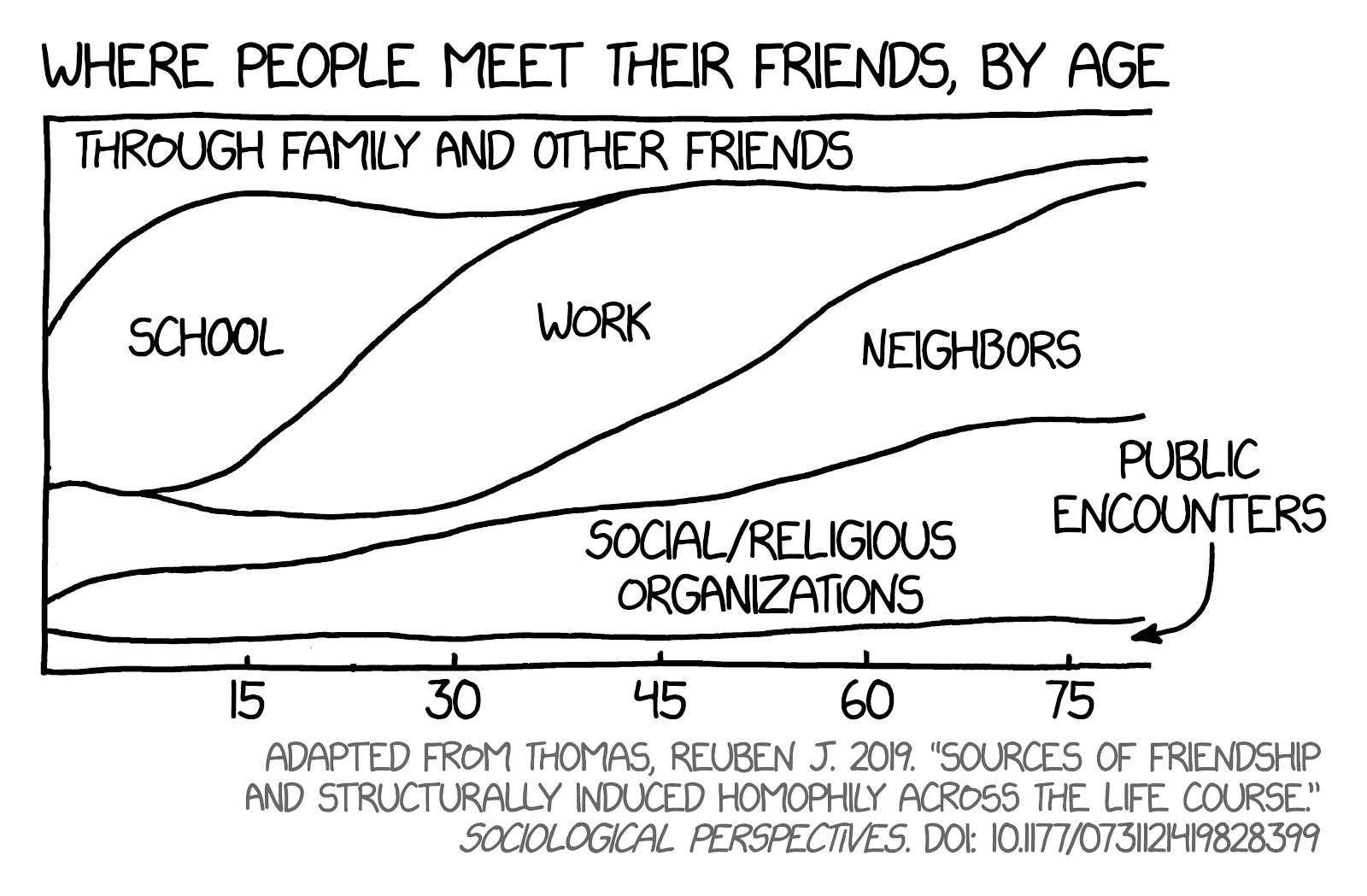
But (to varying degrees) most of the new construction around the world since WW2 has been oriented around driving and separation of land uses, and as a result when you age you end up living in a nice little garden home far removed from any day to day life going on. And once it gets hard for you to drive... then you really end up spending a ton of time alone.
I don’t think there’s an easy fix for this, and that makes me sad.