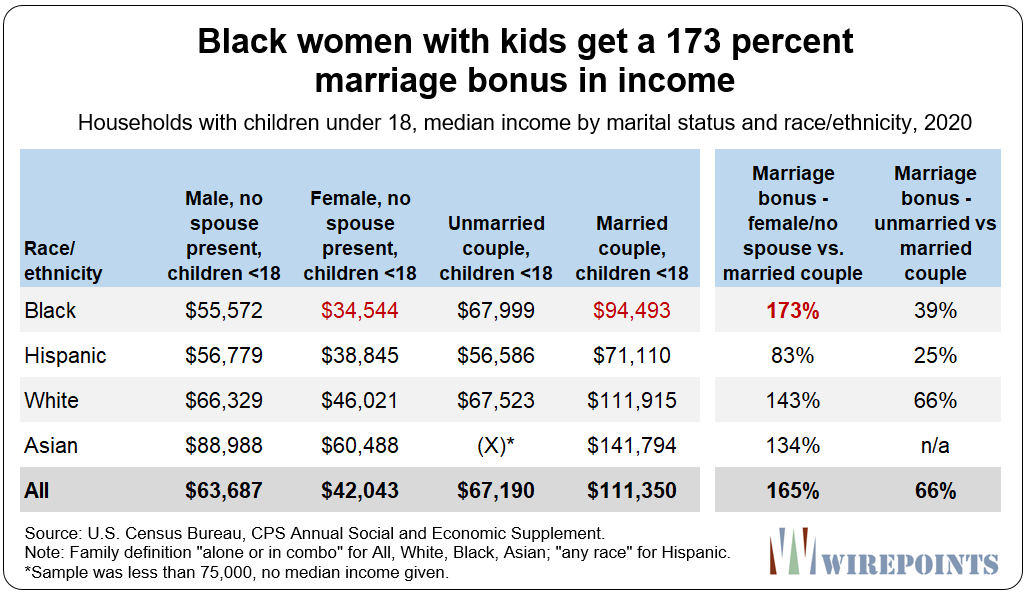
It doesn’t even have to be genetic. Parents which are able to raise their children to be functioning adults probably were raised by functioning adults and were able to find a job that leads to higher household income. We‘re talking about statistics here, so outliers are not relevant. Unfortunately this often prevents lots of meaningful discussions, because that would imply that a) it’s not just „you need to work hard to be successful“ (which one side of the political spectrum does not like to hear) and b) where and how you grew up is very predictive of how capable you are (which the other side does not like to hear).
I agree. There very clearly is a causation link between certain behaviors and long term success. Household income is something people have direct control over. I can go out and immediately cut mine in half tomorrow if I choose to. Doubling it would be harder but i imagine I could do that too if I took the appropriate actions.
being able to double the household income is a privilege you have. what makes you think anybody could do it but is chosing to live with half the income instead ?
> Parents which are able to raise their children to be functioning adults probably were raised by functioning adults and were able to find a job that leads to higher household income. We‘re talking about statistics here,
What is a functioning adult, and where are those statistics from?
Why would marriage matter? Marriage may be an indicator of something, but there are plenty of successful single parents. I can think of several exceptions I know, all of whom are reasonably successful - one a somewhat well-known academic, one, last I checked, a rabbi somewhere, one, now deceased, a...actually, I forget what she did, but she managed to have a home in NYC and didn't come from a rich background, so she must've done something for a living (her kids were both academics.) When I can think of that many examples of reasonably successful people who break your rules without thinking too hard, there's probably something wrong with your theory, or at least my interpretation of it (sorry if I'm misreading what you wrote!)
"For instance 2-parent households will either be able to provide a much higher average income in the case when both parents work, or a more supportive environment when only 1 parent works."
I knowed a single-mom-family of 20 (twenty persons most under 21y), so if that mixed comment seem to look like 'that 2 parents build a safety-net for their children, if one becomes ill - for example - no the heck if you think how worse it is when a child got ill, 'horrifying!', think in that family of 20, on a regular basis _all_ got ill. At the same time. So you've to get a complete medical "lazarett"-team (doctor, sisters, helper,...) but to underline it (for the extreme... with the 'working parents') or there may be a need for an nanny-state-scenario... that may be called 'social'...
And for the original question: "Why would marriage matter", cos marriage seem to be often about rule and expections, not? Um But if i remember correctly, there were some academics, centurys ago speaking about "Moralstats" ("Moralstatistik" in German), where one finding was that not been married correlates with bad-tooth.
It's a question of what is the rule and what is the exception. Single parent households correlate extremely strongly with many negative factors, relative to 2-parent households. This doesn't mean that somebody can't live a good life coming from a single parent household, but that on average they are much less likely to do so than somebody coming from a 2-parent household.
And while correlation is not causation, many of these factors are obviously causal. For instance 2-parent households will either be able to provide a much higher average income in the case when both parents work, or a more supportive environment when only 1 parent works.
> And while correlation is not causation, many of these factors are obviously causal.
You might think so, but the negative factors are sharply divergent between single parent never-married households and single parent widowed households.
Maybe that was misleading. The statistics I’m talking about are from the article, and the sentence before was just my guess - but I really think this is common sense, isn’t it?
Hard work is only a path to success if you're working on the right things. For example, if I decided to be an Olympic athlete, and worked like the devil, I have zero chance of making the team.
In regards to a and b, wouldn't someone who thinks the former likely be someone who also thinks the latter? Those don't seem contradictory and, indeed, one is a possible explanation of the other.
People who lean right, tend to think movement from lower classes to higher classes is possible with hard work and that a person’s starting point doesn’t matter as much.
People who lean left tend to think where you start is the biggest predictor of where you will end up regardless of how hard you work. Hence the reasons one side favors the social safety net more than the other side does.
I think that the difference is probably that one side thinks that being a parent that raises healthy functional adults comes down mostly to personal factors. The other side believes that societal/structural factors play a large part.
So they don't exactly disagree on what the circumstances for success looks like as much as they disagree on the degree to which those circumstances are under an individual's control.
That would be true if these issues were discussed in rational terms, but unfortunately because it's predominantly political, it means rational terms are not the basis of these discussions. That is presupposing either point A or B is even true.
Yes, this is exactly as I see it - but as you can see in the downvotes many people very strongly think just one of these is true and very aggressively disagree with the other one.