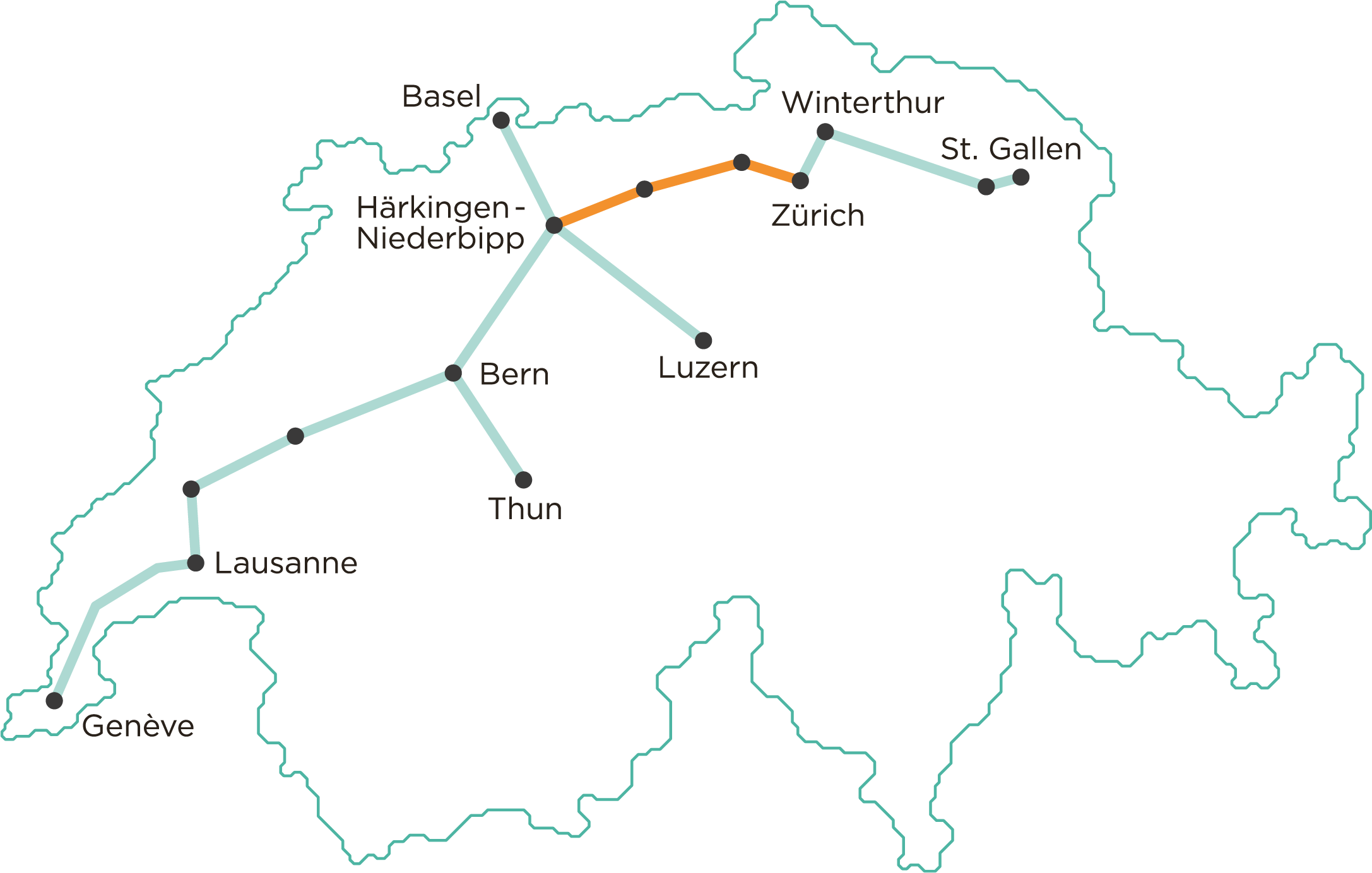
But why tunnels? The article didn't justify it at all. Tunnels are extremely expensive, and usually avoided in all but the most extreme circumstances. Are we at the point now where its easier to just tunnel than buy and negotiate rights of way?
Switzerland has a long tradition of building tunnels, and they have one of the strongest economies in the world. I suspect they have done their calculations. Besides, it seems like a big part of the argument for this project is to reduce the environmental impact the increase in goods transportation have. So even if it is more expensive than a traditional road, they are willing to take the cost. That said, building roads in the Alps is very expensive, so it's not given that this tunnel alternative is that much more expensive.
I think this initiative is brilliant and hope we can try out a similar approach in Norway. We have extensive experience in making tunnels and in automation and should be able to build something like this.
As another commenter suggested, above-ground tubes could be used in less space-constrained geographies, thereby keeping the benefits of an enclosed system, with lower cost.
To my mind, it’s hyperloop with all the nonsensical parts stripped out.
When you consider the price of infrastructure, you have to take into account the period over which the investment will be used, the speed of depreciation and the benefits over time.
In an American way of looking at things, where everything has to give a return on investment quickly, these might not make sense, but in a Swiss perspective, where folks typically think two generations down the road, the immediate cost may be high, but amortized over 60 or 80 years, it is peanuts.
Expensive is relative. California HSR, mostly above ground, is going to cost $80 b for the section scheduled to be built (119 miles) and if the full 500 mi arrives at the current $105 b we'll be lucky. Gotthard Base Tunnel was 35.5 miles and $12.5 billion equivalent.
So the best case is $210 million / mile for the CA HSR and the Swiss already built a tunnel for $350 million / mile.
It looks like they can dodge the topography by building at the cost somewhere between close-to-best-case American rail and worst-case American rail.
They need enclosure around the goods to be transported, and right of way. You can do that by buying many expensive vehicles and negotiating right of way. Negotiating right of way in an densely built-up area is both difficult and expensive.
Building tunnels is not extremely expensive, BTW, if you can avoid most of the factors that drive costs up. They do.
I would imagine tunnels are last mile(s). Cargo depot 1-2 miles outside of town, then down into a tunnel with a couple of terminals near major square(s), last 300ft being via scooter or whatever
There are many existing trains in Switzerland, even high speed ones. Yet those trains are largely above ground. (I can't find any statistics quickly).
This is supposed to be a low speed service - 30km/h - so they could meander around mountains to a large extent. Am I misreading that this is supposed to be entirely underground?
Indeed. The article talks about projected reduction of freight on roads of 40%.
I wonder about induced demand. Presumably total freight volumes will not change drastically in response to the availability of this new system, in which case one could expect road traffic reductions to be stable.
The quieter roads may well induce more personal transportation, but then with Switzerland’s already very good passenger rail connections, maybe not.
Well if you think flat region of Switzerland exists please check the map again.
Even the northern part which is not "in" the Alps is fairly mountainous, with hills and all kinds of natural obstacles