Dropping the official product FAQ that answers some (but not all) frequent question in its FAQ: https://www.cst.ch/en/faq/
My summary, having lived in Switzerland for the last 10+ years:
- Of course actual railways are more efficient. They will continue to be built where possible.
- This is a tunnel network to get the goods into the middle of cities without putting an ever increasing number of trucks onto the city streets to distribute them throughout the city.
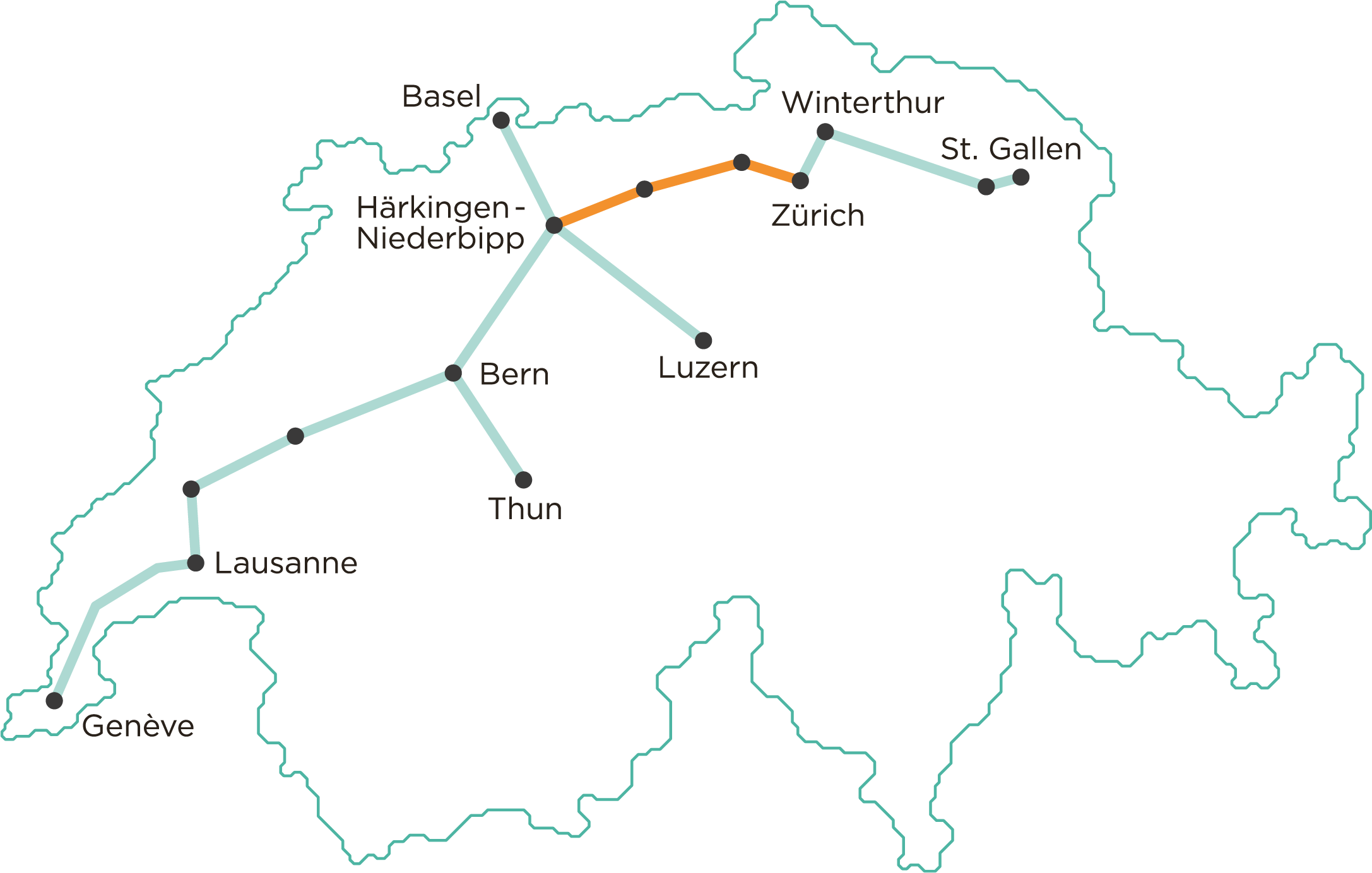
- This runs parallel to the Alps, not through them.
> Of course actual railways are more efficient. They will continue to be built where possible.
Wouldn't this underground network be more efficient than the above-ground railways for cargo? Cargo trains above ground need to stop at lights, need human drivers, etc etc.
> This is a tunnel network to get the goods into the middle of cities without putting an ever increasing number of trucks onto the city streets to distribute them throughout the city.
The article suggests this is to be a national network, not local. If it were just for the "last mile" wouldn't they just use above-ground trains to get the goods to the outskirts of the city before using the underground network to get them into the middle?
> Wouldn't this underground network be more efficient than the above-ground railways for cargo? Cargo trains above ground need to stop at lights, need human drivers, etc etc.
Depends on your definition of "efficient" - I imagine it's definitely more efficient to ship a cargo container full of grain than a CST pod full of grain simply because they are higher volume. If your goal however is "get cereal boxes into an urban supermarket", then cargo rail is probably less efficient, yes.
> The article suggests this is to be a national network, not local. If it were just for the "last mile" wouldn't they just use above-ground trains to get the goods to the outskirts of the city before using the underground network to get them into the middle?
I seem to have phrased it poorly then - yes, that is exactly what CST wants to do. The goal is not to replace urban truck traffic with CST.
> The goal is not to replace urban truck traffic with CST.
Though reducing that traffic is one goal.
"""
In urban areas, city logistics can reduce delivery traffic by 30%.
"""
I guess this is achieved because deliveries get aggregated by destination in the logistical center (where they have space for such buffering), while currently many places might still receive multiple deliveries per day (depending on sender).
"""
In the CST system, the goods are already sorted and bundled by destination when transported in the tunnel. This bundling process means that they are optimally prepared for the subsequent micro-distribution process.
"""
> Wouldn't this underground network be more efficient than the above-ground railways for cargo? Cargo trains above ground need to stop at lights, need human drivers, etc etc.
I think CST vs. cargo rail are very much complementary.
Cargo rail need huge logistical centers and rail yard for sorting, those can be outside of town. CST provide the delivery network from those logistical centers to urban areas.
> Wouldn't this underground network be more efficient than the above-ground railways for cargo? Cargo trains above ground need to stop at lights, need human drivers, etc etc.
Grade separation is a thing in much of the world.
And building a country-spanning network of heavy-duty underground tunnels isn't exactly cheap, even compared to a fully grade-separated train network.
On the other hand, having a national network of tunnels built and maintained is great for when an asteroid strikes off the coast of New York and you only have a few hours to get people to safety. Handily, they're also full of supplies and battery power.
In Cold War context, Switzerland used to mandate nuclear bunkers maintained and stocked for that purpose, they’re been decommissioning those for decades.
Starving in a tunnel is not helpful, and if you’re supposed to plan for an asteroid hitting New York directly affecting Switzerland, a network of cargo tunnels are more likely to collapse on you than save you.
Even tunnels which were built with that purpose in mind (like Lucerne’s Sonnenberg) have huge logistical problems caused by their scale.
It was a joke about disaster movies. One of them even had tunnels in its plot. There's a disaster movie set in Australia that goofs on the tendency for all asteroids to hit off the coast of New York by having the news come hours before the disaster reached them.
Autonomous battery electrical vehicles on simple roads might be a lot cheaper, faster, simpler, and more flexible than either railway or this. This project has a high risk of being technically obsoleted by such a thing long before completion.
Switzerland has no space for additional "simple roads". It would also be extremely difficult go get it approved, as it would pass through many municipalities. You would have hundreds of objections by residents and probably also a few referendums.
It also would not solve the problem which this is trying to solve, less vehicles on the road and less congestion in the cities.
Unless of course you mean to say that all vehicles on the road should be autonomous EVs before the first stages of CST are finished (sometime in the 2030s), in which case I want to congratulate you on your optimism that that would be "a lot cheaper, faster, simpler, and more flexible than either railway or this".
Autonomous vehicles can use existing roads more efficiently. In fact, that's the whole point of this tunneling project. Think of a tunnel as just a stupidly expensive road and you'll see that simply having autonomous vehicles without the billions of dollars of infrastructure would achieve the same goal. Simply close a few roads for normal traffic and you have the same advantages but without the tunnels and power rails. Vastly cheaper. And there already are lots of roads. So, these vehicles could go to a lot of places instead of only a select few elevators above the tunnels.
And of course you could actually mix autonomous and regular traffic as autonomous vehicles get smarter. Like is already happening in parts of the world.
Also, the main issue in cities is not tunneling into a central location but distributing goods all over the city using e.g. cargo bikes, small vans, etc. Many of those are already electric and typically operate from distribution centers on the edge of the cities. Banning regular traffic out of the cities would free a lot of space for that. Some cities are already doing that or at least strongly discouraging car traffic. E.g. London, Paris, Amsterdam, etc. have large car free zones and lots of modern electric delivery vehicles.
Swiss here and my sister does contribute to the CST.
Looking at a few questions: Yes we have a very well working train system (for example a delay of more than 2min is announced). The problem is rather that our infrastructure can’t keep up with the amount of commuters (at least prepandemic).
Secondly nearly every squaremeter is either used for agriculture or very expensive land (at least around the cities). On top of that we have laws to prohibit trucks or trains to ride at night.
And no we don’t have just mountains here, the upper part from geneva to Bern to Basel and Zürich are more or less flat.
All of these with a good expertise in tunnel building are reasons why CST can be a solution… it is just that construction project can take years or 10s of years to get approved and everything moves quiet slowly.
I am not knowledgeable about this, but I wonder how it interfaces with existing logistics. The pictured vehicles look dramatically different in size and form factor than the standard Intermodal container [1] or even the ubiquitous (and smaller) US military Quadcon/Tricon/Bicon boxes. Will items have to be repackaged from standard international shipping containers into these autonomous cargo vehicles? What are the security (ie insurance) considerations?
Also, given some of the deadly tunnel fires originated in freight ignition and combustion, what are the considerations for fire management? [2]
Looks to me like the pods could carry 1 or 2 EUR pallets. [0]
These are absolutely ubiquitous in logistics in Europe. If you pick up a low-margin product like toilet paper or potting soil in the supermarket or hardware store, it will be sitting on a EUR pallet. Between packed in a factory somewhere and sold to the end customer, all that needs to happen is to remove the outer protective wrapping (that has shipping/tracking bar codes on it).
Edit: This (2016) article has some design renderings, showing 2 EUR pallets per pod [1].
that still means you need to unload the pallets from a container and reload them on each side of the tunnel. You must have a really good compelling reason to do so vs moving the container wholesale.
> Efficient micro-distribution in urban areas is a nice idea, but so far there has not been a single city logistics project that has functioned in reality. How is CST city logistics going to fare any better?
> In the CST system, the goods are already sorted and bundled by destination when transported in the tunnel. This bundling process means that they are optimally prepared for the subsequent micro-distribution process. At the hub, the goods simply need to be loaded onto appropriate vehicles – depending on the size, volume and destination, these are courier bikes, motorbikes or small delivery vans. This guarantees coordinated deliveries to sales outlets and end consumers, rather than each supplier delivering their goods individually.
Unbundling from containers to pallets only needs to happen at one end of the tunnel — at an out-of-town logistics center as a sibling comment suggests.
> This guarantees coordinated deliveries to sales outlets and end consumers, rather than each supplier delivering their goods individually.
It's worth noting that most companies delivering pallets don't typically deliver their goods by themselves - usually for palletised goods there is a "pallet network" where the pallets are transferred to a central hub and then consolidated onto a mixed multi-customer load to go to a particular territory. In the UK these pallet networks are usually membership organisations formed by various regional transport operators (see Pallex as an example). As a member you will typically pick up any goods from companies in your local area that want nationwide delivery, deliver those goods to the central hub, and then in return are given a mixed-load of goods to be delivered back to your postcode area. The bigger scale a single network has the cheaper deliveries are (because they will therefore be picking up and delivering the same volume to a smaller territory, so the 'inter-drop distance' is smaller).
Similarly there are van networks, where if you want to deliver something by van from the south of the country to the north of the country, you can give this to a third party logistics provider who will then consolidate your goods with other providers at a hub, place a mixed lorry-load of goods up to the north of the country, and will then organise a mixed-customer van route from the hub.
This effectively seems like a pallet network without the central hub. A great idea - but the idea that all suppliers deliver their goods individually is inaccurate.
Wasn't Mont Blanc speculated to be caused by someone throwing a cigarette out a window which caused the fuel in a vehicle to combust?
Very few of the circumstances of Mont Blanc would be true in this scenario - no combustion engine vehicles, no humans to throw cigarettes and so on. As the other commenter mentioned, you could probably just seal the tunnel entirely in the unlikely case of a fire, since there are no humans to suffocate in the tunnels.
Because much of Switzerland has a mountainous landscape, I wonder if the tunnels would follow the terrain contours (and be at a constant depth relative to the surface) or they would avoid uphill/downhill sections by being at a constant elevation relative to sea level? Probably the answer is "neither" but I'm curious what the thinking is.
Looking at the map, it seems to be running mostly in the highly populated valleys. I guess the spurs are probably just tunneling under mountains (if they are underground, I doubt they would go up, the bigger problem is blasting through rock under the mountains).
This doesn't reach Alps, it stops at foothills of them (Luzern, Thun). Of course its not absolutely flat, but it will mimic existing regular speed rail system.
Due to it not being rail, it can tackle few steeper parts (ie uphill around Lausanne, that's solid 300m altitude difference). Lausanne subway (tiniest city in the world to have one) also uses rubber tyres on the section which goes straight uphill.
Swiss here. Not an expert on the project but AFAIK the idea is to reduce the impact of transportation on the surface.
With globalization and population increase, the need for point to point logistic is going to go through the roof in urban areas in the next years.
Currently this translates to having more trucks on the highways and roads, as our rail wail system is close to saturation already. Not to mention our road are really small compared to US (ie: highways are two-lanes per direction). This creates a ton of air and noise pollution and traffic jams.
This new transportation system should absorb some of the goods traffic and hopefully scale country-wide in the future while sparing the environnement at the surface as much as possible.
Assuming regenerative braking you can get much of the energy back again when the train goes down a hill. But your point broadly stands - for reasons like limited wheel/rail adhesion heavy trains and steep gradients seldom go together.
Depending on how the ‘stations’ work there maybe slopes up to them and then slopes down from them to help decelerate and accelerate the trains in and out of the stations
But why tunnels? The article didn't justify it at all. Tunnels are extremely expensive, and usually avoided in all but the most extreme circumstances. Are we at the point now where its easier to just tunnel than buy and negotiate rights of way?
Switzerland has a long tradition of building tunnels, and they have one of the strongest economies in the world. I suspect they have done their calculations. Besides, it seems like a big part of the argument for this project is to reduce the environmental impact the increase in goods transportation have. So even if it is more expensive than a traditional road, they are willing to take the cost. That said, building roads in the Alps is very expensive, so it's not given that this tunnel alternative is that much more expensive.
I think this initiative is brilliant and hope we can try out a similar approach in Norway. We have extensive experience in making tunnels and in automation and should be able to build something like this.
As another commenter suggested, above-ground tubes could be used in less space-constrained geographies, thereby keeping the benefits of an enclosed system, with lower cost.
To my mind, it’s hyperloop with all the nonsensical parts stripped out.
When you consider the price of infrastructure, you have to take into account the period over which the investment will be used, the speed of depreciation and the benefits over time.
In an American way of looking at things, where everything has to give a return on investment quickly, these might not make sense, but in a Swiss perspective, where folks typically think two generations down the road, the immediate cost may be high, but amortized over 60 or 80 years, it is peanuts.
Expensive is relative. California HSR, mostly above ground, is going to cost $80 b for the section scheduled to be built (119 miles) and if the full 500 mi arrives at the current $105 b we'll be lucky. Gotthard Base Tunnel was 35.5 miles and $12.5 billion equivalent.
So the best case is $210 million / mile for the CA HSR and the Swiss already built a tunnel for $350 million / mile.
It looks like they can dodge the topography by building at the cost somewhere between close-to-best-case American rail and worst-case American rail.
They need enclosure around the goods to be transported, and right of way. You can do that by buying many expensive vehicles and negotiating right of way. Negotiating right of way in an densely built-up area is both difficult and expensive.
Building tunnels is not extremely expensive, BTW, if you can avoid most of the factors that drive costs up. They do.
I would imagine tunnels are last mile(s). Cargo depot 1-2 miles outside of town, then down into a tunnel with a couple of terminals near major square(s), last 300ft being via scooter or whatever
There are many existing trains in Switzerland, even high speed ones. Yet those trains are largely above ground. (I can't find any statistics quickly).
This is supposed to be a low speed service - 30km/h - so they could meander around mountains to a large extent. Am I misreading that this is supposed to be entirely underground?
Indeed. The article talks about projected reduction of freight on roads of 40%.
I wonder about induced demand. Presumably total freight volumes will not change drastically in response to the availability of this new system, in which case one could expect road traffic reductions to be stable.
The quieter roads may well induce more personal transportation, but then with Switzerland’s already very good passenger rail connections, maybe not.
Well if you think flat region of Switzerland exists please check the map again.
Even the northern part which is not "in" the Alps is fairly mountainous, with hills and all kinds of natural obstacles
Imagine the bandwidth of those pods transporting backup tapes!!
This project gives me futuristic vibes, if they could make the numbers work, is a great idea, it could be even a closed tube that goes overground outside the cities and goes underground on the populated places.
I't more or less the idea of the hyperloop, but for cargo, and without the constraints of speed and safety that make the hyperloop so expensive. As a concept it seems so good, that I really hope that is going to be financially viable in a short amount of time.
Virgin Hyperloop is in fact an investor in CST since 2016 [0].
I can't help but find this maybe ironic, maybe fitting (?) since AFAICT (from skimming [1]) Hyperloop has given up on passenger transport this year to focus more on ...cargo.
A lot of cities here now use underground trash collection [1] . At the moment these have to be emptied via truck from above. I could see such an underground system take out the trash directly.
Knew of the existence of these, but never seen the emptying process. It’s a very neat design consideration the way the barrier rises up out of the ground, so you’re not left with a gaping hole.
I think the obstacle to connecting trash receptacles to a subterranean logistics network would be just how much tunneling you’d have to do.
CST will connect to urban distribution hubs, with the last mile fulfilled by courier bikes, motorbikes or small delivery vans.
I think this is trying to solve delivery inside cities. However, I don't see cities beeing clogged by parcel delivery services. Transportation of goods is more problematic on the inter-city level. But that's too far to build a tunnel.
What is causing troubles for cities seems to mostly be human traffic (that's why rush-hour is a thing) - for that subways could indeed be a solution.
Unless Switzerland's traffic is looking completly different from what I know from Germany of course?
All your questions can be answered with "Switzerland has a functioning railroad" (for public transport).
Compare the modal share between Zurich and Frankfurt [0]. 44% of travelers in the Frankfurt area use a private motor vehicle, whereas only 21% do in Zurich.
> However, I don't see cities beeing clogged by parcel delivery services.
Cities are clogged by any kind of vehicle period. Particularly delivery trucks will run into issues in the future as more and more European cities start enacting low emission zones/diesel bans inner-city [0], yet the overwhelming number of delivery trucks are diesel.
> Transportation of goods is more problematic on the inter-city level.
Inter-city has rail and lorries with trailers, both do not work inside the city where every extra vehicle leads to extra congestion due to the high density of everything.
> Unless Switzerland's traffic is looking completly different from what I know from Germany of course?
Berlin, Darmstadt, Hamburg and Stuttgart already have diesel bans and low-emission zones inner-city. In most bigger cities driving into the center is an exercise in frustration, not just due to congestion but particularly due to lack of parking spaces.
> Cities are clogged by any kind of vehicle period. Particularly delivery trucks will run into issues in the future as more and more European cities start enacting low emission zones/diesel bans inner-city [0], yet the overwhelming number of delivery trucks are diesel.
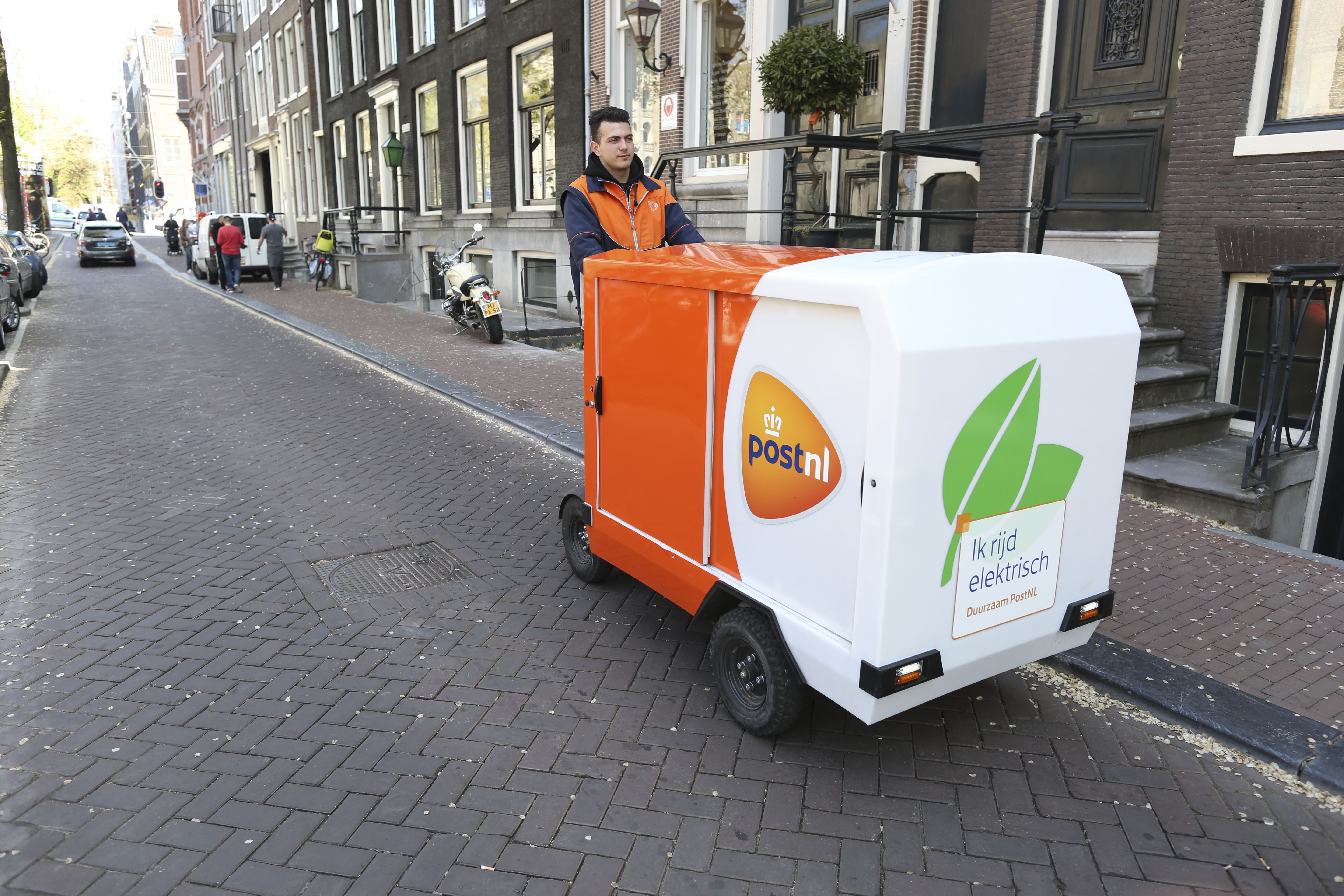
Here in the Netherlands, it seems electric delivery vans [1] and cargo bicycles [2] are becoming more and more popular.
Switzerland has an extensive network of railways, so I would see underground tunnels useful for last mile delivery within cities but not for longer distances.
This particular network certainly isn't last mile - they are talking about dropping the goods off at 10 hubs rather than last-mile.
Also last-mile with tunnels isn't really practical - bearing in mind that last-mile means getting goods all the way to a customer house (i.e. it's not really last-mile if someone else has to pick it up and move it to the final destination).
Note that the maximum distance on this network (Geneva - St. Gallen) is only 300km, so a ~10h trip at the projected speed of 30km/h. That's still overnight shipping.
Also, seeing as the goal is to get (consumer) goods into cities, I would call that itinerary a bit hypothetical.
(I agree with the general statement, and I hope so do the designers. This should complement, not replace.)
All the cities of the world can't have that because quite a few of them do not have the geological conditions to be tunneled under on a large scale.
In others there are issues with digging up old stuff that's archaeologically relevant, like any time something is dug in Rome.
And any place with such a system also needs its economy/commerce to be "expensive" enough to justify such an investment. In Switzerland that works because it's pretty much one of the most expensive places on the planet.



My summary, having lived in Switzerland for the last 10+ years:
- Of course actual railways are more efficient. They will continue to be built where possible.
- This is a tunnel network to get the goods into the middle of cities without putting an ever increasing number of trucks onto the city streets to distribute them throughout the city.
- This runs parallel to the Alps, not through them.