Everyone mentions the scammy nature of NFTs and cryptocurrencies, but I think the bigger reason might be that Steam doesn't want to be subject to financial reporting requirements when people buy and sell crypto equities on their platform. KYC applied to Steam would be a nightmare.
It's not only KYC. They would need to start putting in anti-money laundering detection reports, OFAC reporting... the list of financial reports/audit/regulations is ENORMOUS.
No way a gaming company wants to do this... in every country they operate in.
Not to mention, that gaming platforms have been used in the past to launder money, so it's not even a stretch to assume that would be happening.
Agreed. Tangentially, seems likely to me is that blockchain makes it impossible for Steam to police fraud. There's consumer expectations around refundability that Steam simply won't be able to meet in this world, and people will blame Steam for if they're on the bad end of it.
This is the simplest and correct answer. Intentionally or otherwise, finding yourself operating as an unlicensed securities dealer, deposit holder, brokerage or money transmitter is going to give you a very bad time with any number of federal authorities that (heavily) regulate all of those things.
This is most likely it. They already collect light KYC (SSN) if you make significant sales on those trading cards that you get from games randomly and can sell or dust. Currently, there are not enough clear rules around how to regulate any digital asset, so it could be a very complicated problem for Steam.
I do believe we'll eventually see integration of digital assets into the platform, but I believe that will absolutely be the case with all major platforms.
Like many I am willing to buy NFTs and enjoy their many benefits.
Steam will likely try to capitalize on it when it becomes an even bigger market by either introducing their own marketplace or token or something else.
> Steam will likely try to capitalize on it when it becomes an even bigger market by either introducing their own marketplace or token or something else.
They may be a big business, but its not clear at all that it is th kind of business that Steam wants to be in. Just because a business opportunity exists doesn't mean a particular existing incumbent business in a different field will transition to engage in it.
No one is buying NFTs expecting copyright ownership right now, that's just the nonsense people who are out of it think. There are NFTs that provide copyright with the purchase but that's optional. For now they are an alternative way to directly pay artists. An interesting idea that is gaining traction within the photographing community are people NFTing their photos and releasing them via CC when they are sold. If you buy the nft you get to fund the artist and this collectible has value afterwards.
Usually the more scummy ones you see are limited piece PFP collections with rarity traits etc. The OGs( cryptopunks) where interesting as the first NFTs to be ever made but the current churn is just hype. Besides that the more artistic generative collections like the art blocks curated are interesting. Most of the big pieces are in the collections of people that have no intention to ever sell them. Some are experimenting with online galleries of shorts.
Basically throughout the whole hype bubble with nonsensical projects( crypto is the definition of fuck around and find out) there are some who are exploring some cool artistic stuff. Personally I never understood high art so I'm staying out of it.
Also don't get caught up on the prices, these are priced in Eth, not $$. Eth was $80 a couple years ago and a few cents when it launched( and yes I do know people who have held eth since way back then). When something appreciates so fast it makes sense that some people are more willing to spend it in such ways.
1. A way to pay the artist directly for the work/effort being made (and against the counter-argument of "you could always buy a painting/physical artwork, its much better and would also be helping the artist" there is the: i don't need another "physical" artwork - my home is already littered as is; i just like to contribute and give money to people that are doing cool things and NFTs allow me to do that in a clear direct way)
2. NFTs bring a simple way to find and monetize/create value around previously hard to value/commoditize art domains like: interactive art, generative art and iterations - around authority sites like hic et nunc et al (now i can for the first time peruse common places that serve NFTs and fund/incentivize certain art styles that were previously out of the generalist/mainstream art market - previously how would you pay for a generative art and immediately have the creator reach you out for a conversation over its style and substance?)
3. An immutable receipt that i paid for it (which can be anonymous, but still it is good to have)
here is a bonus point that I personally don't find it as cool, but still worth a mention:
4. There is a whole after-market movement for these immutable receipts, look for it, people are cool, friendly and creating new amazing things with an incentive that is stronger than ever to produce new digital trendy objects (some you can even interact with, some might change whenever they get accessed, some might even freely stop existing at some point in time... its crazy ahah)
1. Patreon exists, this seems like a far safer way to support the creation of art (and a lot of artists already use it heavily).
2. The monetization of art is a heavily controversial topic and a lot of artists rightly think that patronage is a much better system to exist under since it provides a more reliable and stable income.
3. Paper is pretty immutable generally speaking. I don't think NFTs will actually significantly impact issues around long term art providence with both laundering and forgeries still remaining prominent. Additionally, almost all of the art world already supports publicly anonymous transactions to protect purchaser privacy.
4. I think there's some interesting stuff in this realm with interactive art - but I think there are ways to accomplish much the same thing with conventional sale processes.
1. Patreon is not direct, involves a 3rd party (patreon.com), requintes registration (besides a bank account/wallet address), and is centralized enough that they can ban you as a creator and as a giver.
2. With nfts the monetization of art is at least one step less controvertial than current approaches and does not exclude or goes against patronage (which is always a valid non-exclusive approach that can coexist with and along nfts)
3. Paper can be stolen, can be destroyed and is not public by default (it stays in your pants pocket while they go to laundry)
are these counter-arguments to the points I provided?
I fail to see the point here.
Are you speaking for the ones that like to support cool art or against them? are you speaking for the artists? or just generally against NFTs as an alternative tech innovation to a current existing problem?
Lots of NFT projects have gamification systems built around them; some include voting rights, others grant access to things, can be melded with other NFTs, provide FTs, so on. It's really the wild west right now and HN is completely out of touch.
https://variety.com/2021/biz/news/wme-signs-pixel-vault-1235... -- WME has signed Pixel Vault, an IP business dedicated to drive value to NFTs. The agency will grow Pixel Vault’s catalog of IP beyond its established NFT business into other areas including film, television, podcasting and gaming.
Here's two big name projects with all kinds of gamification going on around them: BAYC and CyberKongz
They're actually relatively simple. If you want to see some of the more complex NFT ecosystems that are really pushing boundaries, see Loot and NeoTokyo.
I doubt they ever allow withdrawal. They are in perfect position, they either keep getting 5 or 15% cut from market transactions over and over again or 20-30% cut of game sales. Or even 100% cut with certain items.
Why allow money to go out when it is almost yours anyway.
This is the correct answer. They know how much money is potentially at stake here, they want to bide their time and do it right while they formulate a way to capitalize on this mammoth of an opportunity.
Axie Infinity just recently raised $152M at a $3B valuation, and it's not going away. People from the Philippines are making a livelihood out of this game, and that is so powerful I can't even put it into words.
The genie is out of the bottle so to speak, and the entire world is going to get into P2E games and the metaverse sooner rather than later. If Steam is really serious about not entertaining this, there is a HUGE opportunity for a new contender to come in and disrupt them by allowing blockchain-based games. WebGPU + WebAssembly in particular is a fascinating way to deliver binaries without having to go through walled gardens, and you can today hook these games up wallets like Metamask. I'd go as far as to say a meaningful part of web3 will be decentralized gaming on the blockchain.
> Axie Infinity is a trading and battling game that allows players to collect, breed, raise, battle, and trade creatures known as "axies" (characters based on axolotl), which are digitized as NFTs.
That just sounds like CryptoKittens
> Axie Infinity uses NFTs for the rights to each pet that is purchased. To grow these pets, you purchase or farm SLPs, or small-love potions. You can sell these pets or SLPs for cryptocurrency, then swap into your respective currency.
I don't see what's novel here, the game was intentionally designed to store inventory/assets with NFTs. It sounds like these people are farming in-game items and selling them to other players (whales). It's literally just gold farming in wow except allowed by the developers. Any other game that lets users trade their inventory for crypto (to prevent charge backs if you were using paypal etc) could also do this without NFTs.
I wouldn't want to play a game that allows gold farming, because then the metric of your progress isn't how much time you've spent playing, but just how much money you've spent on it.
I'm not sure I'd go so far to call them an outright scam, but they're highly fragile assets that likely won't stand the test of time.
I would be interested to see if someone is working on implementing NFTs in a way that I can feel confident that the digital art will remain provably attached to the NFT for decades and centuries in future.
From this tweet, it sounds like NFT's are not much more reliable than html <a> tags? If the host is down, the NFT is nothing more than just a pointer to a 404?
And worse, the host of the image could theoretically change it on you and you'd have no way to prove (at least in a trustless way) what the original image was.
it depends on how it's implemented. its much harder to implement onchain so a lot of projects will do things like <a> tag which is not trustworthy long term like moxie said.
there are well respected projects that are fully onchain such as cryptopunks and autoglyphs
IPFS would definitely be better, but there's no guarantee that the data will be stored on IPFS forever.
I'm thinking something more like a hash of the artwork embedded in the NFT directly rather than just a link to it. That way, even if the link breaks, you can still prove that a piece of digital art belongs to the NFT.
> Is it correct to say that an IPFS address can only point to a specific piece of data, and re-uploading that data will generate the same address?
Technically I believe the answers to those two questions are, respectively, “no (because hash collisions are possible)” and “yes (because the same content will always have the same hash)”.
I don't see why NFT game devs should care about this to be honest. We shouldn't be putting decentralized games on one of the most centralized platforms in history.
Love Steam, but you can do your own distribution pretty easily these days. If they want to miss out on the next platform evolution, that's a mistake they'll have to reckon with.
I don't see it affecting the NFT gaming market one bit.
I'm not a fan of "collectibles" or "cosmetic items" or whatever they are called these days in games, but even I can see the use case where you can gain those in-game and then manage them outside of the game, trade them with other players, and maybe bring them with you to the next version of the game or even to another game. NFTs enable this without having to build any of the infrastructure to support it.
>even I can see the use case where you can gain those in-game and then manage them outside of the game, trade them with other players, and maybe bring them with you to the next version of the game or even to another game.
All of this sounds completely dependent on the game designers, which is the opposite of decentralized, no? What requires NFTs? You can't just "bring" something into another game.
>What requires NFTs? You can't just "bring" something into another game.
Isn't that kind of the point of NFTs? With an NFT, you hypothetically could bring something into another game. You'd need different developers to agree to recognize certain NFTs, though.
I think the better question to ask is the reverse: what requires bringing things into different games? Historically, nothing. This doesn't seem to be a thing most developers want. And if they don't want that, there wouldn't be a point to implementing NFTs, since they're already keeping things centralized.
So it's really just a philosophical discussion about the idea of things being tradable between and outside of particular games, and the potential merits of that, rather than a technical discussion about NFTs.
For this to be useful, you'd need an infrastructure-- standard APIs and formats for interchange.
I'm picturing the initial sell as like those old Pokemon events or trading via the link cable, but you could buy a Trabant P601 from Gran Turismo, Zhongli from Genshin Impact, and Messi from FIFA21 to drop into the game too.
How do you make use of that sort of open-ended diversity without ruining gameplay? You'd either be limited to trivial uses (avatars/skins or randomizations) or you'd have a huge vector for feeding in game-breaking items and characters. The alternative is a closed network-- only allowing a small selection of pre-vetted NFTs that won't break the game, which adds very little value over something like the Skylanders/Infinity/Amiibo concept that already exists, except you don't get a cool figure too.
Doesn’t require NFTs, but NFTs could solve the problem of digital trading in untrustworthy markets - like game codes and event tickets. (Introduce other problems too, like getting hijacked by people who are overexcited at the thought of fractionalised links to jpgs…).
Does it really solve for digital trading in untrustworthy markets though? How would the smart contract verify that the event ticket or game code was legitimate? If it was up to the buyer, they could just lie.
This still makes absolutely no sense to me. The developer of Runescape is not going to collaborate with the developer of Warcraft to give them a copy of the model, figure out how the stats translate, put the textures in the right format, etc. Games use completely different equations for damage, defense, speed, etc. It's 100% magical thinking.
Even if you did have game items transferring across totally unrelated games, you'd _want_ a centralized database to make bug fixes possible. After all, games as a class of programs aren't known for being bug-free.
So.... this party hat asset comes with a permissive license that lets world of warcraft distribute it from their servers down to players' clients, right? So that the people who are playing on the same server as the owner of this NFT can see the hat, being worn by that player, in their game?
But then if it's licensed that freely, what's to stop world of warcraft just using it in general? Put it on a bunch of NPCs. Let any player put it on their own character.
Or does the license have some sort of restrictions - 'you may only use this asset as a hat on the player character of the person who owns this NFT'? How's that enforced?
Seriously, WHY would WoW go to the trouble of supporting this nonsense?
The NFT piece of this is just such a small part of what’s needed to make this work though. This sounds like it is only something that would work in a very cooperative model - where the players and the games devs have their interests aligned in getting to use these shared assets.
The most similar thing I can think of is like gravatar images - as a blog comment section it made some sense to let people bring their ‘identity’ with them in a low trust way.
Sure, that kind of interest alignment can exist in games but if everyone’s cooperating there’s no need for a system like NFT to enforce the rules about who gets to use what cosmetics.
> But if that existed, the Runescape and Warcraft developers would not have to coordinate at all
At a minimum, there would need to be a known (to the asset developers) stable asset description format to target, covering both the cosmetics and in-game mechanics of the items, for every game the asset would target.
For it to work, game developers need an incentive to open their multiplayer games to third-party assets and asset developers need an incentive to target games they don't own with assets.
1) world of warcraft can incorporate the party hat asset
2) world of warcraft chooses to implement a mechanism where that hat can only appear on a character whose accountholder has authenticated as 'owning' the NFT that points to that hat
then yes, that could happen.
But... why would they do that?
Why would they not just rip the hat and put it up for sale in their own store for anybody who wants to pay them for it?
NFTs do nothing to address what's actually hard or unrealistic about this. If WoW and Runescape are already collaborating, they can just ask each other who owns what. If they're not collaborating, this scenario never occurs.
>If WoW and Runescape are already collaborating, they can just ask each other who owns what
This is actually not that trivial from a technical standpoint and takes a lot of time and money to maintain.
First Runescape would need to set up and hire a team to maintain uptime on a few public facing web service servers and define an item status API. They'd need to integrate this web service into their backend infrastructure to give live updates.
Second World of Warcraft would need to write some custom code to read these party hats and their owners from the Runescape API and also maintain a way to link Runescape and World of Warcraft accounts so the right people get them (OAuth2 would likely do well here). WoW would also likely need to design the system to fail gracefully when Runescape servers are down.
This is just for read access, if WoW wanted to let players trade these hats then the Runescape API at least doubles in size and now includes synchrony assumptions and complexity in case players try to trade at the same time in both games. Not fun.
Alternatively Runescape could just make party hats NFTs and players would hold them in their own wallets. WoW would write a handful of lines of standardized code to read the NFTs from the player's wallets and display them in game. Allowing users to trade these items would also just be a few lines of code and would work seamlessly across these two (or more) games. Ethereum also has 100% uptime and the reliability allows designers to create a simpler system overall.
It's the difference between weeks/months and a few days of work on the development side. It's also more standardized and compatible with all other apps when using ERC-721.
The NFT in this case - like, the actual ethereum wallet? - actually contains game assets that are compatible with WoW?
Meshes with different LoDs, textures, animations, skeleton weights for physics? (I mean, obviously you want your party hat to flop around realistically when your character emotes, right?)
And WoW is going to take this arbitrary untrusted asset from a player-provided NFT, and... load it into the WoW client of every other player who is near the player.
Yeah, that sounds like a terrible, terrible idea.
The content moderation aspect (textures covered in swastikas or porn?)... the possibility of players providing meshes that are ridiculously large or complex... the security attack surface...
This does not sound like 'just implement a few lines of code and you're done'.
Ok, but couldn't they build off the content of those NFTs, just without bothering to actually care about the NFTs? I don't get why this artificial restriction-by-convention is appealing.
Ok, but the supposed benefit was to a game's prospective competition. Why in the hell would the game developer want to license content created for their game to be used in a competitor's game?
> in the absence of licensing restrictions, the nft owners are incentivized to prefer projects that provide utility for their nfts.
And everyone who doesn't have those NFTs have no such incentive. Even if I own game X's NFTs, there is no disincentive for me to play game Y that straight up uses game Z's NFTs for free. Or hell, even if it used game X's. I might want to play with an item I don't have in game X, after all.
If a game came out tomorrow that reused TF2's hats and shit, do you really think anyone would consider the fact that they have hats in their TF2 account a disincentive to play the new game?
This is like that part in HGttG[0] where the Golgafrinchans decided leaves were currency and burnt down the forests to ensure their scarcity. I have no idea why you people can't see how mad you all are.
[0] In case anyone doesn't know: The Hitchhiker's Guide to the Galaxy, by Douglas Adams.
minecraft and roblox show the demand for games with content from a variety of artists.
imagine you paid a few hundred or thousand dollars for the hat, you'd be strongly incentivized to call the games that aren't contributing back to the ecosystem freeloaders. and as for everyone else, there's a thin line between not caring about the artist getting paid and piracy, and i suspect there isn't a whole lot of money in the segment anyways.
Game devs would never do this. Even if they're bullish on NFTs. The whole point of a sequel or spin-off is to hit the reset button on your game economy and shake down big spenders once more.
It is also a design challenge. One of the design benefits of a new game is you can cancel, rework, or nerf strategies that players spent money on in the previous game.
This could still work with NFTs though, for example MTG has different formats of their game which have restrictions about which releases of cards are eligible for use, and some cards are banned from use in any format because they are too overpowered. Similarly, we could have games which ban NFTs which are overpowered turning them into collectibles with no in-game use. This isn't the reason NFTs aren't workable, because even if you could overcome the regulatory burdens, the bigger reason is control of IP. If other games can consume the NFTs from my game, then they can steal my player base by essentially forking the game with the promise of maintaining player inventories. Why would a publisher want this?
I don’t see companies letting their intellectual property float out onto a public blockchain to be used by any other game. Unless they have total control over how that IP is used, I don’t see any publishers funding games like this. I think it would even undermine their copyright if they didn’t enforce these limitations.
Think about it, a much smaller fish could offer a very similar game that uses the inventories of NFTs from GameA and become a serious threat to the business of GameA overnight by sniping the player base with the promise of keeping their inventory.
I keep seeing this argument and it makes ZERO sense. You still need to build infrastructure to read the NFT and incorporate it into your game. You can already do this without a blockchain and a global network of hyper redundant miners/validators.
> NFTs enable this without having to build any of the infrastructure to support it.
So I could build this infrastructure on mongodb/dynamodb in a single weekend, offer it without $$$ minting/gas fees, still get higher margins, point out my solution is green, and offer my simpler solution to game devs, and everyone will be better off.
Not any more so than car titles are fungible. If I give you $10k cash and you give me $10k cash we end up in exactly the same material position, despite owning technically different objects (dollar bills) than before. That's because the dollar bills are fungible tokens representing a value. But if we trade titles for cars worth $10k each, we are both now in a different material position since we own different cars now.
(The problem with NFTs in this analogy is that transferring car titles has legal weight, while selling an NFT probably doesn't without additional contractual language.)
They aren't. You're trading one non-fungible thing for a different non-fungible thing.
Alternatively, a game could also offer SFTs (semi-fungible tokens, as described in ERC-1155 [1]), in which case players could trade multiple identical versions of some indivisible asset. Something like a skin or a hat would be an SFT unless only one copy of it existed (i.e. only one player could ever use that skin or hat at any time).
They would be unique items that are identifiable from other items. (e.g. different hashes, even if they represent the same item in game) “There are many like it, but this one is mine.”
I was thinking the same thing. I found this article about a game called Axie Infinity.
“ NFT games such as "Axie Infinity" and "NBA Top Shot" let people earn money by grooming and selling animal characters called Axies, which players treat as digital pets. […] They will then groom these Axies, team up with their friends and make Axies do battle like Pokemon, and build so-called "virtual kingdoms."“
In any other game the characters you develop are essentially the _same_ as any other character played by any other player—maybe with the exception of the character name which you could personalize.
I can appreciate the notion that you can develop a character which can be uniquely identified.
Without devolving into a philosophical argument about games simulating reality, I’m thinking you can see NFTs as a fundamental change, because NFTs offer a unique player experience. If Eve Online creates a unique experience by allowing players to create corporations, then NFT character is a unique experience at the individual player level.
Unique digital assets are compelling like baseball cards
> We shouldn't be putting decentralized games on one of the most centralized platforms in history.
That's something that I believe is currently a big issue in our society, so many things are pushed between black and white. You can definitely see the advantage of both system and use both in their own when one is better than the other. The fact that you see potential in a decentralized value transfer system and want it to evolve doesn't means that you believe every single thing need to be decentralized. I'm sure you downloaded something using P2P, yet you are still enjoying centralized file distribution everyday too.
Not only that, but Steam doesn't require any exclusivity or dependence to their platforms. That means that as a publisher, you can share it on multiple platform, which make it essentially decentralized...
Agreed. The browser route using WebAssembly and WebGPU is the path to decentralized distribution of games to players. This is what our team is working on! No 30% cuts from walled gardens, and developers have the freedom to whatever they want, and if that's to implement their game on the blockchain then they should be able to.
%100- I had a game in submission status "retired" this week because "NFT's"- the game is 45gb so its more difficult to find a place to host it/etc when its that big and have it make financial sense right now. Sort of the same with 4k video hosting. I know the problem will be solved eventually. But because of this as a dev I'm not publishing to Steam anymore.
The love their blockchains. So why not make a blockchain for distributing games? Patching would be lot more secure as it would be cryptographically secure and any player could just build the newest version from shared blockchain.
between this news and sweeney's dismissal [1], the decentralized future is bright
> Sweeney: We aren’t touching NFTs as the whole field is currently tangled up with an intractable mix of scams, interesting decentralized tech foundations, and scams.
I think this is a bit of an uncharitable comparison though.
NFTs and crypto are explicitly supposed to have real-world value and uses that are more or less completely divorced from their use in these games. If you delete the game, the items themselves still have the majority of their purpose.
Whereas for the things on the p2p marketplace, their value is entirely predicated on the game they exist within.
Given Steam is a games platform, I think it is pretty straightforward for them to want to keep non-game-related stuff away. Even if it's just from a pragmatic point of view: as weird as it is, lawyers and accountants at this point are very familiar with how to handle users trading in-game things. Pulling in things that exist sufficiently in real life to be in danger of being considered a security is absolutely a big departure from what Valve is used to supporting on its platform.
I think you are misunderstanding the term "real-world". Obviously they sell digital content on their platform. That's the whole point. They don't sell "real-world" things like tee shirts or toys.
The only way to withdraw the money made on the marketplace is to buy marketplace items and trade them for money via online payments / cryptocurrency, which is against their ToS. Looks like they aren't enforcing that, though.
In addition to the fact that the very idea of NFTs is a scam, Valve doesn't want to enable money-laundering lest financial regulators drop the hammer on them. Banning any games that involve real-world assets (or anything easily convertible to a real world asset like crypto) is just smart business given current financial regulations.
It also gives them a complete monopoly on their internal marketplace, so that's a nice bonus.
They are quite hard limiting the step 2. Seeing that even some bigger profile titles don't get enough keys to allow them be on quite well selling bundles like Humble Choice. At least not before they have generated enough organic sales.
Also gems have absolutely horrible conversion ratio. I think lowest I can find in my inventory is 6 gems per copy of game. You can sell gems for 0.30€ per 1000... So 167 copies. And accounts...
Not to forget that it cost 100 dollars I think to release game on Steam...
Isn't there a lot of money lost in between all those steps? I mean steam keys cost money, bot farms, I doubt those gems have a very attractive exchange rate (it's a 'last resort' way to get rid of cards), buy / sell cards has Valve's cut, as does said game and the financial processors in between. It just sounds like a lot of effort.
Generally money laundering schemes are very lossy, apparently 30-50% isn’t unheard of. This is because dirty money you can’t spend is nearly worthless, and because generally the people doing the actual laundering are agreeing to take on a large amount of legal and safety risk and demand to be compensated in proportion.
From a money laundering “user” perspective, would you rather have $1 million that will likely send you to jail, or $700k that you can spend freely without concern?
> Isn't there a lot of money lost in between all those steps?
Very low, perhaps. Each bot cost $5 in order to trade. That's an upfront cost, and can be reduced if they buy their asset flip. A certain number of Steam keys can be generated free by the developer. Asset flip games might be near free, depending on the assets. Developer accounts cost money, but again that's upfront. Bots can farm in VMs. There's money "lost" on Steam and gray market trades, but that money never really existed. Yes, it takes lots of time, but it's automated and scales decently.
I'm pretty sure that Valve's marketplace tax makes it much harder for low-margin scams to scale. You could definitely pull off an "exploit" like this today, but the main reason why it's not mitigated is probably because nobody is really getting scammed here. It's like Office Space, where the actual profits from this grift are so minute that the only way it would be profitable is if you stuck it out for several years.
I mean, to really make bank, what you need is for those digital assets to be worth something, right? So here's the plan, we just make a game that's really fun and market it so that it becomes super popular, trick people into playing it, you know? And then every day those rubes will be paying us money for digital assets we make for free, and for a 30% cut Steam will deposit it right into our bank accounts - clean, laundered cash. After five years or so, when they're starting to catch on, lose interest, we end ongoing support and just disappear off into the sunset with the money...
Hahaha sometimes it does seem like scams are so clever and involve so much work that the people involved would be substantially more successful in almost any business.
Laundering isn't about getting fungible currency (that's the input), its about converting a stream of illegally obtained fungible currency into a smaller stream of fungible currency that appears to government authorities to be a legally obtained.
I actually think in-game content is one of the most legitimate uses for NFTs. It's also cool that since the on-chain data doesn't go away if the game does, it allows for in-game collectables which are not tied to a specific game. Lots of possibilities there.
Pardon my ignorance - but if the game goes away, what precisely does the NFT token which remain grants you? Isn't it just a confirmation that you own an item in a game that you cannot access/use anymore?
I guess as always, I am looking for benefit of NFT/chain solution over simpler non-NFT/chain solution. I hear persistency, but in this case I don't see it in practical terms.
It can be used by a different game. The token is just a token, what it means depends on how it's used.
A smart game producer that sees a NFT-based game go down could say "hey, you know all those items you had on <game X>? Come over to my game and you'll get <benefit> based on that stuff!" Since ownership of the token is publicly visible and not locked into Game X's database.
It could also be used by anything else, really.
Lots of ideas where cross-game promotion could be done using NFTs to validate ownership of something in Game A within Game B without requiring the game developers to set up a specific intergame data link.
> A smart game producer that sees a NFT-based game go down could say "hey, you know all those items you had on <game X>? Come over to my game and you'll get <benefit> based on that stuff!" Since ownership of the token is publicly visible and not locked into Game X's database.
So... Game X has enabled competitors to steal their customers by not using their own database. What exactly is the benefit here? If it's the same company they can just use their own database.
What if Game X and Game Y decide they don't get along and start to flood the network with items that are worthless in Game X and EXTREMELY VALUABLE in Game Y? There are so many reasons you don't want to cede control of your game world to a competitor company!
> Lots of ideas where cross-game promotion could be done using NFTs to validate ownership of something in Game A within Game B without requiring the game developers to set up a specific intergame data link.
Oh good, all we need is for all games to define their item data on a universal scheme that fits the needs of every single game.
How is this a more effective way to bootstrap a player base than, say, handing out drops on twitch or having seasonal item packs up for free for a limited time on the store (i.e. "Until Nov 1 you can get the Halloween cosmetic pack for free on steam if you own our game"). In all the cases I can think of tying your promotion to an NFT that needed to be earned in a different game is purely going to lower the number of people that this promotion will apply to while not at all lowering the cost in terms of dev time & art (because while an NFT might indicate a Santa Hat you actually need to build that item as an art asset in your game and make sure it's compatible with models and clipping and all that junk).
I feel like most of the NFT arguments I've read in this thread are assuming that somehow using an NFT gets you out of the cost of actually spending the art & dev time on producing the cosmetic - just because it exists in another game doesn't make it appreciably any cheaper to add to your game.
I will admit there are ways to make art more "valuable" by actually limiting the number of available copies - but that trendiness is hard to effectively harness. Beanie Babies took off in the 90s and everyone's brother started buying up newly released ones... almost all of which were worthless because they scaled up their production to meet demand - and if they hadn't they wouldn't have been easy to get a hold of.
> If you let people import their stuff, it's an excellent way to bootstrap a player base
So, its good for a competitor to the original game developer. What motivates the original developer? If they want to bootstrap a new game feom an old game user base and purchases DB, they can do it without a public database of assets while excluding competitors from the same opportunity.
But having a business model predicated on user acquisition by timing for a competitor game going out of business doesn’t seem a sensible bootstrapping plan.
In this space people tend to have a main game and customer retention is a significant part of revenue. So making your game compatible with a competitor such that they could easily walk away would work against your best interests. Otherwise these co-marketing activities would already exist since there is no inherent need for a blockchain to implement them. A soft example of this is games that include characters from other games.
A lot of these suggestions fall foul of the same problem that they offer a great deal for the customer but not for the game maker. Which whilst altruistic is rather naive to commercial reality.
A value add model like the Amiibo would work better but again is predicated on developers actually capturing some revenue from supporting it.
> A lot of these suggestions fall foul of the same problem that they offer a great deal for the customer
If you ignore that NFTs are basically a glorfied registry for micro transactions.
This is like buying a $200 refill cup from a movie theater then being allowed to use it at a competing movie theater chain, except the cup isn't real. It was never a good deal, and there's no incentive for theater's to join in.
Yes my point is that the ideas aren’t viable even if they weren’t suggesting NFTs and that business models exist for similar things that work but wouldn’t for NFTs.
> Otherwise these co-marketing activities would already exist since there is no inherent need for a blockchain to implement them.
One of the big changes in the way I've viewed this is because the blockchain we're talking about already exists. A lot of the technology is already there so over time the idea of creating a new shared database and managing it becomes more work than just using some libraries and an existing shared database - even with limitations.
> A value add model like the Amiibo would work better but again is predicated on developers actually capturing some revenue from supporting it.
Amiibo support itself doesn’t sell games so I doubt an NFT equivalent would either. The failure of the whole toys-to-life stuff speaks to this as well.
And that technology exists does not make a notional use of it something people actually want or need. The reason for a lack of co-marketing isn’t a lack of technology as the parts of my post you didn’t quote note.
Sure but that is a much weaker case for using NFTs versus doing something similar without them. For example running a free weekend or marketing campaign.
Why would a dev write a game that detects another game's micro transactions and then give the player the fruit of the dev's labor while ignoring that the other game's devs got the profits of the micro transactions?
Why would another game ever honor those tokens outside of cosmetic fluff junk? It's like, as an IHoP, agreeing to honor every coupon Denny's issues - like sure, you can grab a bit of extra business that way, but Denny's could also screw you by flooding the market with coupons where they aren't competing.
Also, bear in mind that you still need to cook all those meals (or, rather, do all the art for those cosmetics). And if you're making art you probably want your normal players to be able to give you money for it as well... and you might not want to give it away for free to players just because they supported this other company that's not you.
A smart game producer that sees a NFT-based game go down could say "hey, you know all those items you had on <game X>? Come over to my game and you'll get <benefit> based on that stuff!" Since ownership of the token is publicly visible and not locked into Game X's database.
Why is this better than just "Come over to my game and get all the benefits that everyone gets, even if you didn't play <Game X>!"
> I feel like you're on the cusp of a penny drop moment here with blockchain
And I'm really not sure what you're getting at. This particular use of NFT is as certificate of unique ownership. That's what the original buyer thought they were obtaining.
Now - maybe they shouldn't or maybe they were deluded - but that's currently how NFTs are being marketed.
So if the original issuer of an NFT goes out of business I, as another studio, can't continue to print tokens for the same asset? (I mean I guess I could print a duplicate line - but I couldn't carry on the same line).
Anyone can mint an NFT to point to anything. There's no guarantee beyond what's traceable on the blockchain. Once the NFT "points" to something outside of the blockchain, then all bets are off.
So you want your game to appeal to users who buy and thoroughly play lots of games (and likely would snap up yours anyways if it was in the same genre) while also discouraging users who are new to the market?
If requiring you to do stuff for some reward instead of just giving it to you is "discouraging users" in your mind, I think you've missed the point of many games.
Maybe they're all games you made, maybe they're all games built in a community, maybe it's a fan made extension of another game. Those all have reasons you may want to add access to something based on data from another game. Perhaps it's a core mechanic, where puzzles are only solvable by completing tasks in other games. Perhaps it's just letting you play as Guybrush Threepwood if you've played the first Monkey Island.
It doesn't have to be all within games. Gated access to communities perhaps (a speedrunning discord if you've got a certain achievement).
The ingenuity of game devs never ceases to surprise me, and sharing data between programs is fundamental to lots of interesting systems so the idea that sharable data between games provides no utility is odd to me.
I don't dislike this sort of unlock system - I think Assassin's Creed Odyssey made a thing of it by letting, for instance, you crew your galley with Enzio wannabes if you'd played through AC2. However, the utility is pretty low and I'd imagine you end up sinking more dev time into the endevour than you're going to reap.
I've worked in the gaming industry. Margins are incredibly tight and the timetables are usually extremely brutal. It'll take time to support different character models and swappable cosmetics have, on multiple occasions, resulted in game exploits. One of the early notable ones was Oddjob in Goldeneye[1] but you also often see clipping bugs where tall characters might clip through no pass boundaries and either insta-kill themselves or find a way to get out of bounds. These things have costs.
I'd also like to add that games are only one use-case for NFTs. Recently I saw someone offering NFTs for donating to charity. Incentivizing charity donations is a really cool and creative use-case IMO.
This is like saying someone offered a human sacrifice for donating to charity, therefore incentivising charity donations is one use-case of human sacrifices that is really cool. What?
I was going to donate $1000 to charity (or nothing to charity), but now I have the option to pay an additional $100 gas/minting fee for a pointless proof-of-wasted-energy token?
Oh there's nothing wrong with it - and it might be (much like collectible pins[1]) that this is a thing that can help boost engagement in a profitable manner. But it's just "Gotta Catch'em All"-ism and I wouldn't say it's utterly without value - but there isn't a lot of value there.
I think the best case scenario it would be useful if game host goes out of business, primary game server closes but users still have assets which persist on the chain. It'd then be possible for the community to resurrect the game and use on chain data to restore functionality
reminds me of sword art online! This same concept is used in the anime, ids of the items from the base game were transferred over to the new game. Interesting to see something like this happen in a few years.
You know what else is a shared database? Shared databases. In the mobile market games already have a long history of key-ringing on common advertiser IDs to strengthen their Ad revenue (i.e. all Square Enix produced games might use a shared advertiser ID on OSes that support that (like iOS)).
Additionally some games already have carryover content - it's rather rare but a good example is Total War: Warhammer - where DLCs from the first game also applied to the second game (i.e. allowing you to play the Wood Elves in Mortal Empires). The reasons these things are rare is that, except for some limited circumstances (like in TW: WH it was the same dev and publisher) you're usually cannibalizing your own sales to boost some other game's revenue which is just weird.
Who looks at video games today and thinks “what I want is to spend increasingly absurd amounts of money for in-game items”?
That kind of microtransaction garbage is already ruining many games without the need for this NFT nonsense on top of it. The only people who want more of that are the people who think it’ll make them rich.
> Who looks at video games today and thinks “what I want is to spend increasingly absurd amounts of money for in-game items”?
I think it is a generational gap thing. I myself (40 year old) play CS:GO quite a lot (I'm really bad at it as well haha), but don't care about all the stickers and other custom stuff that people buy there.
However, there's a huge market for those stickers. And there is people that really like spending money to "own" that stuff. I feel that my generation (X/xenials and older) don't have a strong sense of "digital property" (in the end, we grew at the time of napster, kazaa, edonkey, and downloading copies of anything digital. At the same time "games" were owned physically through NES, SNES, Gameboy, Genesis cartridges )
But for Millenails/Z, digital property comes more naturally and they "feel" the "ownage" of digital property.
Ah, this explains everything. Not-young people who don't understand microtransactions thinks that young people really loves NFT's, and therefore spends a ton of money on NFT's hoping they will be valuable. But young people don't care about them at all. This is Beanie Babies all over again.
> In addition to the fact that the very idea of NFTs is a scam
An NFT is just a digital certificate stored on a blockchain. It's certainly not a scam and has perfectly legit uses.
For a variety of reasons, everything related to blockchain is ridiculously overhyped. What should be boring accounting technology is suddenly a pop culture fad, and that birthed thousands of get-rich-quick schemes.
It's a flaw in human behavior though, not a problem with NFTs or cryptocurrencies.
It's a digital certificate that is already being used to represent ownership of things like artworks. Not a theory, an active reality where they already serve a useful purpose.
Just because scammers jumped all over it, and even if most NFTs are scams, that does nothing to overwrite the fact that there's a useful technology here, albeit with a niche purpose.
The problem is that people are using the hype to scam, that's human behavior, not an issue with NFTs themselves, which are just boring certificates.
I think blockchains are interesting in theory. I think that the underlying assumption about trust and reliability are interesting. But I still have not seen any use-case for them that makes more sense than what they replace in a real world use-case.
For NFT's this is even worse, because they not only claim to be magic internet money, they also (often) claim to represent a real world object or artwork, so you basically have two overvalued markets reinforcing one another. An NFT does not represent a ownership over anything more than the NFT itself unless it also comes with legal and/or physical possession of the thing it supposedly represents. If it comes with legal or physical possession then the NFT is not the core of the transaction, is it?
In theory an NFT is just anything on a blockchain that cannot be equally substituted. In practice it is a way to hype and scam.
> An NFT does not represent a ownership over anything more than the NFT itself unless it also comes with legal and/or physical possession of the thing it supposedly represents. If it comes with legal or physical possession then the NFT is not the core of the transaction, is it?
Of course, you buy a house, not a deed. The fact that people are hideously misinformed about NFTs isn't a problem with NFTs though. It doesn't make any sense to me to blame the technology for people's ignorance.
The question I was asking (and perhaps I should have been more clear): If I'm not buying the house (I can't live in it), and I'm not buying the mortgage (as in a bank would), and I'm not buying a picture of the house (as in having exclusive rights to an image), but I am buying a hash of a specific image of the house, is that not a bit crazy?
And if you think it is but think there are better usecases for NFTs then I'd advise changing the acronym for your use-case because for me and a lot of other people NFT equals either scam or bubble. The term is tainted.
Can you name some NFT ecosystems that use them to represent ownership of artwork in a meaningful, useful way, and not just as resellable bragging rights?
I think you're getting the FOMO the wrong way around. Im pretty sure an average HN reader understands a lot more about NFT then the average NFT owner.
Bitcoin was technically interesting.
Whatever your stance on all the negatives in the real world, everybody agrees its elegant in theory. It combined problems to create a solution. That's what real innovation looks like.
NFT's as 'investments' are a scam. Claiming Git commit hashes as property is not valuable, innovative, or game-changing. From the bottom to the top of the pyramid its people who are salty they didn't make more money in 'crypto' and are afraid of missing out twice in their lives.
An nft can map to anything. This mapping is up to the implementer.
I can show an nft that represents a role, access to an event, a cross-game asset, as a property title, as a binding contract, rights to use intellectual property etc.
Maybe i'm reading too much into this, but are you suggesting they stop trying to prevent it from happening in any channels, because it might be possible in one?
I'm suggesting that they apply similar standards to channels they tax and channels they do not tax, or come out and say "we won't support this because we can't tax it" and not some bs about money laundering.
I was ready to come in and prove you wrong but I found this in the Steam Support FAQ:
>Will you be asking me to provide tax information to you, and/or will you be providing 1099’s based on my transactions in the Community Market?
No. Previously we required that U.S. citizens and residents provide us with certain information, including name, address and social security number, prior to exceeding 200 separate sales transactions in a calendar year. We have concluded that this information is not required and we will no longer be asking you for this information as part of Community Market participation. We will also not be providing IRS Form 1099’s with respect to sales activity in the Community Market.
With that in mind, it seems like you can money launder fairly easily, right? I thought that the 1099s were the primary blocker to that.
Most places have stopped asking me to sign when I make a purchase less than $X with my debit card (Generally around $25). Their thought process is that it's much faster cycling people through and the risk of money loss isn't worth the loss in throughput.
What you quoted is specifically for less than 200 transactions in a calendar year. The implication being that any account involving 200 or more transactions in a calendar year will need that information.
Which brings about two points.
1. Exactly how much money can someone launder buying < 200 csgo skins in a calendar year (are we arguing that they're paying $50k per skin?), and
2. How exactly does the idea that they've decided to take on some risk to decrease friction incompatible with not wanting to deal with NFT's, which *COULD* conceivably go for $50k a pop.
Steam support in-game purchases and trading of goods. I don't understand why NFTs are any different. To me this just about control and they are probably working out the best way to monetize this platform.
because presumably steam can't guarantee any of the usual anti-fraud schemes or other obligations they have if the financial transactions happen outside of the purview of the ecosystem.
Obviously it's about control and understandably so because letting uncontrollable financial transactions happen within applications on your platform sounds like a legal nightmare waiting to happen.
Selling signed URLs to frequently low-effort JPEGs, that don't convey ownership, don't guarantee the continued existence of the thing they point at, and don't come with any legal rights whatsoever?
It's basically just a next-gen version of the star registry scam that's been going on for decades. [1]
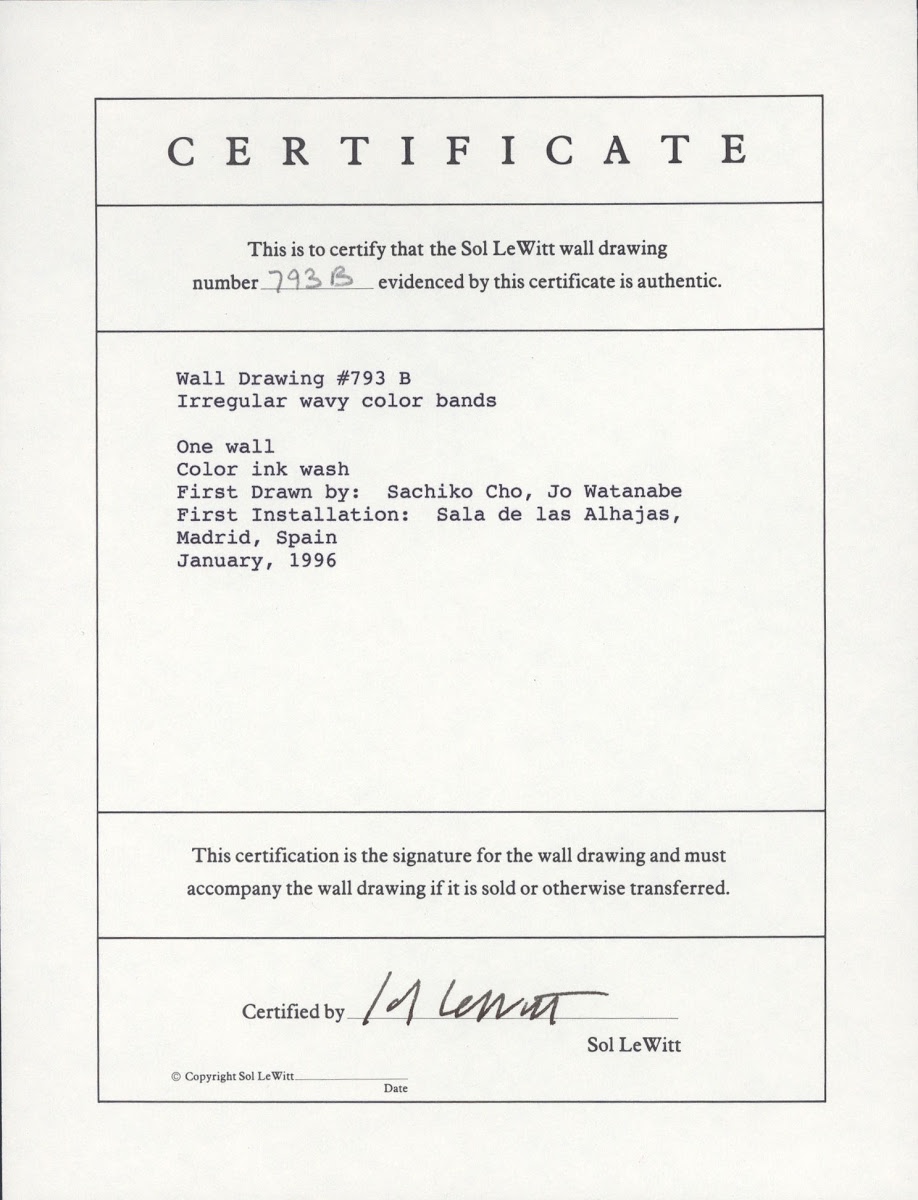
The certificate itself says that it is to accompany the actual work. I suspect the certificate itself, separate from the work, isn't actually worth much.
"Wall Drawing #1136 can be installed, removed, and then reinstalled in another location, as many times as required for exhibition purposes. As such, there can also be periods of time in which the work does not exist in physical form."
For starters, let's take the Autoglyphs (https://www.larvalabs.com/autoglyphs): the smart contract gives a list of instructions for each piece that you can use to draw the final output.
In the NFT case you’re buying a URL pointing to the instructions not the instructions haha, and they can disappear or change and also you don’t own them.
In the case of Autoglyphs there actually is no URL involved. The instructions are stored immutably in the smart contract. However that is besides the point.
How is the mode of ownership of this wall drawing different? The physical piece can change or disappear. What matters is who is recognised as the owner of the artwork an immaterial sense, as evidenced by the certificate.
The owner cares about the piece of paper but not because the typography is so sweet. The piece of paper is not the artwork. The piece of paper is a token.
"A glyph can be created by anyone who is willing to donate the creation fee of 0.20Ξ ($769) to our chosen charity, 350.org."
No, the glyph can be created by anyone who runs the code. And the code is publicly available. The "donation" is completely unrelated to the glyph, yet they try to trick you into thinking that both are connected.
But can't a Sol Le Witt wall drawing not also be created by anyone with a paint brush, by simply following the instructions as given in the diagram (see above)? Which brings us back to the question why the Tate would pay money for the certificate of ownership (and then has to pay people to actually paint the wall!)
The wall drawing can be replicated by anyone, but legally only the copyright owner can replicate it (unless it's for private use only). This is why the Tate has to buy a license from the copyright owner that grants them the right to replicate the wall painting. Why do you find this mysterious?
The Tate didn't buy the license. Neither did MASS MoCA, which owns many Wall Paintings. They bought a certificate of ownership.
The certificate will still be valuable even if the copyright on the work expires. If the artist would work with say WeWork to reproduce this work across their offices, the certificate still has value. The Tate is still able to resell that certificate.
It's actually not clear to me that Sol Le Witts estate could enforce a copyright claim on an "unauthorized reproduction", since describing a drawing in words is not the same thing as actually drawing it. But regardless, the copyright question is entirely incidental.
There is a reason why the guy didn't just drew the damn lines himself, and why his such an influential figure in art history. It's precisely because he intended to interrogate some of these ideas.
Note that even if we suppose your way of thinking about this, in terms of a license grant that will move over to any would-be buyer of this certificate, is the correct one, that means this certificate shown above either a) grants such a license implicitly, or b) a separate license grant is communicated somehow. In both cases, this is still exactly like an NFT, where artists often communicate licenses to buyers of NFT certificates.
I did some research and you're right they didn't buy a license. According to Lewitt himself, Everyone is allowed create a drawing following the instructions. But they did not a buy a certificate of ownership either. They did buy a certificate of authenticity. This is the certificate in question
That's a signed statement, from the artist, stating that the drawing in question was created in accordance with the instructions.
Does such a certificate have value of its own? It depends on whether somebody is willing to pay for a certificate stating that a particular drawing (which may no longer exist) was created according to the instructions. So, maybe yes, maybe no. I don't know why you think this is important though.
Does a certificate of authenticity make sense in the case of a digital image? No, because we can verify the authenticity ourselves by calculating the MD5 sum of the copy and comparing it to the MD5 sum of the original. We don't need to pay a trusted third party to do that for us, we can do it ourselves for free.
Thanks for doing some research! That's all I'd like to see people do.
You misinterpret the practical workings there a little bit. The Tate will not need to buy another certificate if they choose to exhibit the drawing once again, by hiring draughtsman to paint it on a wall once more. It doesn't refer to a specific installation.
The number of the wall drawing on the certificate refers to the design, not the physical object.
Nevertheless, even with your interpretation, you could ask why a museum would want to pay for an artist to provide this kind of certification.
I'm writing this from Frieze Art Fair. There are a number of video pieces here which you can buy. They'll give you a USB drive. They will pinky swear to only sell one of those, to you. And they'll give you a certificate of authenticity. Its supposed to certify that this isn't just a copy of the video that you made. Which isn't to say that you can't make a copy and give it to your friend. She will own the same bits. But only yours is authentic, because you have that certificate. That is what is meant by authenticity.
It's a system the art world has experimented with for a while. These kinds of certificate-based works don't sell that easily either. Much easier to sell a painting. But it's the same system as an NFT and not more or less scammy than that.
If the certificate does not refer to a specific installation it cannot perform its function as a certificate, which is to provide some sort of a proof that a particular installation is authentic. If the artist is indeed issuing and profiting from these certificates it could be considered fraud.
A certificate of authenticity does make absolute sense in the case of physical art (provided that it actually certifies the authenticity of the work, of course), because physical copies are all slightly different. Therefore people may want to tell those that are original, i.e. made by the artist or under their supervision, apart from those that are not. By contrast, there is no such thing as an original copy of some digital information, because a piece of digital information isn't put together by any individual that could claim to be the author of the copy. Even if they could (which they definitely cannot), all copies are identical and impossible to tell apart one from another. Then, what would a certificate of authenticity be certifying exactly? Nothing. It's just a ploy.
Yes, it's a ploy, to create a mechanism to sell digital conceptual and otherwise intangible art that cannot be owned in a physical way.
A ploy that all actors willingly are signing on to - artists, galleries, and collectors. No one is misunderstanding what is going on. People are selling the certificate on the artificial assumption that it represents the art somehow, but you are buying the piece of paper.
It's a ploy to trick unsophisticated investors into believing something infinitely abundant is actually scarce, through false advertising, deception and lies. The NFT industry must be called out for what it is—a rent-extracting industry that preys on the intellectually-challenged. Everybody would be better off if it went away.
have you heard of Hirst's "The Currency"? i suspect that most buyers will choose to burn the physical copy. collectible art is moving to the digital era, and certificates are the scarcity mechanism.
> The way The Currency works is that collectors will not be buying the physical artwork immediately. Instead, they will pay $2,000 for the NFT and then have a year to decide whether they want the digital or the physical version. Once the collector selects one, the other will be destroyed.
When you buy stocks, you think you're buying a share of a corporation. It sits in your brokerage account. Now you've traded money for "something" you can't touch.
The existence of your stock ownership depends on a legal and social framework to exist. If the government was overthrown and you were exiled tomorrow, you have nothing. If an asteroid destroyed half the earth tomorrow, and you survived, you still have nothing.
You take for granted the systems in which you live and function in. There are many things we "own" and cannot touch, yet they are as real as anything. The money in your bank account is an example of that. It has value, you own it, but if we are stranded on a deserted island with no electricity or wifi, it ceases to exist to us.
I guarantee some court of the 27th century will be deliberating the validity of someone's claim on Gliese 674 simply because they have the only documented claim anyone ever bothered to make, in the form of a vacuum preserved slip of foolscap naming their star registry buying ancestor as the owner.
I can almost promise you this won't happen - since star registries have no claim to the rights they're selling. Most star registries I've ever seen are purely about naming and just because a town is named Munkton and I'm the sole descendant of the original owner doesn't mean I have any implicit claim to any of the town land - even undeveloped city land is still held by actual entities.
I will grant it is slightly possible if we have a data destruction period between now and the 27th century. Claims to property after the nazis were overthrown could often be made by jewish residents with very little proof due to the fact that all the real proof was intentionally destroyed. But even those could end up extremely contentious. You can read up on Jewish Restitution[1] and you'll see a lot of really difficult cases that had to be dealt with.
The former is possible on chains where "gas" is a fraction of a fraction of a cent. Even if we're being pedantic there - what, the miners/validators are the scammers in this case?
The latter is not extrinsic at all - it's all in the contracts on the blockchain.
Selling thin pieces of cardboard with images of athletes printed of them, which don't come with any legal rights whatsoever?
Oh, that's the sports collectibles trading card industry.
NFTs on blockchains solve the problem of provenance and permanence.
You need to do a bit of effort and think about why anything is worth anything at all. Why is the Mona Lisa worth millions but a forgery worth nothing, even if they are indistinguishable from one another?
> You need to do a bit of effort and think about why anything is worth anything at all. Why is the Mona Lisa worth millions but a forgery worth nothing, even if they are indistinguishable from one another?
How much is a museum map from the Louvre with directions from the entrance to the current location of the Mona Lisa, signed the museum attendant worth haha.
They are of course distinguishable. One was actually physically created by the artist.
The images the URLs point at are 100% exactly identical, and you do not have the right to the image in question. You may not even have the right to display it to anyone.
You're just buying the plastic sleeves the baseball cards come in without the card itself.
> NFTs on blockchains solve the problem of provenance and permanence.
[edit] Not really no. After all the provenance is on faith that the person who originally sold the NFT is both the original creator of the work (or authorized to sell it) and that they have the legal right to do so, probably, who even knows.
Trust me, the judge is the judge of that, not the blockchain. Blockchains only actually work for concepts wholly encapsulated by the blockchain. Art is not that.
And as for permanence, no, it's just a URL. The contents may disappear, even in IPFS.
> Trust me, the judge is the judge of that, not the blockchain. Blockchains only actually work for concepts wholly encapsulated by the blockchain. Art is not that.
Art is represented and encapsulated by data.
The judge of provenance is society: whatever the buyer deems necessary to prove legitamacy is what sets value. An old rolex with papers is worth more than one without. A rolex that can't be identified as authentic by anyone is worth nothing.
Art is represented beyond just the data itself, it's also the legal rights that come alongside it. However, that notwithstanding you're not buying the art. You're not buying the legal rights to the art. You're buying a URL. A signed museum map telling you where you can find art right now. It may in fact just change to different art at some point in the future or disappear entirely, because you bought nothing.
An old Rolex with papers is worth more than without, but the papers without the Rolex are worth nothing. In this case you're just buying the papers.
> you're not buying the art. You're not buying the legal rights to the art. You're buying a URL. A signed museum map telling you where you can find art right now. It may in fact just change to different art at some point in the future or disappear entirely, because you bought nothing.
Yes, you're starting to get it. You're not buying art, you're not buying legal rights. If the data was written directly to the blockchain, then it is permanent. But even if it points to some temporary host, big deal, the file itself wasn't the valuable part. Data can endlessly be replicated and rehosted.
It is the genuine provenance of an artist that was bought and traded. It is proof representing a work, whatever that artist declares it to be. They could simply resell it again for all anyone knows, but that would hurt them and devalue all their future work.
All value is abstract.
The papers without the Rolex can be worth anything anyone wants to pay for it. Following that rule I suppose fake papers can even be worth something, but most likely not.
I would pay maybe hundred or two hundred for nice indistinguishable replica of Mona Lisa. Not my favourite big, but if it was really really good why not.
The Bitcoin network has produced blocks every 10 minutes since January 3 2009 without fail.
It is a decentralized network that has faced the test of government, natural disaster, organizational and technical risk, etc.
So no, maybe blockchains won't last "forever", but neither of us enough information to confirm either way. My bet is on blockchains outliving everyone typing on this forum.
You seem to misunderstand the comment you replied to.
They agreed that the current manifestation (signed URLs to JPEGs) are scammy, but that is one use of the NFT concept. In gaming, NFTs can represent in-game items with utility and unique attributes that change as you use them. They can be used across multiple games and sold/traded on an open marketplace.
> In gaming, NFTs can represent in-game items with utility and unique attributes that change as you use them. They can be used across multiple games and sold/traded on an open marketplace.
I hear this a lot, but it really makes no sense to me.
An in-game item is really only suited for the game in which it exists. What good is a CoD FN FAL with certain balance, certain damage, certain bullet velocity, certain balance - in Minecraft? Anywhere else really?
Game creators go to extreme lengths to make their games balanced and fun and engaging. Opening up the ability for people to port in legendary weapons from unrelated games seems like the last thing game creators would want, and certainly, it's the last thing I'd want as a player.
Am I missing something? What's the draw?
Then if there's only one source for items, and only one place to use those items, you've got what we call a centralized system. Why would the game creator then want to give away the revenue from such a marketplace to "the blockchain" when they can just do it themselves and have a far more lucrative business model?
CoD items in Minecraft make no sense but imagine two new games adhering to the same metadata in the NFT. Or a new game explicitly made to be compatible with NFT items of another game.
I am building a web based Travian inspired game. It will have nfts for all ingame items and one of the stretch goals is to integrate some other's project nfts. At least in a way.
Main goal here is to get more recognition / free advertising
In addition to the fact that the very idea of NFTs is a scam
This makes no sense. It's like calling the very idea of an Oracle database is a scam. NFT's are basically a consensus-driven shared database, that can be used for legitimate reasons or for scams.
If the Louvre decided to sell an NFT of the Mona Lisa, nothing prevents them from generating another NFT (or a few thousand) of it as well. Same thing for an NFT pointing to an image at some URL and containing a hash of that image, it doesn't actually generate ownership of that art in any legally meaningful (or enforceable) way.
Digital ownership only works for things that 100% stay in the digital realm, and even then it's not a guarantee.
From what I read so far, NFT "ownership" works about the same way as those certificates from the 60s that attest ownership of a plot on the moon.
It's "ownership" of something without granting you any of the perks or rights that usually come with that.
It's not even exclusive ownership - because, while you have exclusive control over your particular token, there is nothing that keeps some other entity from minting another token and declare that it symbolises ownership of the same asset that is symbolized by your own token.
I think NFTs do have some interesting properties. The ownership of the token itself is indeed exclusive - this is enforced through the blockchain. Moreover, token ownership can be verified by software, without any human involvement. This could enable some moderately interesting use-cases, like resellable digital assets: You could imagine an online game where each character is bound to an NFT. You can sell the character by selling the NFT - and the game can restrict access to the character to the current owner of the NFT.
But this doesn't seem to be what's actually done: Instead, NFTs are simply declared to symbolise "ownership" of some real-world asset, without having any kind of actual connection to that asset.
I bequeath to you digital ownership of this string. Let's imagine hn is an immutable forum. It represents a block of gold. What are you going to do with it?
You can now be scammed by the company that makes the game and third party sellers on the blockchain! The future is truly a wonderful and fascinating place.
This is precisely why the "big" NFT games at the moment are all on boutique chains like Flow. They want full control, a % cut, and no secondary markets.
Buying an NFT is most certainly NOT a scam. People do it because they want to. Or is there an approved list of Internet actions that you can provide us with.
Also how is buying an NFT money laundering exactly? Especially if it's done on the blockchain, this seems to be the ultimate in traceability if it's done with ETH, which invariably it will be.
So they get legal ownership of the artwork the NFT points to? Wait, what do you mean they don't? What do you mean all they get is a legally unenforceable digital hash representing that they "own" it in some nebulous way? What do you mean the actual owner of the art can mint a million NFTs pointing to the same piece of art and sell them all? What do you mean someone who isn't even the actual owner of the art can mint an NFT for it and sell it?
But it seems to me you just don't like NFTs. Most people who buy them know exactly what all this is about. If NFTs were "deceptive" in some ways (and of course there are always projects with 10K bot followers that aren't legit),then I'd agree with you. But I think for NFT people, it is what it is.
I can't imagine that a game would ever be improved by having a blockchain waste my electricity as opposed to just having an efficient database store the same data on AWS.
Realistically, these are all just scams, and they aren't trying to improve games at all.
Why would I want my game to be decentralized? That's a wasteful idea. You have to trust a central authority to make the game playable anyway. If you're concerned about the monopolization of computing, you can host the game's servers on Vultr or Hetzner or your basement instead. An SQL server anywhere will be better than an NFT blockchain.
Sounds anti-competitive and monopolistic to deem all games must be centralized and hosted on cloud providers. Regardless of simplicity of hosting it implies a cost and maintenance to those systems. Meanwhile decentralization democratizes that cost to the people using said system.
What you seem to disagree with is peer to peer applications? You can trust the creation of a game but don't have to rely on centralization to play. Conflating the two is a dishonest take.
There are different concerns that would drive someone to make a decentralized game over a blockchain one. That different concern is what I see you failing to really grasp.
I'm struggling to think of any examples of this or reasons for it.
The game in the article is a single-player FPS where the developer mints limited runs of certain items and sells them as NFTs. There's no advantage to the players of any scarcity there even.
Even with blockchain, you still need a centralized source to generate items. You couldn't trust clients to generate items themselves. (BTW, hosting a server is not that expensive, and if you're selling items, you should easily be able to pay for the maintenance with that profit. Asking me to waste my electricity to make up for the developer not wanting to pay for a server is not a very compelling argument.)
And if the game is continually updated or the developer is the only one who can bestow items, you probably have to download updates from the centralized servers anyway to play, either directly or through the blockchain.
If you're looking to play with others you didn't trust over LAN in a place with no Internet, I guess it would have an advantage? But it would only work if neither has gotten an item from anyone else more recently than both were online and there would still be easier ways to accomplish it.
The point of using NFTs in your game is that you don’t have to implement a marketplace yourself and you can just plug in the existing ones. As a bonus people can now trade their stuff from anywhere even outside your game and potentially even across games.
NFTs aren’t any more stupid than the existing game cosmetics/collectibles.
Okay? NFTs are still fundamentally stupid and only exist because people can make money selling worthless...nothings. That meets the definition of "scam" in my book.
Bitcoin at least has theoretical uses, although practically it is definitely a negative force in the world. Their current price does not logically make them useful.
If I buy a license of a game, I gain the legal ability to play the game.
If I buy a print of and associated license to art, I gain the legal ability to look at and resell my copy the art.
If I invest and buy the copyright to something, I can sell the above rights to others.
If I pay to record on a blockchain my ownership a hash, I gain...nothing. I guess I could brag about how I paid money for a hexadecimal string when no one else was willing to? The theoretical advantage is that I can try to pawn it off on someone else for more money by convincing him that he can do the same to someone else.
NFTs are not a copy of the art. On a technical level, they're hashes of the item for which you're paying to store on the blockchain. You can't get the original work from a hash, only verify the accuracy if you already have both. Then on a legal level, you do not give you any legal right to even view the art. The artist isn't signing you a license to copy the work, and, as described, a hash is not a copy for which such a license could be implied.
If you buy just an NFT and send the US registered artwork itself along with it to the buyer, that's copyright infringement, and the original artist could sue you for thousands of dollars.
If the art is digital how and the artist agrees that editions of the NFT represent a copy of the art how is an edition of the NFT not a copy of the art?
Because it's factually not. You can't get the art from the hash. It's one-way. That's the whole point, to create artificial scarcity and non-fungibility.
Since it's not actually a copy, there's no first sale doctrine license to the copyright, making it illegal to have a copy of the art unless you have a separate licensing agreement. And if you do have such an agreement, that's the thing giving practical value.
You and I can agree that a rock represents your car, but I'm still not going to pay you for it.
There is in practice no first sale doctrine for digital images; the first sale doctrine gives you the right to distribute your copy, not to make your own copies; and you can't transfer a PNG to your friend without making a copy. The first sale doctrine deals with the intersection of copyright with physical copies of a work.
This is why no one is buying and selling digital artworks, except using an artificial concept of ownership - a certificate. The artworld has done it with paper certificates for a long time; NFTs are the same thing.
> This is why no one is buying and selling digital artworks, except using an artificial concept of ownership - a certificate.
You seem confused. A certificate does not grant ownership. The reason nobody is buying and selling digital images is because producing an exact copy of a digital image costs nothing, which means it's irrational to pay for a copy of an image since you can make a copy yourself for free.
Because a "copy of the art" is a work of art that is the same as the original art and an NFT is not a work or art and is not the same as the original art. An NFT is a virtual token, than may or may not contain some metadata. This is not the same thing as the original art. Therefore it is not a copy of the art.
You mean games that have been doing just fine with just usual microtransactions? Sure big publishers are going to throw that away and switch to NFTs because... Why exactly?
Are there any surveys or something on how much gamers care about NFTs in their games? Because if there's no such data I can't think of a single reason for publishers to care about this.
No, the concept sounds neat and impractical, but I don't care much about it.
The implementations get me a bit angry.
They enable criminals to extort and launder funds.
They've led to massive profits for speculators at the expense of ignorant people throwing their own money into the bubble.
They haven't benefited the average person at all.
Bitcoin wastes monumentous amounts of energy, raising the price for everyone else and further polluting the earth; it has wild value fluctuations, making it completely unusable as a currency; and it has no underlying value.
Then NFTs aren't even really ownership. You're buying the right to record a ownership of a hash. It just makes people feel like they own something unique. If you actually want to buy a digital assets without an intermediary, you contact the creator of a work and have him e-sign a contract giving you the copyrights in it. Boom. No need for a intermediary like OpenSea to skim its 2.5% off the top like NFTs do in practice, and you actually gets real rights in the work. People just don't do that because they don't want to actually give up something of actual value, they just want to rip people off, and because it's boring. NFTs are just a fad.
I personally see lots of value and potential for smart contracts. The current NFTs making news for the highest transaction price are are terrible examples of that value and appear to be scams - they provide no significant value. It looks like speculation and greed without significant additional value. The only additional value I have seen so far appears to be the equivalent of a country club membership when you buy certain NFTs.
I suspect there will be more opportunities for NFTs to change my mind in the future with governance, but that risks them stepping into SEC governed territory.
More realistically, Steam is scrambling to develop their own L2 they can control to prevent secondary markets. HN seems blissfully unaware of how much momentum there is in crypto and the larger web3 space right now.
Web3 gaming, meaning decentralized games in the browser on the blockchain is the future. No 30% cut from walled gardens, and direct distribution for developers to their end users.
What makes these games decentralized and how are they different from hosting your own http server for distribution and taking crypto for payments?
Or is "decentralized games" a marketing term for just that?
I don’t understand the distinction. You can sell a game on your own website today without using any of these technologies if you want to avoid walled gardens.
TF2 items are not NFTs. They're just entries in Valve's databases. There are several times where someone hacked someone else's account and stole hats which Valve returned, and I remember at least one time when a bug gave out hats by mistake and Valve trade-locked them to prevent the abusers from tanking the market and profiting from their abuse.
Oh I suppose not all of them are differentiable, so they would be fungible. I thought they had some that do things like track ownership/number of kills etc which would make them non-fungible & I'd say they are tokens.
If you're trying to convince me microtransactions are bad, I'm on your side. I'd like to see Valve just outright ban microtransactions as they are not only predatory, but also arguably a violation of ADA.
One could argue that's better, too - for instance in support of AML, KYC and the ability to reverse erroneous transactions - but the point I was making is that they aren't basically the same thing in this case.
Digital asset should not be worthless if somebody put some work into creating it.
By your definition YouTube videos are worthless, but companies, individuals and Google burn a lot of gas to transport staff and tech, and a lot of electric energy to record videos, convert them into several formats and host them to billions of people.
The asset isn't the image, it's the certificate of authenticity.
> [edit] By your definition YouTube videos are worthless, but companies, individuals and Google burn a lot of gas to transport staff and tech, and a lot of electric energy to record videos, convert them into several formats and host them to billions of people.
Literally nowhere close to the amount of energy expended by blockchains, and they achieve far, far more. The mental gymnastics to justify the sheer global scale of the waste continues, I see. Also, this is just straight up whataboutism.
Based on what I found about Youtube energy consumption, it's somewhere in the 6.38 - 100 TWh range [1] .
If most blockchains (perhaps excluding Bitcoin) moved to Proof Of Stake and cut their energy expedinture to cumulatively use less than 200000 MWh per year, would you consider using them?
CS:GO Skins are semi-fungible Tokens. StatTrak™ skins with counters are complete Non-Fungible Tokens. There's some game that happens to recognize them for in-game use - That's just as true for "NFT Games"
What Valve has banned is NFTs not using Valve's Tokens. It's not because they're decentralized, because I'm certain that NFT games using some other company's centralized platform would be just as unwelcome.
Is this "moral" of valve? No, I don't think it has any high horse moral standing. I think it's practical because Valve has to work with legal frameworks for virtual goods and they can't guarantee that any other token standards work within those frameworks.
All of this is just to say: Digital goods are stupid. Stupid can be fun - I own dozens of skins for various virtual games that i have bought with real money. I also understand that I "own" nothing and could lose them all at any point. I don't care, because I know they're stupid. Anyone trying to sell them as anything but stupid fun (and most companies are, Including Valve, though I think they're the best of the bunch) should be fined for doing so, and draw the ire of consumers.
A lot of NFTs are backed by IPFS URLs. Some are pure on-chain SVGs.
But even the ones that are mere API URLs are still far superior to arbitrary, closed-standard in-game proprietary marketplaces that prevent user ownership and exchange of digital assets they've earned.
What if Steam rugpulls your game that you spent 2 years of your life working on? Can't do shit about it. Say what you will about crypto but plausible neutrality of the platform itself is a huge win for content creators and users.
I’m not against this move, Valve reserves the right to vet any product they have on their platform. The PC is an open platform, and unlike say ios, there are alternatives including plain old shipping a binary. Valve has made significant leaps with Windows compat in Linux with proton /wine/dxvk
Valve seems like a good player that is helping open systems. Good guy gaben
Blockchain games are probably not going to be distributed as PE/ELF bins anyway. They will be wasm delivered via the browser and interact with the web3 wallets.
The closed economy of steam has never liked attempts to take value “offshore”. It’s probably for the best for platform integrity.
Performance concerns aside, WASM + WebGL has never looked sweeter. Zero trust required from the user and no walled garden. File this latest incident with the other app store shenanigans.
There’s nothing stopping you selling downloadable games on your own web store either. The hard part is actually reaching an audience and then monetisation (and chargebacks). The ‘Steam effect’ is very diluted these days but a hell of a lot stronger than going without which is why everyone is still there.
Nope and it's even easier now that Web3 standards like ERC721s and Ethereum exist. It's a few lines of code to make it so that users can sign and pay with crypto, so you don't have to go through third party gatekeepers.
That just adds a further complication that you need to find people that want to spend ETH on a game download rather than a speculative asset to hold or flip.
Yeah, WASM and WebGL could use a fresh boost like that.
Once they get proven in games we can finally start getting rid of legacy stuff like HTML, CSS, JS and start innovating again.
100% this. With all the talk of web3 and gaming, WebGPU + WASM + WebXR is the path forward to the metaverse.
No walled gardens asking for a 30% cut, direct embedding of games inside a developers site, and for players they don't have to install anything locally. This is what my startup is building with our browser-games platform.
The fact that by having a wallet you already have an pseudonymous account with every dapp that will ever exist is an exciting concept. Likewise, the developers don't have to really think about authentication or authorization or payments.
You know you can just host game installers on your website today right? A big part of Steam's value is that you don't have to build your own distribution infrastructure, which you will still need even if your game is just a big ass WASM file.
I can't imagine it will be easy to get low latency silky smooth 90FPS+ out of WebXR, even with a pure WASM app. Being at the mercy of the Chrome devs sounds like a challenge.
Aren't the on market listings limited to something like 1700€... Real pain I noticed when trying to realise the gains. Ofc, you could run multiple accounts, but still...
Now I know why they "retired" our recent game in progress that had two QR codes in it that linked to an NFT for the game. Steam was TERRIFIED of our little erc721 token haha.
What i suspect you don’t like is having games in a walled garden at all then. Because app stores need rules of some kind, as they are liable for problems. The internet itself isn’t.
what do you mean true ownership? the only thing you can truly own on a blockchain is something that is internal to said blockchain. you get absolutely zero protection for things that are external to that blockchain. if you take a game like hearthstone and create nft's for the cards, there is nothing about an nft on the ethereum blockchain(or any blockchain for that matter) that restricts blizzard's ability to take your cards from you, inflate said cards supply, destroy said cards or give said cards to another person even if it violates the state on ethereum. for things external to said blockchain particularly when it comes to centralized products and services it offers no guarantees over what you would get from a centralized database.
There's an interesting social consensus that seems to emerge around provenance and originality of NFT contracts.
Some NFTs are extremely valuable (e.g. Crypto Punks) and attract many clones. The clones may be on the same blockchain and have very similar or even identical art. Or, the clones may reuse the same art but issue tokens on a different blockchain. In all these cases, the social consensus on the value of these clones is approximately $0. It's a weird psychology.
i agree, when it comes to things like cryptopunks consensus is what decides what is authentic and what isn't. i still think they are stupid, but i'm at least sympathetic to the argument of ownership and authenticity. you still own nothing more than what exists on the blockchain though, which is self evident based on the fact that people can make all of these clones.
when it comes to hearthstone blizzard decides. you can have every single nft on the planet, but if blizzard decides you dont get to use those cards in hearthstone you 100 percent absolutely don't get to use those cards in hearthstone.
> when it comes to hearthstone blizzard decides. you can have every single nft on the planet, but if blizzard decides you dont get to use those cards in hearthstone you 100 percent absolutely don't get to use those cards in hearthstone.
NFTs are just as useless. I can sell you the NFT for the original doge Shiba Inu, and I can sell Bill the actual legal rights to use that photograph.
Despite you owning the NFT, you can't actually use that photograph. Bill can. And he can sue you, and win, if you try to.
All that ownership of the NFT entitles you to is... Ownership of the NFT. It's like owning a photograph of the deed to my house. It doesn't mean that you actually own my house. You can keep reselling that photograph, but it's not going to get you any closer to owning the house.
But eh, we can burn a lot of electricity to certify that you do, in fact, own that particular photograph of the deed. Fantastic. Meanwhile, I can take, and sell more photographs...
I think this why there is an increasing trend towards valuing NFTs which assign rights to the NFT owners or simply license the whole project as CC0. That removes the dichotomy between on-chain ownership and legal ownership and leaves only a socially constructed notion of digital property and value.
The idea in blockchain gaming is that the NFT is the in-game item. An NFT would represent that powerful weapon, not the picture of the weapon, and the game would look at the blockchain to understand what items you own. The game can use any image it wants to represent that item, and other games may choose to display them differently. If I sell the NFT to someone, I no longer have access to that item in any game but the buyer does.
In this situation, the NFT does come with usage rights (like a license) and isn’t the same as selling a picture of your house.
There's no point to doing any of this when the game could just keep track of this in a traditional database.
The only benefit is having a 'public' API for ownership of an item that other, third-party games could use, but why, as a game developer, would you possibly give any rando third-party competitor full access to this information? It makes sense if you are curating a community of fan-made tooling that ends up promoting your game, but it makes zero sense to give competitors access to it.
Imagine a Hearthstone-clone that pitches it as: "Join our game! You have every card that you own in Hearthstone! And a <gimmick>."
Do you think it would be in Blizzard's interest for that clone to exist? Do you think it would be in Blizzard's interest to go out of its way to turn its player's cards into NFTs, so that some unlicensed Martian knock-off goes ahead and makes that pitch?
It is in Blizzard's interest to share this information with someone that they have a partnership with (or with another game that they've developed), but that problem can be solved by... An API. With revocable keys.
> the ability to make real income off of your time investment in a game is huge.
RMT (real money trading) ruins games, most MMOs ban people for this. It encourages botting and devalues the in-game currency making it hard to play/enjoy the in-game activities because the rewards are so low compared to what paying a RMT seller $1 could give you
as someone who has played magic the gathering for over a decade the secondary market is easily the worst part about the game. needing to worry about a card you spent 100 dollars on getting banned and dropping to 10 dollars over night or needing to make speculative pick ups in an attempt to save money sucks. like a LOT. I just want to play a game, not be a speculative asset day trader.
I am going to disagree and I suspect making money in the sense you are talking about will be globally banned over time. Any time real money is attached to a in-game currency it is a massive failure and ends up devolving into a scam/fraud situation. WoW filled with auction house farmers, Diablo 3 same thing, Fortnite is just a money printer for Epic and that's it.
Not only that crypto is already littered with scams and fraud. As soon as you start hooking up "central" nonsense to it, it will just amplify it.
Making money will be banned globally? We banning capitalism, now?
There is nothing different about a user purchasing a digital asset on the speculation that it's price will increase than on rare coins, stamps, trading cards, race horses, real estate, pork bellies, etc.
There is a difference in someone collecting some stamps or cards and then reselling them later in live. And someone hooking a ipad game to a crypto coin which can be directly exchanged to USD.
One is a casual thing people do and another directly links you playing a game to generating income. You farming your virtual garden for gems every 15 mins which can be translated to USD over time is a impact on society, and not a positive one. Random guy collecting stamps on their spare time is not. And once that happens you'll have people playing 24 hours and setting up all kinds of scams. At some point politicians will get involved and treat it as a threat, thereby banning it. It's a hypothesis and nothing more, but I wouldn't be surprised if it happened.
> There is a difference in someone collecting some stamps or cards and then reselling them later in live. And someone hooking a ipad game to a crypto coin which can be directly exchanged to USD
No, there isn't. Both are free market activities that are arguably arbitrary, but entirely within the realm of human hobbies and curiosities that sometimes yield profits for the participants.
> You farming your virtual garden for gems every 15 mins which can be translated to USD over time is a impact on society, and not a positive one.
It's entertainment value that is produced, and who are you to be the judge of what is positive or negative? It is entirely arrogant to declare for others what is positive or negative for society.
I grew up hearing the same thing about video games. Waste of time for kids, them being a dangerous exposure to violence, etc. etc. But meanwhile parents were wasting their lives away watching television because that was the thing for that generation. Games to me, were far more engaging and interesting and most importantly, interactive. And that interest in gaming eventually led me to become a software engineer, which has afforded me a very nice lifestyle and given me very solid job security. If I had watched television instead of venturing into the world of technology, I'd be worse off.
Later on in life, as an adult, I still play games. I sometimes spend significant sums of money on them, because they still provide enjoyment to me. Sometimes, I'll even spend a couple hundred bucks on a single game, because I want some cool thing in the game and that provides me joy. That is perfectly ok.
The fact that NFTs provide an interface for interconnecting these in-game items and making it easy to create ecosystems for things like creative character models or environments or mod experiences, is not subtractive in the least. It provides an outlet for creativity and a market for art and entertainment. And it does so in a way that does not enshrine or reinforce existing monopoly marketplaces, which are exploitative to the highest degree for both users and creative producers.
Err, no. People work for companies farming assets, xp and so on in a variety of games and then sell the accounts on the grey market. For normal games. In the NFT space Axie Infinity has a very similar model and similarly targets people in poorer countries with a pay to earn model although their currency was collapsing last I looked. Although it’s intentional rather than something games companies want to avoid it’s not actually mechanically that different.
Moat owners be defending them moats. They're so much more well established they can change their positions in a few years if need be or absorb them. Boring for sure but expecting the app store of games to follow almost-not-developed speculative stuff is a bit optimistic. In 10 years of course you'll have them in steam store that's a given but in the space until then I fully expect 99% of them to lose 99% of value or more.
If you’re serious about your project, you should set up a website or something outside a discord server. I hate cluttering my discord with all these projects and games that insist you join their discord to “learn more”
There is a website, and it's here - https://digiplaygaming.com/, but it really doesn't contain any worthwhile information. "We'll host your web game" - okay? But I was doing that back in 2009 when I first sold a license to my first commercial flash game. It's not hard to embed a game in an HTML document. Clearly NFT's and crypto stuff feature somewhere in there but it's not spelled out, and because it's not spelled out I'm instantly 100% suspicious.
Yeah looking over the site I guess I understand why the discord was linked instead. They may or may not have killer ideas/tech, but the website fails to explain how it’s much different than the flash game sites of yesterday.
Edit: So I was planning on adding an edit with my thoughts after viewing the correct website, but my points mostly still stand and now I’m confused because both sites are like 70% the same..
I see the insanity of replacing forums with discord is really catching on now. Maybe people do want to be constantly distracted and unable to search for organised information?
I think it happens because of reddit. A subreddit sucks compared to a forum, yet it's close enough that separate sites have an extremely hard time getting users due to friction. A discord is different enough that reddit isn't a substitute and most people already have accounts, while providing what reddit lacks the most - personal identity and human relationships.
I agree with all that, the issue for me is when I simply what to peruse info and am forced to join their community. An annoying case for me was a game dev that only posted parch notes in their discord as opposed to a dev blog or something.
I think for me a lot of the pains would be solved if discord allowed a guest mode to temporarily view a server without the (admittedly small) hassle of having to leave the server
You should see some of the highly automated, well-organized, well-run discords out there. It's pretty eye-opening and takes some getting used to, coming from a forum-centric world.
It's a very "boomer" decision. I mean, I can understand Valve trying to protect their users against the unknown, but blockchain games / play 2 earn / metaverses are pretty much the future.
Just imagine VRChat with unique collectibles, immutalized on a blockchain like Ethereum (so the item and the owner is completely verified), and being able to trade them for real money.
It's like when Diablo 3 had a real money auction house. They were early, we still are, but these kind of game features will be the general norm in some years.
So Valve will probably evolve in the future and accept them, when the space looks safer.
Wow, hang on, you're bringing up Diablo 3's auction house as... a positive example?? That's a new one. It was, and still is, widely agreed to be a colossal, almost game-sinking failure, and Blizzard couldn't shut it down quick enough, once they understood the ramifications of their decision:
I understand that many people are genuinely excited, and not everyone is trying to perpetuate a scam, but it's hard to be convinced when all arguments I find in favour are variants of vague references to "the future" and sentences starting with "imagine". No real "NFTs are a better alternative for X", and no convincing descriptions on what they can do that don't lean heavily on handwaving at some step.
I'm sorry, but the emperor is really walking around with his buttcheeks flapping in the wind.
Disclaimer: I've never owned or bought a crypto thing in my life.
Most of the biggest games in the world run on selling skins, the natural evolution of that is going from a position where a game developer says you own that skin because there's a record in their database to a position where you own that skin because you have the NFT and the developer recognises your NFT.
It gives portability to something that already has massive massive demand. I do expect gaming crypto currencies and gaming NFT's to absolutely dwarf everything that came before in the crypto space.
The thing is, when a skin's ownership exists in a developer's database, that means the only way to get a skin is to buy it directly from the developer. EA doesn't want you to buy a rare FIFA Ultimate Team player from another FIFA player, they want you to buy a bunch of Ultimate Team packs from them directly. Only Valve really enables any reselling, and that's only on their closed platform, where all the money ends up back in Valve's pockets.
In addition, a lot of game developers are already under scrutiny about gambling-like mechanics in their games (e.g. loot boxes). Turning this stuff into NFTs just makes it easier to cash out, which only makes the comparisons easier.
The only people actually making NFT-based games are small developers using it as a marketing tool, or people using these games as a means to promote their NFT project. No large developer is making any major investments in this space, because it isn't a path to making more money then they're already making.
I don't disagree, major developers won't use it any time soon. I expect smaller devs will see it as a way to monetise their games. Bear in mind there's a multitude of early access games, the PUBG's, the RUST's, the entire survival sandbox genre who are candidates to adopt NFT's/crypto game currencies.
Big established companies never adopt tech like this until they're forced to adapt.
> I would argue these "metaverses" are the scams of the future
Don't throw the baby out with the bathwater. The concept of metaverses have existed long before the cryptocurrency/ICO/DAO/DeFi/NFT community co-opted it. Same way they have, unfortunately, co-opted the term "web3" in current vernacular. It won't last though.
I suspect it'll be too late. There's enough money sloshing around inside the crypto ecosystem for someone to build a crypto friendly steam and I think there'll be demand for such a platform imminently.
One big hit, one CSGO, one pubg and there'll be a competitor to steam that the likes of Epic can only dream of.
You are missing the fact that people who aren't hyped about crypto don't see it as a feature or a reason to switch launcher.
Epic hinged on being able to bring in tons of costumers to the Epic Games Store using Fortnite (A bigger than big hit), but they have not really managed that.
Just like that, a crypto-friendly games store wouldn't be able to bring in enough costumers, even with a really big hit, to touch even the amount of people the Epic Games Store has gotten (freebies definitely helped them).
Epic didn't fundamentally offer anything different from Steam, it's just games that would've otherwise been on Steam that epic bribed to be on epic. That from the outset annoyed a lot of people and the funny thing about fortnite is, the people who play it... only really play it alone. So getting them onboard doesn't necessarily mean they'll buy anything else on epic.
In terms of getting people on board, I expect it'll come down to how much content gets pushed out by streamers and youtubers, if a game's hot on twitch people will likely at least try it, especially since I'd expect most crypto games to go f2p.
> Epic didn't fundamentally offer anything different from Steam
And for the vast majority of gamers, neither does crypto.
> the people who play it... only really play it
And the same would apply for a crypto friendly games store that had a big hit game.
One thing I wasn't aware of, which I only just learned/realized from seeing worried conversations from a game I follow (that incorporates crypto) is that because of all the negative news about crypto, the general public view crypto quite negatively.
I feel like crypto will need to spend a few years as "boring" before it can truly shine.
I don't think crypto will never truly shine. I see two use cases illegal things and remittance/inter-market transfers. Later could be solved, but on other hand demand from regular people is low and existing players like PayPal and credit cards already take care of purchases from commercial entities.
For me it is just bad solution looking for a problem.