I'm finding the response people are having to this mail in voting thing to be...puzzling.
It's not a ridiculous thing to wonder about how susceptible mail in voting is to fraud, and it seems like some of us are putting blinders on simply due to our distaste for the current president.
If we were to hold a hackathon with a $100,000 prize for the most plausible path to exploit mail in voting in order to swing an election, are people implying that there would be no entries? Or maybe no viable entries? That's ridiculous.
Here's some spitballing: (eh, I removed this. I don't think brainstorming how to committ election fraud is a good idea. I'm assuming that readers of hacker news can probably figure out some relatively obvious ways of casting doubt into the outcome of a mail in election)
How are people looking at what recently happened with 100s of millions of dollars of fraud being committed against various US unemployment systems, and not thinking that other systems might be at risk as well?
Remember the Iowa caucus? That was a hastily put together vote reporting system, not even meant for tallying, and look at what a disaster it was. Now we're expecting that states will radically alter their voting system, in 5 months, and that it won't be vulnerable to interference?
To be clear: I LIKE mail in voting. I have permanent mail in voting status in my state (Arizona), and my wife and I usually get breakfast at our favorite restaurant and spend HOURS meticulously researching every candidate and BI on the form. Being able to take that amount of time is fantastic, and a luxury I wish everybody could have.
But it doesn't have to be so polar. I like mail in voting, obviously, but I'm not so stupid as to think that it cannot possibly be criticized. I am a hacker after all.
Boo to twitter for this. This is twitter obviously putting their finger on the scale of an election, and after all of the drama surrounding the idea that foreign actors might have purchased a few 10s of thousands of dollars of facebook ads, I'd hope that Americans would have a distrust a company where foreign entities have a major stake doing such a thing. Not acceptable in my opinion.
>Yet votes cast by mail are less likely to be counted, more likely to be compromised and more likely to be contested than those cast in a voting booth, statistics show.
and another:
> Election experts say the challenges created by mailed ballots could well affect outcomes this fall and beyond.
And another:
> The trend will probably result in more uncounted votes, and it increases the potential for fraud. While fraud in voting by mail is far less common than innocent errors, it is vastly more prevalent than the in-person voting
So who is to be believed here? Twitter? The New York Times? Why aren’t the experts from this article being listened to?
There is no need to do this much intellectual work on behalf of the president.
If he has an argument to make, let him advance it. If he fails to make a compelling case, it's not our job to look up citations and write paragraphs to fill in the gaps.
Also, please remember the context. The only reason so many states are considering mail-in voting now is because they are concerned that huge numbers of voters will stay away from physical polling places.
This is not a matter of "pick the theoretically best voting system." This is a matter of "how can we hold an election without accidentally killing thousands of old people by communicable disease."
I don't have to think that mail-in voting is perfect to prefer it over radically depressing turnout.
I could accept that argument if it were being made in good faith, maybe there is some real evidence that mail in voting is more susceptible to fraud. But the argument is not being made in good faith, the argument is part of a long on-going coordinated effort across Republican governments at all levels to limit the people's right to vote.
The issue is that mail in voter fraud doesn't scale and you need scale to turn a national election. So you can argue this is a concern in general, but someone arguing this is a real problem for the integrity of the 2020 presidential election is being disingenuous at best.
Elections are run by the states, not by the Federal government. If Washington, the 13th most populous state can conduct elections purely via mail-in ballots, why not any other state?
>Elections are run by the states, not by the Federal government.
Sorry, I was talking about national scope and not the federal government actually running the election. The larger the electorate, the more votes cast, the more votes needed to change the results, and the more important scaling becomes in your plan to rig the election.
> If Washington, the 13th most populous state can conduct elections purely via mail-in ballots, why not any other state?
Is this true? I don't think it is, and I think that has been borne out in several of our most recent presidential elections. In the last election alone, Clinton won NH by a mere 2700 votes, for instance.
OP edited their post, but they were talking about methods to change maybe one or two dozen votes at a time. The minimum number of votes that you would need to reverse the 2016 presidential election was 107k. That was if you had perfect polling going in and knew exactly what votes to change. In practice you would likely need to change several hundred thousand votes if not over a million. This process would need to be done in multiple states all over the country. You would need a large distributed team of people all committed to defrauding an election. That isn't a smart plan for a conspiracy.
Online voting could be vulnerable to such an attack but paper-based voting such as is used by mail in voting is very low tech and distributed. hacking and fraud are hard to scale in that case.
So, every mailbox in a post office gets one or two voter applications or ballots. A bunch of them get sorted out and thrown in the lobby trash can as people pick up their mail.
Some unscrupulous person grabs a bunch, forges signatures on them and mails them back in.
I mean, its hard to say that no voter fraud isnt going to happen...
but for it to happen in any meaningful way is super super unlikely as most other democracy's around the world can attest to.
he's technically right, but its not going to be in the order of even 1%. even if EVERY person in the US voted by mail, fraud on a level that would less than 1% of the entire vote.
Its a stupid blatant obvious ploy to try and gerrymander the vote.
Yes and I live in Arizona and mailed in my ballot for the 2016 election. The point is not that it is possible to do some mail in voting. The point is that it isn't ridiculous to think that mail in voting could be succeptible to fraud. Certainly not so much so that twitter should be trying to influence an election in this way.
Except that we have several years of experience with mail-in voting in states like Oregon, Washington and others. No one has ever uncovered any impactful voter fraud.
Paper-based voting like this is very hard to hack or commit fraud on a scale that is large enough to have an effect. If you were to fill out your aunt’s ballot, as someone suggested, it would have a nearly unmeasurable effect.
There are lot of interesting rules about such ballots. For example, some states do not count them at all unless the margin of victory is less than the number of eligible or returned absentee ballots.
I think most opponents are not questioning the possibility of hacking mail in election systems. I don't know if the idea you posted would have worked because lots of people can spitball ideas without fully thinking them through. Even so, proponents contest the likelihood of that happening balanced against other considerations, like the disenfranchisement of those who cannot or will not reach a polling place for health reasons.
There is also the question of differential susceptibility. Sure election fraud is possible with mail in ballots. I'd even stipulate that it's easier than casting fraudulent in person votes. But I think it remains to be answered how easily it can be scales, and whether the rewards are worth the risk this would pose to perpetrators' freedom.
I think it's reasonable to wonder if mail-in ballots are susceptible to fraud, but there is not a lot of evidence that such fraud is widespread. In particular, Trump's tweet is completely off base with what election experts already know about voter fraud.
> Now we're expecting that states will radically alter their voting system, in 5 months, and that it won't be vulnerable to interference?
Are mail in ballots for everyone really a "radical alteration" of their voting system? Local governments already have the capacity to send and receive thousands of pieces of mail, and the method of counting ballots is the exact same.
I am not sure whether there has ever been mail-in voter fraud, but it seems like the relevant agencies actively or passively avoid collection of data which might demonstrate or disprove such fraud. Absence of evidence is not evidence of absence.
>Are mail in ballots for everyone really a "radical alteration" of their voting system? Local governments already have the capacity to send and receive thousands of pieces of mail, and the method of counting ballots is the exact same.
How would you set up this system if you were tasked with it?
Every state already has absentee voting. I would expect that the system will follow the same procedures as already exist for absentee voting, hiring more clerk and postal staff as necessary.
The same as normal ballot counting, except instead of receiving in person ballots, volunteers count mail in ballots.
Sending mail and receiving mail is already a solved problem. The post office handles nearly half a billion pieces of mail each day, and 200 million pieces of first class mail.
It's not a ridiculous thing to wonder about how susceptible mail in voting is to fraud, and it seems like some of us are putting blinders on simply due to our distaste for the current president.
You scoff at the reaction yet you've surgically extracted the political context of Trump's motivations for disparaging mail-in voting from your analysis. There isn't a new developing threat to mail-in votes, Trump has a clear political agenda. In Trump's own words a couple months back:
The things they had in there were crazy. They had things, levels of voting that if you’d ever agreed to it, you’d never have a Republican elected in this country again
Can you at least pretend to understand why some people might have a hard time accepting Trump's credibility on the issue?
You could literally make the same argument about in person voting. How hard is it to get a fake id ? How about hacking ballot machines ? How about compromised ballot counters ? Yet, there is this weird focus on mailed ballots, which really should be default in a 21st century democracy. Trump is arguing in bad faith
> Yet, there is this weird focus on mailed ballots
It's not that weird. Mailed ballots can be coerced quite trivially at home, out of the view of authorities; no technology hacks or fake ID needed. That's why some of the "fact check" figures themselves are nonsense , such as the one claiming that only 0.00006% of mail votes are fraudulent. That's based on convictions. Nobody knows the real number.
In Northern Ireland postal voting is strictly controlled and monitored and permitted only in individually-reviewed case, because we had decades of coerced fraud by balaclaved men with baseball bats.
I'm more curious as to why you're giving Trump such a high benefit of the doubt giving his rampant lies in the past.
The reality is that most mail-in voting operates via what is effectively a two factor auth system or a handshake authentication system. Person A gets official mail being told they can register to vote. Person A goes to site and registers to vote. Then they receive a ballot sometime before election day, fill it out, certify that they are who they are, then it goes out.
The government can send a further correspondence indicating that you voted and where to check your vote to confirm. If someone attempts to vote multiple times using the same person this is easily verified. If the dead vote, you can cross-reference with obituary data to identify identity fraud. If someone votes for someone else (like their parents or their siblings) then that can be somewhat identified through the final check and letting people file a claim.
The reality is that actual fraud for mail-in votes is incredibly low and committing mass fraud requires the fraud to occur at the point of ballot counting. At which point you have a politician issue [1] not a voter issue. Which again, is pretty easily caught. The increase in mail-in fraud is likely offset by the disenfranchised voters that could gain the ability to vote as well as the voters in areas without easy access to voting booths.
It's frustrating that you think I'm giving Trump some credibility here. I'm not. He's an idiot, but that doesn't mean it is appropriate for twitter to behave this way.
People have been voting by mail for decades, in the US and many other democracies. There haven't been any incidents. And, yes, I am convinced wide-scale fraud would be almost impossible to hide: you can't pull off any fraud without, for example, many voters turning up at polling places even though they have been mailed a ballot. Or people noticing the voter rolls show them having voted when they didn't. Or whatever scheme you are using to intercept thousands of individual letters addressed to individual residences being noticed. Or sudden, unexplained changes in participation being noticed. Or many dead people somehow voting because you can't possibly stay up-to-date with all recent deaths in the community.
And, of course, the discussion isn't actually about voting-by-mail, yes-or-now? Because that has been possible for a long time and isn't going to change. The discussion is about making it easier and/or the default to protect people from communicable diseases.
The issue, then, isn't even if voting by mail allows fraud. It's if the likelihood of fraud is significantly higher when, say, 50% instead of 30% choose that option.
This is yet another blatantly obvious attempt to stack the deck in Republican's favour. It's sickening to see people pretend to care about the integrity of democracy by engaging with all these phantom debates about voter fraud, in the complete absence of any actual fraud happening (except that Republican in South Caroline, of course).
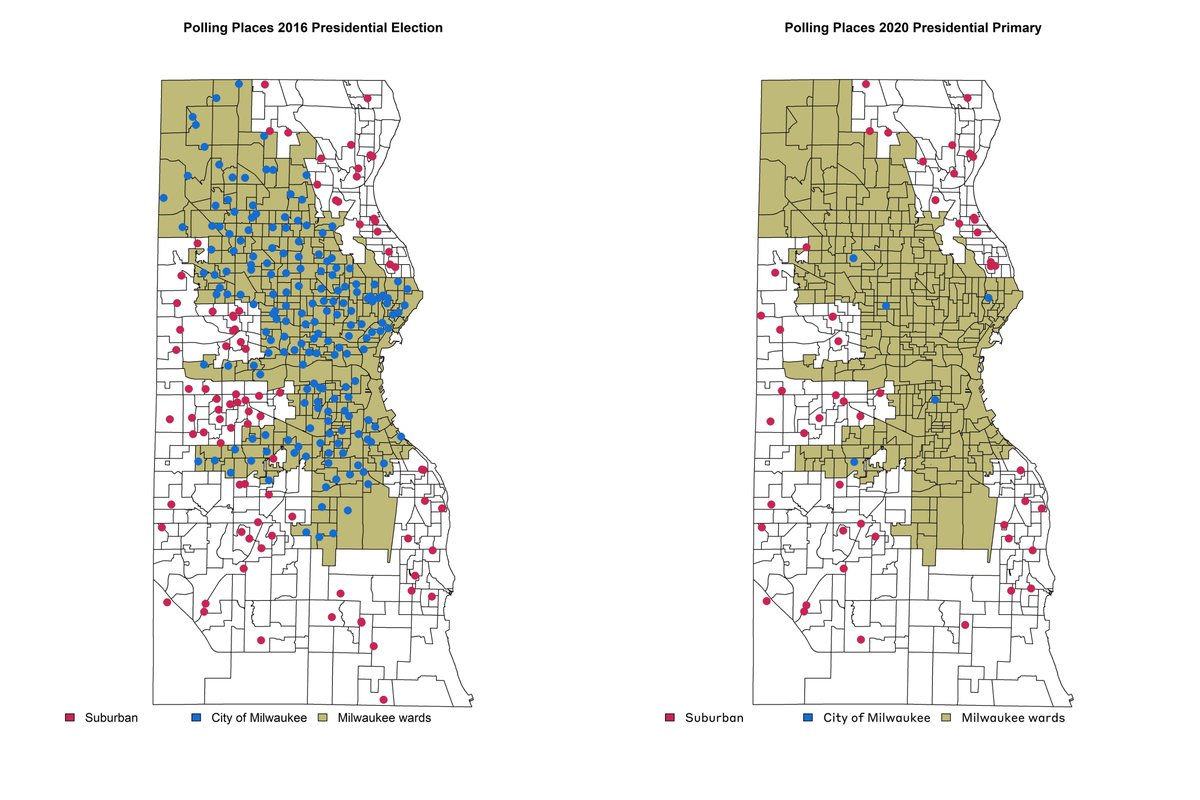
Meanwhile, real damage is done to democracy by the unrelenting attempts to selectively make it harder for people to vote. Take a look at these changes in polling locations in Milwaukee for a blatant example (the red, suburban spots are predominantly Republican locations, while the urban core leans democratic) : https://pbs.twimg.com/media/EYoIrdZXQAILKlB.jpg
So 0.000001% of votes were fraudulent if you take the Heritage Foundation's analysis as fact (1,285 votes fraudulent out of 119,000,000 who voted in 2016).
Does 0.000001% fraud qualify as a problem in any reasonable sense?
Republicans' electoral strategy is basically "the less people vote, the better". Is that good for democracy? Is that just?
>>>f you take the Heritage Foundation's analysis as fact (1,285 votes fraudulent out of 119,000,000 who voted in 2016)
That's not how I interpreted the data. Not 1 incident = 1 vote, but 1 incident = 1 criminal case affecting 1 election. So election fraud at Timbuktu County could have impacted 2 voters, or 500 voters, but either way is recorded as 1 incident. I'm not seeing a link to their actual database so we can't dig into the records to confirm either way, which is disappointing. But the narrative text seems to support this.
>Not 1 incident = 1 vote, but 1 incident = 1 criminal case affecting 1 election.
This doesn't reason out.
The question is "What impact does voter/election fraud have on elections?"
You determine this by calculating the impact that these fraudulent votes had on the election. It doesn't make sense to say "because there was 1 fraudulent vote in one county in one state, we have to count all 500-100,000 (?) votes in that county as fraudulent too."
This Heritage Foundation report is literally an analysis detailing how voter fraud is a non-issue in American elections.
I found their webpage for their database! It's not 1 database record = 1 voter, they are listing cases of election abusers, often multiple criminal defendants in a single record, with multiple felonies and multiple votes per record.
Here's one entry for the state of Pennsylvania:
"According to Wild Acres Property Manager Robert Depaolis, Cowher approached him and asked him to provide Cowher with ballots that were due to be mailed to property owners in the community who seldom voted, for the express purpose of filling out those ballots and guaranteeing victory for Cowher's preferred Board of Directors candidates. Depaolis went to the state police, who surveilled a meeting where Depaolis handed over the ballots, catching Cowher in the act of filling out the mail-in ballots. He was arrested and subsequently convicted on 217 counts, including forgery, identity theft, and criminal conspiracy. His accomplice, Kupershmidt, was found guilty on 190 counts."
Wait a minute. That 1,285 total includes every case they could find since 1979? LOL
This proves the point even more in the extreme that voter fraud is a non-issue. An extremely motivated source like the Heritage Foundation was able to find 1,285 instances over 41 years? About how many billions of votes cast in that time period are we talking about?
Maybe my 0.000001% voter fraud estimate was too generous. It's looking more like 0.000000000001%.
Edit: Did you even click through more than one of these? The first 20 that appear for my state show that no votes were actually cast fraudulently, meaning some portion of that 1,285 instances accounts for zero fraudulent votes. This gets more hilarious the deeper we go.
>Donald Dewsnup, a housing development activist in San Francisco, registered to vote using a false address.
>State Sen. Roderick Wright (D_Inglewood) was convicted of eight felony counts of perjury and voter fraud. He deliberately misled voters as to his residency in order to run for office in a neighboring district.
>Immigrant-Rights activist Nativo Lopez pleaded guilty to one count of voter registration fraud when it was discovered that he registered to vote in Los Angeles while living in Santa Ana.
>Jose Fragozo, a trustee on the Escondido Union School District Board, pleaded guilty to a felony charge that he voted in the 2014 general election while registered at an address where he did not live.
>Alexander Bronson, former Trustee for Manteca Unified School District, California, pleaded guilty to charges of voter fraud. He listed a false address in order to qualify for candidacy in the November 2014 Manteca Unified School District Board of Education election.
blows whistle
Flag on the play. Moving the goalposts. Five yard penalty. Repeat the first down. But more seriously, let's go allll the way back to your original post: https://news.ycombinator.com/item?id=23318100
>>in the complete absence of any actual fraud happening
That is an objectively false statement. Will you concede that?
>>>An extremely motivated source like the Heritage Foundation was able to find 1,285 instances over 41 years?
>>>Did you even click through more than one of these?
Did you? California's list doesn't have a single entry pre-2000, and over half of them are post-2010. Texas? Same, nothing pre-2000. New York? One in 1983, one in 1999. Florida? Four entries pre-2000 (and a BUNCH 2002-2010, probably due to fallout of Bush-v-Gore).
So either election fraud enforcement has become significantly more vigilant post-2000, or election fraud incidents have seen an astronomical uptick. Or both. But what we DO know for certain is:
-The incidence rate is non-zero, especially in the past 10 years.
-Some elections have in fact been swayed by fraud.
-We should probably spare at least some modicum of serious thought and allocate some resources to improving the process integrity and security of one of our most sacred civil institutions. We make it rain fiat currency for every other government boondoggle imaginable, why is there so much opposition to THIS?
On this website, there's an indication above each comment that notes which user left that comment. You'll notice that the comment you link was not posted by me.
>So either election fraud enforcement has become significantly more vigilant post-2000, or election fraud incidents have seen an astronomical uptick. Or both.
An astronomical uptick from 0.0000001% to 0.00001%? Horrifying! This is like when there's 1 murder in a town of 100,000 people one year, 2 murders the next, and the local paper prints "MURDER RATE DOUBLES".
>The incidence rate is non-zero, especially in the past 10 years.
Okay? Whether there was zero or greater than zero incidents doesn't tell us much.
>Some elections have in fact been swayed by fraud.
Fair enough. But again you're basing your argument on conveniently skipping over the real question which is not "was there at least one fraudulent vote in America in the last 41 years?" (the question you're trying hard to answer over and over with "yes!").
The question is whether it's a problem that has a material impact on our elections. Basically, is it really a problem? 1,285 instances over 41 years (and how many _billions_ of votes in that time period) makes the answer extremely obvious.
It's funny because I am in favor of voter ID on principle alone. But you have to acknowledge the fact that voter fraud is a non-issue in practice. There are better arguments to make in favor of election integrity.
>>>You'll notice that the comment you link was not posted by me.
You are....100% correct. My mistake to attribute that to you.
>>>The question is whether it's a problem that has a material impact on our elections.
Less than 600 votes decided the 2000 Presidential election. In the aggregate that seems tiny, but in swing states in particular, with close elections, the potential implications are massively outsized. And that's to say nothing of the State & local elections where even smaller absolute numbers are impactful ("all politics is local").
>>>But you have to acknowledge the fact that voter fraud is a non-issue in practice.
Even one of the winning candidates said the election was trash, partially due to mail-in ballots. And it's not a bunch of minority-oppressing white Republicans in that article who are complaining about the election either (not saying that's your position, but that particular strawman has been brought up elsewhere in the conversation).
>Fair enough. But again you're basing your argument on conveniently skipping over the real question which is not "was there at least one fraudulent vote in America in the last 41 years?" (the question you're trying hard to answer over and over with "yes!").
>The question is whether it's a problem that has a material impact on our elections. Basically, is it really a problem? 1,285 instances over 41 years (and how many _billions_ of votes in that time period) makes the answer extremely obvious.
>It's funny because I am in favor of voter ID on principle alone. But you have to acknowledge the fact that voter fraud is a non-issue in practice. There are better arguments to make in favor of election integrity.
We're just going in circles here. Have a nice evening :)
Am I misunderstanding something? Are you saying they completely closed down all those polling stations? It seems like the less populated areas have more* polling stations than denser ones, what is the justification for this?
I think it's important to weigh whether the person you're arguing with is making their argument in good faith. Is Trump making a nuanced argument that weighs the pros and cons of mail-in voting? No, he's clearly not. If you want to have a debate about the pros and cons of mail-in ballots, you can't have it in that context, because the other person isn't trying to debate, they're trying to dominate the discussion and cow the opposition.
Someone should coin a word for the act of getting nerd sniped, but rather than getting distracted by a fun puzzle you're sitting down trying to account for all of the nuances of an argument clearly made in bad faith.
Trump isn’t really “criticizing” mail-in voting in a responsible and measured way here though, is he? He’s claiming that it is a scam by his enemies that will definitely result in massive voting fraud. Is there any evidence for him to make those claims at all? Is there any other way he could have responded, even if he did genuinely care about empowering citizens to vote?
>>He’s claiming that it is a scam by his enemies that will definitely result in massive voting fraud. Is there any evidence for him to make those claims at all?
I think the rationale is that the existing incidence of local ballot fraud points at a widespread, under-reported problem that doesn't inspire confidence in the process.
Voting by mail is pretty normal to me, being in the military and outside of my home state for most of my adult life, but it's about as secure as WEP encryption for your Wi-Fi.
The Inquirer article is talking about old-fashioned ballot stuffing at a polling place, not mail-in voting.
The Dailybreeze is documenting a case where it looks like someone was trying to do a scam with 80 ballots. That could have an impact on a municipal election but would be lost in the noise in a national election and is hard to replicate in a coordinated and unnoticeable fashion.
It looks like the Heritage group is has been collecting cases of voting fraud for 4 years and have 1200 records. Not a huge number over so much time. It’s not clear that that is related to mail-in voting or other kinds of fraud. Again, this kind of stuff is hard to do in a way that has an impact on a national election.
Elections are never perfect but, based on the experiences in Oregon and Washington, I don’t see mail in voting adding a significant added risk. The virus on the other hand does.
> Trump falsely claimed that California will send mail-in ballots to "anyone living in the state, no matter who they are or how they got there." In fact, only registered voters will receive ballots.
This not "wondering about how susceptible mail in voting is to fraud," it's an outright lie.
"Only registered voters will receive ballots", you cannot state a future event as a fact, since it hasn't actually happened yet. Stories like the one linked show that in the past, California has had problems with this.
Should twitter now fact check their fact checking? Perhaps the idea of future-telling is flawed to begin with and twitteer should not attempt to be a source of truth!
What a bad-faith take. Technically, no, twitter's statement is not a fact about the future, but merely a fact about California's policies. In the utmost of pedantry, it should read "According to California's election policies, ballots are only to be sent to registered voters at the addresses listed on their registration."
But if we're really drilling into semantics, you posted a link about dead people on the registry. That does not, in fact, preclude twitter's statement. Hundreds of dead people have active voter registrations! Twitter's statement is not invalidated by this.
But neither does it support Trump's claim about "significant" voter fraud. Hundreds of votes in the state of California is neither significant, nor guaranteed that the dead people's ballots will be used.
But Trump's claim is that ballots will be sent to everybody in the state. That's a far greater lie than your overwrought interpretation of their statement.
A multinational company just decided to put their finger on the scale of a US election. I think that decision and the way it was made invites scrutiny.
Well, that's certainly Trump's characterization of the situation. Fox News has also been fact-checking him lately and he's similarly outraged. Bottom line, the Founders' remedy to false speech by government officials is the freedom to discuss those lies in an open forum.
He's the president of the United States operating on a private platform owned by a private company! No one should be above reproach on such a platform and that includes the president.
If he doesn't like it, he can direct Lockheed Martin and tell them to spend a couple billion dollars on making Litter. At least then it'll go to something slightly more productive than whatever contracts they're currently siphoning money off of.
Trump is not "wondering". His statement was unambiguous: "There is NO WAY (ZERO!) that Mail-In Ballots will be anything less than substantially fraudulent."
This is an unproven statement. Numerous elections experts disagree with it. Why is Twitter not within their rights to warn people of this?
"NO WAY (ZERO CHANCE) THE YANKEES ARE GOING TO WIN THE WORLD SERIES!"
Am I making a statement of fact, or stating an opinion here? Should twitter fact check this statement with some ambiguous "experts" who think that the yankees are the best team of them all and WILL win the world series?
I agree completely. Trump does not have a crystal ball. Therefore, he should not present things as established fact if they are merely unproven opinion.
He is in a position of power and influence. His words have far-reaching consequences.



It's not a ridiculous thing to wonder about how susceptible mail in voting is to fraud, and it seems like some of us are putting blinders on simply due to our distaste for the current president.
If we were to hold a hackathon with a $100,000 prize for the most plausible path to exploit mail in voting in order to swing an election, are people implying that there would be no entries? Or maybe no viable entries? That's ridiculous.
Here's some spitballing: (eh, I removed this. I don't think brainstorming how to committ election fraud is a good idea. I'm assuming that readers of hacker news can probably figure out some relatively obvious ways of casting doubt into the outcome of a mail in election)
How are people looking at what recently happened with 100s of millions of dollars of fraud being committed against various US unemployment systems, and not thinking that other systems might be at risk as well?
Remember the Iowa caucus? That was a hastily put together vote reporting system, not even meant for tallying, and look at what a disaster it was. Now we're expecting that states will radically alter their voting system, in 5 months, and that it won't be vulnerable to interference?
To be clear: I LIKE mail in voting. I have permanent mail in voting status in my state (Arizona), and my wife and I usually get breakfast at our favorite restaurant and spend HOURS meticulously researching every candidate and BI on the form. Being able to take that amount of time is fantastic, and a luxury I wish everybody could have.
But it doesn't have to be so polar. I like mail in voting, obviously, but I'm not so stupid as to think that it cannot possibly be criticized. I am a hacker after all.
Boo to twitter for this. This is twitter obviously putting their finger on the scale of an election, and after all of the drama surrounding the idea that foreign actors might have purchased a few 10s of thousands of dollars of facebook ads, I'd hope that Americans would have a distrust a company where foreign entities have a major stake doing such a thing. Not acceptable in my opinion.
Just to highlight my point a little further: here is an article from the nytimes highlighting that mail in voting is far more vulnerable to fraud than in person voting: https://www.nytimes.com/2012/10/07/us/politics/as-more-vote-...
Here’s a quote from the article:
>Yet votes cast by mail are less likely to be counted, more likely to be compromised and more likely to be contested than those cast in a voting booth, statistics show.
and another:
> Election experts say the challenges created by mailed ballots could well affect outcomes this fall and beyond.
And another:
> The trend will probably result in more uncounted votes, and it increases the potential for fraud. While fraud in voting by mail is far less common than innocent errors, it is vastly more prevalent than the in-person voting
So who is to be believed here? Twitter? The New York Times? Why aren’t the experts from this article being listened to?