Not sure how accurate this is - is the spread of CO gonna be the same as the general smoke?
I’m looking out my window in the South Island of NZ and the morning light is an unusual, deep yellow.
News said there’s high-altitude smoke from the Aussie fires overhead today and this light suggests it’s already off to the east, but that’s not borne out on that neat visual.
The Australian Government's Met service has a neat tool which lets you see live images from the Himawari 8 satelite, which shows the smoke really well.
http://satview.bom.gov.au/
This does indeed happen. For instance, evening winds in southern coastal CA will often blow out to sea ... perhaps in the SFBA it’s similar.
But in this particular instance, it’s hard to be sure if that’s the explanation without knowing more. The data will only be observed once or twice per day, due to the MODIS orbit, and clouds and other problems will cause dropouts. These website data seem to be interpolated spatially and temporally using wind fields and perhaps other side information. So these areas of apparent high CO concentration could be due to the transport model or the prior as much as the actual observed CO data.
The website doesn’t say what data product they are using. The MOPITT website advertises daily data, but the displayed data are faster than that.
Central African Republic looks like it is 98% on fire right now. But the CO display doesn't match nearly as well with the fires as it does in Australia.
When you get off a plane from Europe to sub-Saharan Africa, you are often greeted by the smell of countless open cooking fires dotting the land. It’s quite nice in my opinion, though it’s not healthy for those who use them.
Interesting bit. I have a van with a 100 amp hour lead acid battery and an inverter. You can run a microwave and an electric kettle off it. Seems that solar panels + batteries would be enough for cooking.
Never had any problems with this site before, but that layer (and all the other air quality layers) are just not showing. Does it work for anyone else in Firefox on Linux?
I'm starting to think the least realistic part of every disaster movie plot is when the government recognises the crisis and acts. We've literally got people sitting in boats in lakes or the sea while their towns burn around them; this in a country with well developed fire-fighting infrastructure and well trained personnel. Action now won't kick in for a decade or two, best case, but that doesn't make it any less urgent.
I’ve witnessed this phenomenon that probably causes it up-close in the public sector. It’s a larger-scale case of that same phenomenon that makes bigger businesses generally less able to react than smaller ones - everyone working there is primarily concerned with protecting their own neck or at best, those of their immediate peers in a kind of clique-ey way.
Survival in those waters is about keeping your head in and greasing the right wheels. Dissenters are efficiently dealt with.
Given that, it’s no surprise there’s a general unwillingness to fo against the grain and push for change. The closest you get is elections which are drastically abstract and unable to tackle/target single issues until they become overriding priorities. Even then you’re just swapping out the leadership and there’s a whole abstraction of the machinery of government to wade through before you get close to the ‘able to do things’ people. In fact underneath that you’ve now got an additional layer because many things are farmed out to the private sector.
Maybe this is what the Great Filter looks like from within?
To my knowledge over 90% of the firefighters are volunteers and they are not exceptionally well supplied. Australia has done a worse job than other countries with its vast resources could have done. But I agree with you: when has humankind ever truly united on something to pull together?
Many years after hearing, and being inspired by the world's reaction to CFCs and ozone depletion, I read a piece in one of the main US papers - WSJ, NYT, WaPo, I forget which, that the main impetus for US action on CFCs was Reagan had had skin cancer. Which made it more personal for him.
Whelp, I guess that means we’ll see a proper response right around the time Aspen has no snow over winter, Miami beachfront drowns, or some politicians family members pop their clogs die to something CC related.
How about WWII? If the challenges of climate change were treated with the same urgency the allies mustered together then, we might actually have a shot at avoiding complete disaster.
That's really not an inspiring or hopeful comparison, but probably very accurate to how the world will play the climate crisis. If the Allies/Developed Nations respond with the same vigour, we have another half decade or two of ignoring the issue, hiding under rocks, and need to lose a good few developed nations to the void, without trace, first.
Road to WW2:
You could set up the dominoes all the way back to the punitive Versailles Agreement, but purely militarily...
1930, Japan moved into Manchuria. Germany withdrew from the League of Nations in 33, and immediately started rearming and brought back universal conscription. Rhineland reoccupied in 36, and Fracno put on the throne in the Spanish "Civil War" the same year - where they supplied armaments, troops, supplies, and lots and lots of planes. Blitzkreig was honed and practised here.
Britain and France still busy appeasing, and ignoring clear, obvious unmissable signs. Some fringe, and not so fringe members of their major right of centre parties are highly sympathetic to German rebuilding and aims. They would like to do deals with that nice Mr Hitler. Including the man who was offered the premiership of the UK before Churchill, when Chamberlain stepped down. USA is busy ignoring the world, deep in isolationism, but at the same time building trade with Germany and parts of the US, notably California and New York are most impressed to see German implementation of eugenics as policy (Nazi eugenics and what developed from it originated in US ideas and policies[1]). League of Nations whistles a happy tune as its highest membership was during this period.
In 37, Japan steps up to an all out war of total conquest with China, and the Rape of Nanjing takes place, 300k+ dead. Then follows Anschluss with Austria in 38 with still barely a word muttered on the global stage. Nor was anything done about Sudetenland (half of then Czechoslovakia). The day after the Slovak State was formed from the rest, they occupied that too.
39 Brought the "Peace in our Time" Munich Agreement. Hitler responds peacefully by annexing parts of Latvia, Mussolini annexes Albania. Allies, well the European ones, finally think perhaps they might, possibly/maybe do something. But not yet.
Aug 1939 brings the Molotov-Ribbentrop Pact, which presents an astonishingly accurate picture of the post-war Europe we actually got. September 39 and Poland is annexed. Finally two of the four major Allies do something. War is declared 3rd September 1939. But it will take much stalling to buy time to rearm properly, now at full speed finally. The success of the Battle of Britain after the fall of France (in moments), and Dunkirk, gives a tiny glimmer of hope -- and bought 18 months in which to rearm, though air force losses weren't sustainable.
Those other two Allies, come to the party when it is politically unavoidable. Nazi invasion of USSR in June 41 and Pearl Harbor in December, otherwise they probably wouldn't have bothered without some other major event provoking action.
Australia is the biggest climate denying nation in the developed world. They will never take action because that would require then to acknowledge the climate reality.
Thanks to Rupert Murdoch whom is the main news media owner there and also the source of a lot of false narratives here in the US with Fox news passing what are essentially drama shows as actual news.
Nah. It's thanks to the country having a huge mining industry. A lot of jobs reflected that. Hell, we still have politicians proposing a new coal fired power station in North Queensland. It's not like NQ needs a new power station, much less one that costs far more than the alternatives. It does however have a lot of votes whose jobs depend on mining, and mining coal specifically.
Apparently lying to them is a good way to get them to vote for you. It works for politicians and the mass media.
I'm a progressive that believes that good governance is a good thing, but "big gov" is off-putting right out of the gate. I think the better phrasing would be: "You need a wise and uncorrupted government to pull this off".
You just need effective leadership rather than ones that run away from their problems to vacation in Hawaii when their county is burning and citizens seeking haven in rafts and boats in the ocean and lakes.
Ya Australian firefighters are really good, they actually fly up here to the northwestern US to battle blazes in their off season. They often eat at the restaurants by the airport here in Boise.
I don't know how the politics in Australia work, but the main problem in the US is that the states with the biggest fire problems are democratic (California, Oregon and Washington) so are under constant pressure from republicans to have their federal fire budgets lowered, or are republican like Idaho and vote for smaller federal budgets anyway.
For a bit of background, this crisis has been playing out for over a century. Republicans supported the large timber, mining and ranching lobbies that clearcut the old growth forests of the northwest, poisoned the water with mercury/arsenic and desertified grasslands. Fire prevention measures left forests too thick with young trees of the wrong species that can't survive burns and the loss of native species on the high desert makes range fires larger and more intense. Global warming has raised winter temperatures to the point that pine beetles no longer freeze out, so most forests are sick or dying as their phloem is stripped by the beetles (similar things are happening with invader aphids on the east coast as their forests die). Democratic environmentalists worked to stop public land mismanagement but were largely mocked until it was too late.
This is primarily a republican problem, because democrats vote for solutions but are mostly outvoted in these times. The closest thing to blaming democrats for this would be via political horse trading, so maybe democrats pushed wedge issues like abortion or affirmative action so republicans attacked democratic causes like the environment in response. Or maybe democrats looked the other way as a trade for getting their own causes through. But the evidence suggests that when it comes to fires specifically, there is no "both sides" argument here.
The messed up part is that the politics don't carry over to firefighters. It wouldn't surprise me if they are majority republican, or at the very least conservative. Working hard but being undercut by their party.
Some help is on the way with new federal fire disaster funding put forth by republicans:
But keep in mind that this is a thinly-veiled attempt to reintroduce the timber industry and "thin the threat" rather than letting trees burn. Personally I'm against this, as I've seen extraction lobbyists run roughshod over the environment here. But I've also noticed that younger republicans here, especially hunters and anglers, support protecting public lands and regulating resource extraction more intelligently than in the past in order to protect natural resources for future generations. So time will tell.
I've tried to make this as factual as I can, but it's inherently a political issue. I don't mean to offend, just inform.
I do wonder how the fires would be if Australia had worse firefighting infrastructure. It seems like aggressive firefighting efforts reduce the damage caused by smaller fires but leave more fuel for "the big one", when it comes.
It's not that trivial. Planned burns were managed by firefighters as well, to reduce the amount of available fuel. Now we're not doing enough of it. Firefighters is not a great name in this case and just having better infrastructure doesn't imply actually stopping all fires.
The problem has probably been compounded by the fact that previous bushfires have always been actively fought and many were extinguished, thus allowing more combustible material to build up over decades, where without man's intervention, the bush would have burned in its natural lifecycle.
A lot of the plant material in Australia has evolved around fire. Take for example paper-bark trees which developed a fire resistant shell around their trunks. The blue gum trees especially thrive after files https://www.google.com/amp/s/www.livescience.com/amp/40583-a...
BTW, I've witnessed an Australian bushfire up close once (standing safely at a beach). These gum trees really do explode as the descriptions say, its an incredibly ferocious fire. Perhaps that's their evolutionary trick - burn everything out around them so that their seeds will have less competition to thrive for the next generation.
California, being a paragon of long-term planning, decided to import the pyrotechnic eucalyptus to the state, thinking it would be a good source of fast-growing lumber of railroad ties.
Welp, turns out eucalyptus makes terrible lumber, is unsuitable for railroad ties, lowers the water table, poisons the native flora, and can spontaneously ignite when sunlight shines on drops of the resin.
In my area the eucalyptus was primarily used to create wind breaks and and shaded areas in otherwise wide open barren landscapes. I think maybe there were multiple uses, but agriculture / soil-erosion and sun protection were definitely one of the early ones.
Some species of Eucalyptus I've heard need fire for their seeds to "activate"/germinate. They've also discovered a huge variety of Australian plants in valley's where the fire never reaches (think the Wollemi Pine); where everywhere else is really just eucalyptus. If fire could eventually start in an area you pretty much just have eucalyptus bush everywhere and nothing else.
My non-educated hypotheses is that eucalyptus was a very dangerous weed that uses fire to basically kill everything else around it. It managed to kill via fire every other native Australian plant in the bush expect with the exception of some safe sanctuary spots (close to water, deep valley's where moisture content is higher) many years ago. Some other plants have evolved against this and adapted to fire however (think Australian grass trees).
They did the same thing in Israel. It's PACKED with Eucalyptus trees. They say it was important to "drain swamps and fight malaria", but since then it has spread literally everywhere.
> Perhaps that's their evolutionary trick - burn everything out around them so that their seeds will have less competition to thrive for the next generation.
There's likely some truth to this. Much vegetation in Australia has adapted to regular burning due to relatively frequent natural fires and "fire stick farming" practiced by the indigenous population.
For instance see Xanthorrhoea australis [1] which flowers prolifically after a bushfire to take advantage of reduced competition.
Keep in mind this doesn't really apply to rainforests which were much more widespread before the arrival of humans (both white and native). Rainforests take a long time to build up and are resistant to fire through their damp and cooler nature. But once they're gone the gums move in.
We once went hiking in a newly opened area close to Mt. Kosciuszko, which had previously been decimated by fire. The new growth was so thick and high, it took us 6 hours to walk 5km (3mi), all the while hunting for the pink tags left by the rangers that showed the "path".
It is certainly not that far-fetched to see how the plant life Down Under has evolved to live with and take advantage of wild fires...
In the fine tradition of debunking click-bait headlines, I would like to make a somewhat unusual entry. All parts of this headline are true. The fires are big. They generate clouds/storms. I only call attention to a mere connecting phrase: "So Big (That)." Pyrocumulus and pyrocumulonimbus clouds are not unique to these fires, or even to fires this size. They've been generated by wildfires smaller than these. That is all.
Let’s put it in more perspective. So far in the 2019-2020 season (which is still going) we have lost 1011 homes and 5.9 million ha have been burned.
This is the single largest and most destructive fire season in Australian history. It is still ongoing and currently there are fires burning out of control across the country.
Our PM knew this was happening, but went on holiday. He at least came back. The NSW Emergency Services Minister took a holiday to Europe in the middle of it all. We still don’t know if he is coming back.
You'd know better than I would, but isn't this problem kind of endemic to the region? There's a long history of devastating bushfires going back to the turn of the last century; if casualty numbers have gone up (and '66, '39, and '25 look really bad), so has population and density, right?
The areas burning, the time of the fires and the size of the fires are all aberrant to anything in recorded history, and probably anything in indigenous history. Casualties are actually not as bad as they could be due to fairly strong evacuation warnings. Property losses have been very high despite stronger fire fighting resources being near higher populated areas.
Basically, for the first time in living memory there are areas of Australia that are on fire. We know this fairly accurately from soil, sediment and tree sampling.
The black friday fires started in January 1939. Australia at the time had seriously inadequate training and equipment to deal with this. It also started during a heat wave. In total around 2 million hectares were burnt. In 1851 we had black Thursday in which 5 million hectares were burnt. That fire started in February.
The current fires have now burnt close to 6 million hectares and the fire season started in September. The areas currently being burnt include temperate rainforest that hasn't burnt in living memory. There are concerns from climate and fire experts that some of the areas have been damaged so badly that they will not be able to recover.
Also, these fires are far from over, and many new fires have started in the last couple of days.
In the last few weeks Australia has recorded the hottest temperatures on record, while being in one of the worst droughts on record, and this hasn't been a single year aberration. The last 10 years have each set new records for the highest temperatures on average.
The only reason that casualties have been so low is that we have good communications with areas under threat, and residents in these areas know to leave when the threat gets beyond a certain level.
If you think that that was bad, now the problem has worsened exponentially. You can expect more hot in the next years now that the nature buffer has being hit and weakened. Is like a sort of slipping "extinction vortex" for the entire local area.
Australia seems to still think that can win against this monster with an army of volunteers and the minimum amount of resources possible.
The indigenous Australians used to start fires at a specific time of year for the particular area, and on a particular cycle of n years for a particular area. Some of these cycles and times are known. This meant that, for thousands of years, the fuel load in the eucalypt forests were reset on a regular schedule.
Not only do we not do this anymore, the schedules that worked for millennia probably wouldn't work any more due to the change of rainfall patterns, temperatures and moisture content.
Indigenous Australians certainly would have seen some huge fires, but according to soil / sediment and tree sampling, probably nothing like the ones going on right now.
Here's a good explanation why it's not really an "endemic problem": https://twitter.com/JediJeremy/status/1208997157346242561 (I mean devastating bushfires are not endemic, general fires are, but you can safely drive through and see a normal for up close)
Originally massive fires like this were partially mitigated by fire stick farming https://en.wikipedia.org/wiki/Fire-stick_farming These days we should do the same on a large scale, but we stopped.
It is endemic, however this year it has been particularly bad. Firstly, I can’t recall a fire season that went for this long. It’s getting well into it’s second month now and doesn’t seem to be slowing down.
Secondly, the fire fighters are saying that it has been exacerbated by a lack of fuel reduction (basically back-burning). This has been not from lack of wanting to do this, but the climate changed such that they have been unable to find sufficiently long enough periods to back-burn safely.
So the answer is - as a nation we are used to, and expect, bushfires. They wouldn’t normally cause massive concern - which is probably why Scott Morrison went on holidays during bushfire season - but this year has been the worst in recorded history.
Part of the role of being a leader is... leading. The presence of top elected officials reassures the public that somebody is in charge and gives a shit about about what is happening.
When a leader goes off on vacation while some event happens, it puts off the impression that the government is ineffective and out of touch. It undermines the people on the ground who perhaps are doing something.
Also, in terms of "What would he have done for the fires", there are any number of things. The gravitas of having the man on top demanding action ensures that things happen quickly. As a trivial example, if the Assistant Deputy Commissioner of Brush Fire Extinguishing needs X, he'll get it when the truck or helicopter is available. When the PM needs it, the truck or helicopter is made available, period. Or it could be as simple as giving some sort of speech in your crisis windbreaker to rally the troops.
I don’t expect a CEO of a startup or corp to squash bugs or submit PRs, and similarly I don’t expect a PM to literally put fires out.
I do expect him to show leadership in times of crisis, bring unity, and just ‘be there’, especially when so many volunteers are fighting the fires and his countrymen are dying and losing their homes.
Admit that Australian coal extraction is unsustainable and then resign? Admittedly that does nothing for these fires, but without some change future ones are going to be worse.
Bringing that lump of coal into Parliament was a declaration that he wasn't going to care if Australia burnt to the ground so long as he got his share of the coal money.
Australia supplies a large fraction of the coal burned by Japan, China, Korea and India. Mentioning the CO2 emissions of Australia itself is missing the point completely.
Yes. I was contesting your point about the world making Australia transition. Right now they're buying more of it.
Now, you can try to run on a platform of banning those exports, but it's a tough sell because it affects the revenue of many voters, and Australia is a democracy. It's tough to vote away someone else's living.
Hillary Clinton bragged about putting coal miners out of a job (something she later admitted was stupid) and got an electoral defeat in West Virginia.
There are over 40 countries that contribute to at least 1% of global carbon. If each one of them takes this ridiculous stance, we won’t be easily able to reduce our carbon footprint.
Australia are introducing very harsh laws targeting climate / environmental activists. He could start by reversing those. E.g. Tasmania, up to 21 year jail term for trespass.
One of Australias most prominent features is its captured media. They will write just about anything about the climate and people who care about it. I've already seen it all, and that article is nothing spectacular when it comes to inventing boogeymen.
After all, the 40C+ temperatures obviously didn't start the fires.
Yes, yes they did. The extended dry period meant that fuel reduction efforts were hampered all year round. This caused the intensity and increased destruction of the fires.
It doesn't mean you're fighting the fires but it does mean you're staying informed, keeping people motivated through long hours and bad news and ready to make difficult decisions.
Yea I see people make arguments like this all the time. We frequently get news articles about leaders who aren’t in the capital legislating/leading despite the fact that these people never really escape their work even if they do travel.
The PM isn’t going to do much of anything at this point. The time for the PM to act is prior to the fires starting.
Is that the case this time? I was wondering why I hadn't seen the usual local (NZ) news coverage of fire fighters being sent across the Tasman. It was becoming a regular story for the last few summers.
Currently the death toll is 19 and dozens are missing. The Black Saturday bushfires were a major learning experience though as you’ll notice authorities have been emphatic that people need to leave immediately.
In terms of sheer destructiveness, the fires have not stopped yet and don’t look to be abating. There are over 500 homes lost.
The area burnt and length of time the fires have been burning has never been matched. So it’s hardly a lie to say what I said.
I live in Sydney and have family and friends who have been in fire zones. Calling this political and a “lie” is insensitive and shows you really don’t know what you are talking about. I am well aware of the Black Saturday fires as I lost a friend Bian Tan in those fires. This time round I hope authorities and people more effectively learn how to save lives and homes. I think a number of factors will help us reduce casualties, but that doesn’t mean this won’t be the most destructive fires in Australian history, just in sheer length of time and area burned.
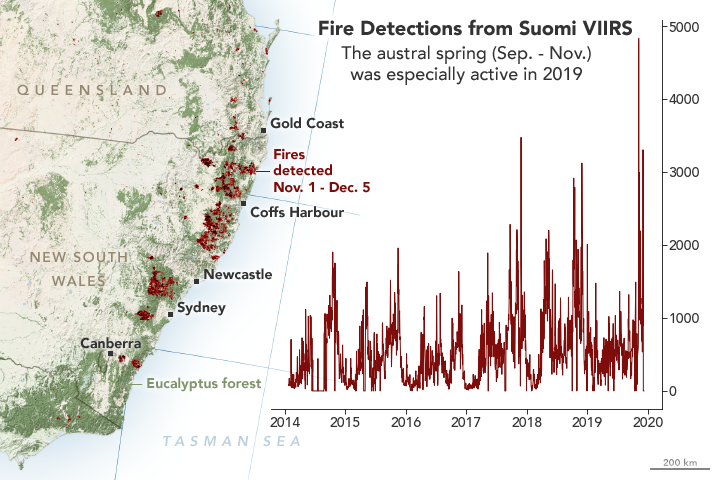
Wished such news articles would ways contextualize such news with a graph of the fire activity in previous years, if not in the entire recorded history. I want a figure how many standard deviations this is above the mean.
Thanks. Interesting how rare and extreme these events are. This suggests a runway process is involved in that the fire spreads and multiplies in just the right conditions, but presumably it takes a while for nature to grow enough to become vulnerable to a large fire again? Not enough data here to tell for sure. It is interesting that some plants have evolved to require fire to survive and reproduce (pyrophytic plants), so wild fire is by no means unnatural. There does not seem to be a positive trend here.
I believe in recent past we've gone through: "everything's burning, let's put it out", "we've had massive fires, let's do planned burns", and now "let's defund organisations that can do effective bush management". This will explain some of the changes visible. The current area is due to the buildup nobody managed - neither by government organised burns, nor fire stick farming.
Yep this is exactly it. There is a periodic phenomenon going on here. We do not measure or collect data long enough to look at it like that. I think the trend is hard to spot here.
That's not what this article is about. Sometimes you have to go looking for an article specifically about the historical context. Here's one I found on initial search [1].
> For the forests and woodlands in the eastern half of the state, this is unprecedented.
I can't help but ask if you have an agenda.. is it to say "See, the NASA graph shows it's not much worse than previous years, climate change is nothing to worry about!"?
The graph starts in 2014, that's not exactly a "pre-climate-crisis" year...
LOL, you guys have a really sensitive "climate denial sensor". I am about as critical of ignorant consumerism as it gets. For example I do not think millions of people need to travel >200 miles a day. But I am also aware that reducing consumerism is associated with a risk of mass unemployment and social unrest. Nonetheless I desire context. It's just my need as a nerd to get the full picture rather than "look at this scary context-less number".
It's not an agenda. News sometimes miss important context.
The Brazilian forest fires this year are a good example. It took weeks until we learned that the forest fires are not significantly worse than previous years. Brazil has been burning at the same rate for many years.
Arson as origin was always a possibility, (same situation in the case of California) but the hypothese gained a lot of support in the last days with 24 people detained accused of deliberately starting wildfires. It seems that Australia has waked up finally.
1 Dear friends, this is now my second letter to you. I have written both of them as reminders to stimulate you to wholesome thinking. 2 I want you to recall the words spoken in the past by the holy prophets and the command given by our Lord and Savior through your apostles.
3 Above all, you must understand that in the last days scoffers will come, scoffing and following their own evil desires. 4 They will say, “Where is this ‘coming’ he promised? Ever since our ancestors died, everything goes on as it has since the beginning of creation.” 5 But they deliberately forget that long ago by God’s word the heavens came into being and the earth was formed out of water and by water. 6 By these waters also the world of that time was deluged and destroyed. 7 By the same word the present heavens and earth are reserved for fire, being kept for the day of judgment and destruction of the ungodly.
8 But do not forget this one thing, dear friends: With the Lord a day is like a thousand years, and a thousand years are like a day. 9 The Lord is not slow in keeping his promise, as some understand slowness. Instead he is patient with you, not wanting anyone to perish, but everyone to come to repentance.
10 But the day of the Lord will come like a thief. The heavens will disappear with a roar; the elements will be destroyed by fire, and the earth and everything done in it will be laid bare.
It's not hard to figure that those who've come from the front lines of fighting the fires, those who've helping the injured and those who have lost their homes are probably doing some hard thinking about their experiences right now. Fighting any confronting, seemingly loosing battle will do that, and it's human nature to be philosophical ("let me find a logical model that pattern-matches well to these specific inputs, but which is sufficiently complicated enough that I juuust can't quite logically verify the model itself properly") to cope.
But if I were going to pick a Bible passage that I felt was the most consistent pattern-match for this situation, I'd probably use Matthew 24:6-7:
6 And ye shall hear of wars and rumours of wars: see that ye be not troubled: for all these things must come to pass, but the end is not yet.
7 For nation shall rise against nation, and kingdom against kingdom: and there shall be famines, and pestilences, and earthquakes, in divers places.
Shrug I'd file what's going on over here pretty unhesitatingly under "pestilences". I'm actually wondering where to move to in future; I'm currently a comfortable distance away from all the hotspots, and would (selfishly) like to keep that status quo. Such logistical considerations may become disillusioningly commonplace in future; hopefully not too distractingly so...
The reason I like the passage above is the bit about "the end is not yet". It's ironic: even as I do believe in the Rapture (or at least the vague, hand-wavy gist of it that the majority of denominations that are prepared to face the idea all agree on) and/or life after death, my soul's currently stuck in this specific body for now, and I have to figure out the best way to move forward.
Luke 19:11-13 comes to mind:
11 And as they heard these things, he added and spake a parable, because he was nigh to Jerusalem, and because they thought that the kingdom of God should immediately appear.
12 He said therefore, A certain nobleman went into a far country to receive for himself a kingdom, and to return.
13 And he called his ten servants, and delivered them ten pounds, and said unto them, Occupy till I come.
The end of verse 13 is my current focus at the moment, and helping me deal with some circumstantial depression that is causing me to lose sight in the value of the simple things. ADHD and concentration issues also make it easy for me to get distracted by details and lend me to top-heavy thinking and castle-building in the sky.
The thing is, beyond the simple understandings that are conveyed in the Bible, and the experiences of a few people that say they've visited Heaven (and who all have noteworthily consistent stories), I have no idea what happens Next™ - you know, after the end of the world. So trying to plan or schedule for or obsess over the future would be premature optimization - even as that leaves me with an absolute sense of "but wat even do I do now then????".
One final verse comes to mind, 1 Corinthians 13:12:
12 For now we see through a glass, darkly; but then face to face: now I know in part; but then shall I know even as also I am known.
Cross-referencing this with later verses in Luke 19 from before,
16 Then came the first, saying, Lord, thy pound hath gained ten pounds.
17 And he said unto him, Well, thou good servant: because thou hast been faithful in a very little, have thou authority over ten cities.
Obviously my life goal is to figure out how on earth I'm supposed to "occupy" even while I can't even see what I'm doing properly because I "see through a glass, darkly" (mirror technology wasn't too great 2000 years ago; modern semantic equivalences might be 300k webcams, or JPEG quality levels below 40) so that, beyond the end of the world, what I do retains value.


(with China looking like its usual, humdrum Mordor self)