Spray foam sounds good at first but it's almost always complete trash. Nasty chemicals, 0 ventilation, poor humidity management, pain in the ass to remove. It's one of these things poor people get because it's cheap upfront but in the end it'll cost you twice as much as a proper insulation system
It's easy to apply and looks cool so that's good for instagram builders/remodelers, plus they'll probably be out of business before you notice the damage.
I have an interest in metal boats and in the 70s-80s it was common to spray foam these vessels. This pretty much always caused premature end of life due to corrosion.
There's a whole class of corrosion in metal structures called Corrosion Under Insulation or CUI. This is a problem for any insulated metal structure, but it is way worse with spray foam because the foam traps moisture very effectively, when it breaks down it becomes acidic, it is difficult to remove for inspection or repair, and it makes hotwork dangerous because it is flammable.
When I started seeing wooden houses and roof decks get spray foamed, I could only think that these structures will likely be rotten and useless in 20-30 years. I would only sprayfoam something if the substrate is completely impervious to moisture, like if it was fiberglass or something. Even then you're likely looking forward to a pretty evil concoction under that insulation in a decade or so.
Some fibreglass boats are still filled with spray-foam, and it has the known effects of eventually causing rot to any wood that might be embedded in the fibreglass. Embedded plywood is much less common nowadays though.
(The foam cores in modern fibreglass construction is PVC-based, moisture safe, and can not be sprayed.)
Really? Properly installed closed-cell spray foam seems to have a ton of benefits:
Moisture barrier: It blocks water vapor and prevents mold growth by reducing humidity levels in crawl spaces and other areas.
Structural strength: It can double the racking load of a home, making it more resistant to severe weather.
Air sealing: It protects against drafts, cold spots, and uneven heating.
Longevity: It retains its R-value over time and can last for decades if installed correctly.
Energy cost savings: It reduces your carbon footprint by consuming less energy.
Improved air quality: It doesn't contain harmful micro substances like fiberglass insulation.
Moisture barrier: it traps the humidity in places you potentially don't want to
Structural strength: yeahhhh... no
Longevity: not more than anything else, a pain in the ass to replace though
Improved air quality: The petrol derivate foam that leaves a god awful nasty smell for days/weeks and can offgas for years is good for air quality ? rock or better sheep wool is much better in that regard
In the end of the day people do whatever they want but I'd rather build smaller and spend more on rockwool than have extra space and nasty ass foam all around my house
Moisture barrier: it traps the humidity in places you potentially don't want to
This is more applicable to fiberglass. How does humidity somehow get past the foam while being kept there? I never see any evidence for these claims.
Structural strength: yeahhhh... no
Foam adds rigidity to wooden structures. This is actually very commonly brought up and noticed where houses creak far less on top of the sounds proofing. Saying "yeahh.. no" is not evidence of anything.
Longevity: not more than anything else, a pain in the ass to replace though
Definitely more than fiberglass, since fiberglass can sag and flatten over time.
offgas for years is good for air quality
This is not typical and happens when it is installed poorly.
> Moisture barrier: it traps the humidity in places you potentially don't want to
Definitely a risk with any type of improperly installed moisture barrier (like ZIP sheathing).
> Structural strength: yeahhhh... no
It would take me some time to find more formal studies, but there are a lot of videos on YouTube that demonstrate the addeded strength. Here's one: https://www.youtube.com/watch?v=4mMHJpSHKJM
> god awful nasty smell for days/weeks and can offgas for years is good for air quality ?
Everything I've read indicates that any offgassing/odor is gone in 24 hours or less.
> In the end of the day people do whatever they want
Agreed. To each their own. Closed cell spray foam also works well in conjunction with rockwool.
> It would take me some time to find more formal studies
No one will study the strength of insulation foam because it will never be authorised as a structural material.
> Everything I've read indicates that any offgassing/odor is gone in 24 hours or less.
Everything you read comes from manufacturers or bloggers/influencers paid by manufacturers. On construction forums you'll find plenty of people complaining of weird smells months/years down the line.
Again, people do whatever they want with their houses and health, personally I'm not touching this shit with a ten foot pole given the alternatives
I don't see the point of building tight, if you're going to have massive holes in the building, through which you force tons of air (which you should). Would you call a jar airtight if you never close the lid?
In multi-tenant dwellings, building tight can help keep people's smells to themselves. That's about it. Like if you have pressurized air in the hallway, keeping the common area fresh, if the apartment units are not built tight, smells can go from one to the other sideways, possibly forced by that very same pressure.
The main reason people build tight is to save on heating and cooling bills, or "save the planet". And mainly how that works is by not ventilating. Ventilating forces out all that hot or cool air that you paid for, so you have to heat or cool the replacement air.
> I don't see the point of building tight, if you're going to have massive holes in the building, through which you force tons of air (which you should). Would you call a jar airtight if you never close the lid?
I'm not quite sure why you're taking thing so literally about combining the two actions. I would call a jar airtight because the glass cannot be penetrated by air, nor can the lid and band.
You can then ventilate the airtight (proverbial) jar on your own terms: using filters and such to control the quality of the air that goes in/out.
The build tight is about the building enclosure; the ventilate right is about exchange stale/dirty interior air with cleaner exterior air in a controlled fashion.
A fully sealed building with zero ventilation would be horrible for people due to increased chemicals from people just breathing (CO2) or cooking. It is absolutely necessary to ventilate a building, but it can be done so to also reduce the incoming undesirable elements in the exterior air.
> Ventilating forces out all that hot or cool air that you paid for, so you have to heat or cool the replacement air.
Ventilating using HRV/ERVs takes the conditioned air and transfers some of its properties (temperature, moisture) to the incoming air to temper it. The incoming air is/can be also filtered to removed things like pollen, dust, wildfire smoke, etc.
> It's basically greed or ideology over health.
There are entire industry standards (ASHRAE 62.1 and 62.2) on the topic of good indoor air quality (IAQ) to make sure that 'just enough' stale air is removed (e.g., to reduce CO2 counts) while not 'over-ventilating' (increasing costs), and it is a topic of active academic research (especially post-COVID):
By not having a tight building envelope treated air can leak out, and untreated air can leak in, and depending on the size of the leaks (holes) you can even get bugs/creatures entering.
The whole point of buildings is to separate environments: inside versus outside. Leaking building compromise that separation reducing the control you have. And if you do not want to separate your interior and exterior environment live in a tent or under a tarp: plenty of ventilation, very little air-tightness.
Not sure if there is a significant climate difference in the UK that makes this construction more problematic, the article mentions moisture but the U.S. building scientists say 2 inches closed cell spray foam will block air and vapors from reaching the wood of the roof. Perhaps the issue is the open cell foam mentioned in the article - it seems that closed cell foam is the recommended type in the USA.
> Not sure if there is a significant climate difference in the UK that makes this construction more problematic, the article mentions moisture but the U.S. building scientists say 2 inches closed cell spray foam will block air and vapors from reaching the wood of the roof. Perhaps the issue is the open cell foam mentioned in the article - it seems that closed cell foam is the recommended type in the USA.
Implementation details matter. From the OP's article:
> At the root of the problem are cowboy traders who apply the foam without a full survey or appropriate expertise – but because of lenders’ caution, this is affecting other homeowners who had similar work.
One potential problem that could occur is ridge rot:
> Lots of attics insulated with open cell low density spray foam (Photograph 1, Photograph 2 and Photograph 3) are having problems – in hot humid climates, mixed humid climates, and cold climates. The problems are moisture related. The attics are “unvented” – open cell low density spray foam is installed directly on the underside of roof sheathing. The attics are humid. Very humid. Unacceptably humid. And the humidity collects at the upper portion of the attics.
> When you spray ocSPF into wall cavities from the interior the ocSPF can act as the air control layer and thermal control layer. It can’t act as the vapor control layer – it is too vapor open. This is a problem when you spray ocSPF on the underside of roof/attic assemblies you can end up with problems (“Ping Pong Water”).
It might be because slate/tile roofs are the most common roofing materials used in the UK and insulation is usually (in my experience) laid between the joists?
You are completely right, a lot doesn't add up. People in this thread seem to just accept the moisture argument without thinking it through or doing research. Lots of people have spray foam and lots of people are happy with it. There is no '25% of wood deteriorating over the next couple of years'.
The reason it's nonsense is that the side covered with foam (especially closed cell) is now protected by waterproof polyurethane. Water isn't getting to that side.
The other side is now insulated from the inside, so that isn't getting things like condensation because the temperature differences should be negligible. If people think about a cheap styrofoam cooler, it's cold on the inside and there isn't condensation on the outside on a humid summer day. The outside isn't cold, that's the point, so condensation doesn't happen there.
Then maybe someone would say if there was a roof leak the wood would get wet and rot, but that would happen anyway. That's a major disaster and foam won't cause any more problems than are already happening.
Water _will_ get through your roof at some point, and it'll sit nice and tight right above your spray foam, for years, decades, and you'll never ever know about it until the problem is too big to handle.
This is especially true for hack jobs on older buildings.
Whereas the traditional warning sign in older UK buildings is for you to know about a problem with your roof by having your ceiling plaster collapse when you least expect it!
I wasn't joking - I've been in two top floor flats in the UK in older buildings (central Edinburgh) that had ceiling plaster collapse due to roof problems.
> Why would water be able to get through your roof with spray foam making anything worse?
Because your roof _will_ fail, they all do, once it does the water will collect between the roof and the foam, because while it's not air tight there will be nowhere near enough ventilation do get rid of it
> Water damage means you have to replace things anyway.
Yes, but if your entire wooden structure rots for 5 years because you didn't detected the leak since it's hidden behind 20cm of foam you are utterly fucked.
It's well documented, feel free to google it if you don't believe me.
You said that already but it doesn't answer any of the questions I asked. Repetition doesn't make something true. There are typically shingles, then a layer underneath, then wood sheathing like OSB. All that is for the cheapest roof.
once it does the water will collect between the roof and the foam
Says who? If water is getting to the wood, why isn't air getting to it? Typical roofs last for 20-30 years.
This idea that foam is bad because seeing water soak through through the entire wood sheathing is nonsense. This is also only dealing with foam on the underside of the roof, which is also not the only place or way it can be used.
but if your entire wooden structure rots for 5 years
Now your "entire wood structure" is going to rot? If you want to know if there is moisture in your wood, go in your attic. This idea that roofs blow off without anyone noticing and huge amounts of water soak all the wood in a house and the entire thing rots without any indication is not reality.
feel free to google it if you don't believe me.
You can feel free to google it because you're the one making the claims.
Not all roofs are "metal plates", most aren't actually. Either way some roofing materials are rated for as low as 20 years, depending on the climate and how good they were installed they might fail earlier
You'll always have a failing shingle/tile here and there, unless you plan on inspecting the whole structure under the foam every year you could very well miss it for many years.
A puddle in the attic or a wet rock/sheepwool panel will be much easier to discover/fix. A small leak under 20cm of sprayed foam will be a nightmare to locate
I'm into watching construction videos on Youtube, and since most of the content originates from the US I see lots of people using spray foam insulation without any sort of air-tight & moisture regulating membrane on the inside (behind the drywall for example). This is a disaster waiting to happen in almost all northern climates during winter (when AC/de-humidification isn't running) for the same reasons outlined in the article here.
It depends on what type of spray foam you use. Closed cell foam is rated to be a moisture barrier. It tends to be more expensive but is worth it to get a moisture barrier and insulation in one. In some scenarios where you need much thicker insulation to hit your desired R value they might start with closed cell for the moisture barrier and then switch to open cell since it is cheaper.
The problem is air escaping from the hot side through "cracks" or holes and causing condensation as it reaches the cold side.
In nordic standards, there must be an air-column between the insulation and the outer "cold" layer, to ventilate out any moisture that might get trapped there. There must also be a moisture barrier between the "hot" side and the layer of insulation, typically a PE-sheet, to prevent air from leaking into the insulation.
Since the wood expands/contracts with changes in temperature and humidity, filling compartments in wood constructions with foam does not guarantee air tight barriers.
Closed cell foam will trap moisture underneath it. When sprayed on wood which is naturally moist that water will have nowhere to go. Any delaminations of the foam from the substrate will form pockets where wet will concentrate, and as the foam breaks down it becomes acidic.
If I were to sprayfoam something I would only consider using open cell foam. If I were to use other impervious zero-perm insulation materials like rockwool I'd only do so with dimple board to allow air underneath. The small loss of efficiency is a necessary tradeoff for giving the moisture which will always be there a path to escape.
Spray foam doesn't remove the need for a designing a proper insulation and moisture barrier system for the building. If you spray foam an interior wall with closed cell foam you most likely will add something to allow the other side of the wood to breath.
Choosing where your moisture barrier line lies is typically easy in new construction but does get tricky with retrofit situations. It sounds like the biggest issue from the article is that they are taking what were vented attics and converting them to non-vented attics with spray foam. The issue isn't really the spray foam, the issue is converting an attic without proper understanding of venting and moisture barriers.
I was initially confused when I read it, but I think that ‘trader’ here must be the politically-correct word for ‘tradesman’ (someone engaged in a trade) rather than someone who trades (like a stockbroker).
You're correct, "cowboy traders" is a British idiom for tradesmen without the appropriate skills, qualifications or experience to fulfil their contract responsibility.
It can also refer to those who will take on contracts (plumbing / landscaping / roofing / building work / etc) without any intention of fulfilling them, or charge exorbitant, inappropriate and unagreed prices.
It's in such common British use that a TV show named "Cowboy Traders" was aired in 2012.
But it's understandable why they haven't used that here, as an insulation installer would rarely be called a builder, just like an electrician or plumber would rarely be called a builder.
In the UK all people who do these kinds of jobs(builder, plumbers, electricians etc) are called traders, I've never heard anyone use the word "tradesman".
Yes, but as I understand it, being a "sole trader" is different from being a "tradesperson". If you're an employed plumber, or you're a plumber with your own limited company, then you're a tradesperson but not a sole trader. If you do web sites or IT support on your own and without having set up a limited company then you're a sole trader but not a tradesperson.
The trouble with "trader" is that it usually means something else, namely someone who trades. A tradesperson doesn't trade; they practise a trade (= craft/profession).
Visit a UK builders' merchant or DIY store and they'll offer a 'trade account' with a 'trade discount' and 'trade deals' - they'll even sell you 'trade paint'
Ambiguous on a global scale? Maybe. Ambiguous when you're standing in a builders' merchant? Absolutely not.
....What definition? As a Brit, I'm telling you that's what we call people in these professions, anyone who comes to work on your house is a "trader" - you can choose to believe me or not lol.
Edit: and as another commenter pointed out, it's literally the government definition of someone running their own business - "sole trader".
Perhaps it is (or at least was) to some extent regional. Oxford English Dictionary does not have the sense of "trader" that's being discussed here. It does however have "tradesman = A man engaged in a trade or a skilled manual occupation". It also has a second sense for that word: "tradesman = A man engaged in trade or the sale of goods and commodities" and one of the examples for that sense, from 1906, is this sentence:
> ‘Tradesman’, which in the north is used to denote a workman who has learned a trade, while in the south it is made to apply to a man who runs a business.
That was more than a hundred years ago and things may have moved on a bit since then, and in any case that sentence is quoted as an example rather than a claim by the editors of the dictionary, but perhaps despite my current place of residence I'm a northerner at heart?
'Cowboy' insert trade here. The ride into town, take on the job and your money, then ride off into the sunset never to be seen again and leave you to clean up the mess...
It's a really old, and well known, UK expression, and not an affectionate one.
Although 'Tradesman' (or tradeswoman) is the overwhelmingly correct term in the UK for those kind of jobs, whether the work they produce is good or bad.
It is correct in so far as Trader == tradesmen. But it isn't some "politically correct" thing. Also attributing political correctness to terms is often a political move in and of themselves.
There is nothing politically correct or incorrect about it. It is just the standard term. Meanwhile in Australia they use 'Tradie' from what I understand.
How is this still happening? We discovered this in Canada in the 1970's. Except in our case, the Urea Formaldehyde foam was giving off formaldehyde gas.
In the UK, the construction industry has a great many cowboys, incompetents and scam artists. There's a lot of demand, so the market doesn't force these people out of business. And the courts can't do much if it turns out the guy gave you a fake name and address - or if the company that did the work went bankrupt.
And we've long had governments that take a hands-off, laissez-faire attitude - expecting the market to sort things out. As they see it, this insulation can be done properly, building owners chose to buy it, why ban a promising new green technology when the UK has millions of under-insulated homes and an energy price crisis?
Similarly, the UK has a load of tower blocks clad in flammable insulation after vendors Kingspan and Celotex scammed their way through fire safety testing - but somehow all the people who made money off it have disappeared and the taxpayer has to pay to remediate it.
What makes it unsellable or unmoragable? I don't know how that works on the UK, but here if there is a defect in a house that requires 3300€ to fix, the house value is just estimated 3300€ less than the price without the defect (or worse case scenario, you account for the value of redoing the roof if there is a risk it's needed)
The mortgage issuers get to decide what risks they do or do not accept and they hate unknowns. One example that often comes up is "atypical construction". Maybe you want to buy a one-of-a-kind house that some crazy architect built for himself in 1968. He didn't use any materials that are known to be unsafe, but on the other hand nobody else had ever built a home like that and no-one did since. Mortgage issuers hate that, you might find a specialist who would be willing to offer you a mortgage, but nobody on the high street will.
It's not unsellable, there are a lot of private buyers, both investors who intend to rent it out and people with significant money looking to just buy outright. For example my mother moved long after retiring, obviously she can't get a mortgage, so she paid cash. However, if a mortgage will be hard to get this makes it significantly harder to find a buyer, especially if your ideal buyer is younger and not wealthy. This can depress prices.
The problem is that it requires a 3300€ removal just to inspect for further damage of unknown and possibly large size. If it is large and the homeowner is unable to cope, the lender is at risk.
Because tbe lenders are at risk here, they won't lend unless you do the removal so that the lender can inspect.
Given housing prices, it seems that the 3500 is merely (potentially) wasteful and (definitely) irritating. It isn't gonna make it impossible to sell a place.
You are wrong to ignore it. Why would you ignore the very point that I'm going out of the way to explain? That's just asking to fail to understand.
The person who wants to shift 300000 isn't the problem. It is the bank who is saying no to the mortgage. Banking has been described as "picking up pennies in front of a steamroller". For them, a housing mortgage has limited upside, and a large possible downside. They stay in business by avoiding hitting that downside.
Therefore a property that can't be inspected property, can't get a mortgage. Full stop.
The prospective buyer can't buy without a mortgage. Sure, the buyer could pay for the removal. But now you're asking the buyer to pay for a large repair, just to decide if this might be the house for them? And that payment comes out of what they could have spent on another house! This makes no sense.
The only party that has the right incentive to fix the problem is the current owner. It's part of getting your house ready for sale. That sucks - they thought that they were improving their home, and they made it worse. But still, they created a problem, and nobody else is going to volunteer to help.
Congratulations. You've just arrived at the whole point of the article.
The owners paid money to improve their house. Now they have to pay more to undo that if they want to have a chance of selling it. That's a rather nasty thing to be hit with when you're trying to sell your house so that you can move.
This is shocking and confusing. In the US if you watch HGTV and Mike Holmes, who works in Canada, all they do is talk about how great spray foam is and that is the gold standard. To the point I have had major FOMO for years because I do not have it.
Reading this article and the comments here ... I do not want to think, other than being glad it was too expensive to consider.
Foam is expensive, and thus for the same profit margin (expressed as a percent) there is more money. Foam thus puts a lot of money into shows like that for advertisement.
Closed cell foam is the best insulation - if it is installed correctly. You should want it as it is the best insulation. However the payoff is several decades vs much cheaper insulation and so most people find it isn't worth the costs.
In general, for most houses, putting in the most cheap insulation you can, and then investing in a heat pump is the most bang for the buck and better for the earth than the most foam you can and then using a much less efficient HVAC system (in a new house this is typically what code requires, but there are a lot of old houses with minimal insulation and a terrible furnace).
I have an interest in metal boats. I read a book written in the 1970s by a British author who went to the netherlands to get up-to-date on the best metal boatbuilding methods used by the world's experts. He enthusiastically championed sprayfoam insulation which was being used nearly universally by the dutch at the time. The boats that got sprayfoamed invariably had short useful lives and horrible corrosion problems. It is no longer considered a good insulation method in boatbuilding.
Yeah, reading this from the US, it looks weird. Our house is insulated using closed-cell spray foam installed in the late 1970's, and it has held up perfectly in the time since, in the generally wet and humid northeast U.S. We have continued using spray foam when we make additions and changes, both for consistency and because it seems to work very well.
Reminds me of an recent instance where some friends wanted to buy a house, but it had solar panels. The solar panels couldn't be included in the mortgage and my friends couldn't afford to buy them outright along with the downpayment on the mortgage. The house still remains unsold.
This is why you don't lease solar panels. This is common because there's little to no initial outlay but don't do it. Buy them or don't get them at all.
This is why you don't lease anything for your house. For example in The Netherlands you can lease a central heating boiler. I even have a friend that leased a couch once. It's always more expensive and you will have problems with your house when you want or need to sell it (except for the couch of course, that's just stupid...).
Because in most cases the leasing company that owns the solar panels will not transfer the lease to the new owner, they will only agree to sell them outright at some outrageous price(usually the cost of the panels when they were new, which usually has absolutely nothing to do with their current market value or in fact with the cost of a similar installation today).
In many locations solar add zero value to the house. So it is possible that you owe more on the house+panels than you can get. Most buyers do not know the worth of solar and so won't pay anything extra for a house that has them (overall, a few are willing to pay, but others will see it as something they will have to pay to remove). Even if you find the one buyer who understands the value, the bank do not understand how it will affect finances and so assume zero - backed up with there are so few buyers who care that they don't see many higher offers coming in for houses with solar.
Very curious where this is? Sounds ridiculous, what jurisdiction wouldn’t include them as part of the house? Utterly bizarre!
Also why couldn’t they afford them? Is this the US where the equivalent of a $5000 system elsewhere in the world seems to cost $25K to install for some reason? Even then, with depreciation as long as it’s a couple of years old surely the residual value isn’t that much…?
In the UK it's quite a common setup that you don't buy the panels outright, you sign a contract with a 3rd party company that installs the panels on your house and maintains them, but they own the panels, you can just use whatever electricity they produce and any surplus goes to the company owning the panels. The problem is that a lot of these companies went bust when the government ended the electricity export subsidy, and in most cases these panels were then transferred to a larger provider that honours the original contract but on the sale of the house they won't transfer it to the new owner - the only option is for the new owner to buy them outright. And because they rarely look at them in terms of current market value, they will quote you whatever the panels were brand new - which yes, absolutely can be in the £15-20k range, which is crazy by any measure, and you end up in this stupid situation. Usually the best option is actually to remove them instead, but as per contract - you are liable for the cost of doing so, which ends up costing few grand anyway, once you factor in scaffolding and labour and recycling and everything else. And so it's now a burden when it comes to selling the house.
The owners of the house may not own the solar panels: there's a psuedo-scam running around where they are installed for "free" by a company that then gets a lien on the house https://www.forbes.com/home-improvement/solar/solar-scams/
This is probably exactly what happened. Those bad boys are not cheap to install either. Systems running well into the 30-50k levels to be paid over '20 years'. The system I put in would have cost about 45k after 20 years if I had taken their loan. I can buy all the electricity I need and 3 of my neighbors for that. As I had the money for up front it ended up costing me 16. Even then the 'ROI' is rubbish. Still cool to get a bill that is just interconnect fees though.
Iowa. I don't know the details, but I assume the solar panels were leased. My friends don't make a lot of money, so they're pretty limited in what they can afford up front. IIRC, the panels would have added around $10K.
There were many dodgy schemes in the UK years ago ("free solar panels! cheap electricity!") where people didn't realise there was a mortgage on the panels for 30 years+ which was now in the deeds of the house and made mortgage companies back out, suspect it's exactly this.
If they were under some kind of borderline-scam scheme like that, yes that would make sense. But that’s very different than just “having solar panels” that the OP said!
Op just said "but it had solar panels" - which.....it does. And because it's such a common setup in the UK, every time you see a house with solar panels you can be almost certain it's done this way, not owned outright by the owner.
That's a bit of a don't shoot the messenger imo. If the construction of a house may be compromised and cannot be verified, it is prudent to not mortgages the house. Don't blame the lenders for that, blame the vendors.
I can sympathize with these people, they are not really to blame imo. Shoddy work needs to be claimed with those that did the work and choose the materials.
What is the recourse when the Swiss government endorses open source, a company deploys open source SprayFOAM or whatever, SprayFOAM fails catastrophically, and causes the company to go out of business? Perhaps they might fund the BBFA - the Bureau of Bureaucratic Failure Analysis?
I generally hate how litigious the US is, but at least in situations like this, I feel like there would be one lawyer that would figure out how to hold someone responsible.
> Executive found that condensation could cause 25% of roof timber to decay within five years if spray foam is applied directly to roof tiles, or certain underlays. The general risks increase the further north the property is, because of colder climates.
Most houses in the UK will have a timber frame, condensation will cause the wood to rot.
I was wondering indeed, I am insulating with PIR plates, but they are coated with a vapor-closed layer and one is advised to tape all panels together with vaper-closed (aluminum) tape, so no air from inside the living area can get into the insulating layer, cool down and leave condensed water. As an additional precaution, the advice is to not insulate from the inside if a vapor-closed foil is on the outside of the wooden part of the roof (where the tiles are resting on), to ensure any vapor getting into the insulation after all, can vaporize away when temperatures rise.
All that being common knowledge, it does indeed seem weird that people were just spraying foam directly on the inside of their roofs as vapor will be deposited somewhere in the open cell structure of the foam, or against the inside of the wood/roof-tiles (as the air cools down, it can hold less and less water so that condenses).
Given all that knowledge, I'm still unable to close all the vapor bridges in my house, because I can't remove certain structures. So it is still a bit of a gamble here and there, where the moisture will pile up. I just try to get it to pile up in sites that are exposed to outside air.
I can't imaging everyone being as analytical and careful as me though. Indeed I sometime here people just pasting PIR plates or mineral-wool in place and leaving them like that, no vapor screens or anything. Time will tell what happens to these houses. Old houses were made to just have a lot of heat-transport through the structure, which prevents vapor deposition. Insulating any house should come with at least some thought about where the humid inside air will go (preferably outside through ventilation holes.)
It’s basically the same thing as wrapping the wood into a plastic bag. When water condenses inside the plastic it has no way of escaping and starts to rot/mold the wood.
When using any type of insulation in places where temperatures can vary and humidity can get high you should always ensure the wooden parts have enough room to breathe (e.g. 10cm of empty space above them if the insulation is at the bottom).
After thinking about this a while (and contradicting my previous reply, though I want to leave it as it is generally correct!) I think this isn't about vapor or condensation at all. I think this is about leaky roofs! If your roof leaks, rain water gets on the wood, and the foam traps it there (even open cell is slow to wick it away) and so it rots the wood away. Worse, since there is no drops inside the homeowner has no warning that things are going wrong and so won't call a roofer to get the issue fixed. (roofers also are not perfect and so if the new roof leaks they won't know to do warranty repairs before the beams fail - in a normal house you notice the drip, and fix the problem before anything bad happens)
The above is my current belief. Who knows if I'm right.
Water vapor condenses into water and causes mold/rot. Closed cell foam doesn't let water out through the foam (open cell does, but open cell vs closed cell needs a long discussion of pros and cons - in general I'd call closed cell better if you can mitigate this issue). The problem is insulation is added in summer when there is high humidity (there is a minimum temperature) so all the wood is at the wetter stage, then winter comes and the whole wall cools off and any air trapped condenses the water since the water vapor cannot escape.
It traps moisture which leads to mold and for wood to rot. You nearly never want to install insulation without a vapor barrier. And especially not with spray foam. People do it because it’s cheap to do. You only have to punch a small hole in the wall and spray into it.
Also if you want insulate an old house consider you should install an HVAC system so that you are properly venting. Old houses self ventilate because they’re so loose compared to modern homes with tight envelopes.
> You nearly never want to install insulation without a vapor barrier. And especially not with spray foam
Closed cell foam insulation is a vapor barrier, which is where the problem comes from. You must never have two vapor barriers as any moisture that is between them cannot get out and this will cause mold and rot.
Punching a small hole in a wall and putting foam is fine so long as the foam and the existing vapor barrier are touching each other and thus form one barrier. However if there is something between the vapor barrier and the foam you have two barriers and problems.
When applying insulation from the inside, the walls and roof will be cool during the winter. If warm air (which can hold a lot of water) somehow leaks through the insulation, it will cool down. Cool air can hold a lot less water, so the water gets released into the structure. A wooden ceiling can rot away quite quickly if it is constantly moist.
I believe the actual issue the article implied was it prevents inspection of the roof lumber in addition to moisture trapping. Since a mortgage company can’t see the lumber and framing they won’t mortgage it. Thus you can’t sell the home to someone mortgaging it.
Moisture management is the largest risk I know of with foam.
Of course ideally the wood holding up your house or roof never gets wet, but if it does it's not an existential threat, unless it stays wet. Foam doesn't allow the wood to dry, and that can cause rot. Rot, if it's enough members can cause structural problems.
>But because surveyors are unable to inspect the roof timbers behind the layers, mortgage lenders tend to issue blanket refusals on properties where any foam is present.
I assume that it's due to the expanding nature of the foam -- they are afraid that the foam might continue to push against the roof timber and crack it I think
No they specifically mentioned condensation and how it affects properties in colder climates more. I think they're afraid the improperly installed insulation will allow condensation to build up below the roof timber which will cause the timber to become wet and degrade.
>A report published in March by the government’s Health and Safety Executive found that condensation could cause 25% of roof timber to decay within five years if spray foam is applied directly to roof tiles, or certain underlays. The general risks increase the further north the property is, because of colder climates.
> At the root of the problem are cowboy traders who apply the foam without a full survey or appropriate expertise – but because of lenders’ caution, this is affecting other homeowners who had similar work.
A good example of negative externality.
(If you are a good libertarian, you believe they don't exist, or everything is fine).
You hire someone to do spray foaming properly, have no problems with it, but suffer negative externality because others fuck it up and you are treated the same.
Regulation would fix that problem. Spray foam works just fine in Finland, although, we usually use mineral or glass wool already in construction phase. You must know how and where the dew point will be when you build or fix a wall.


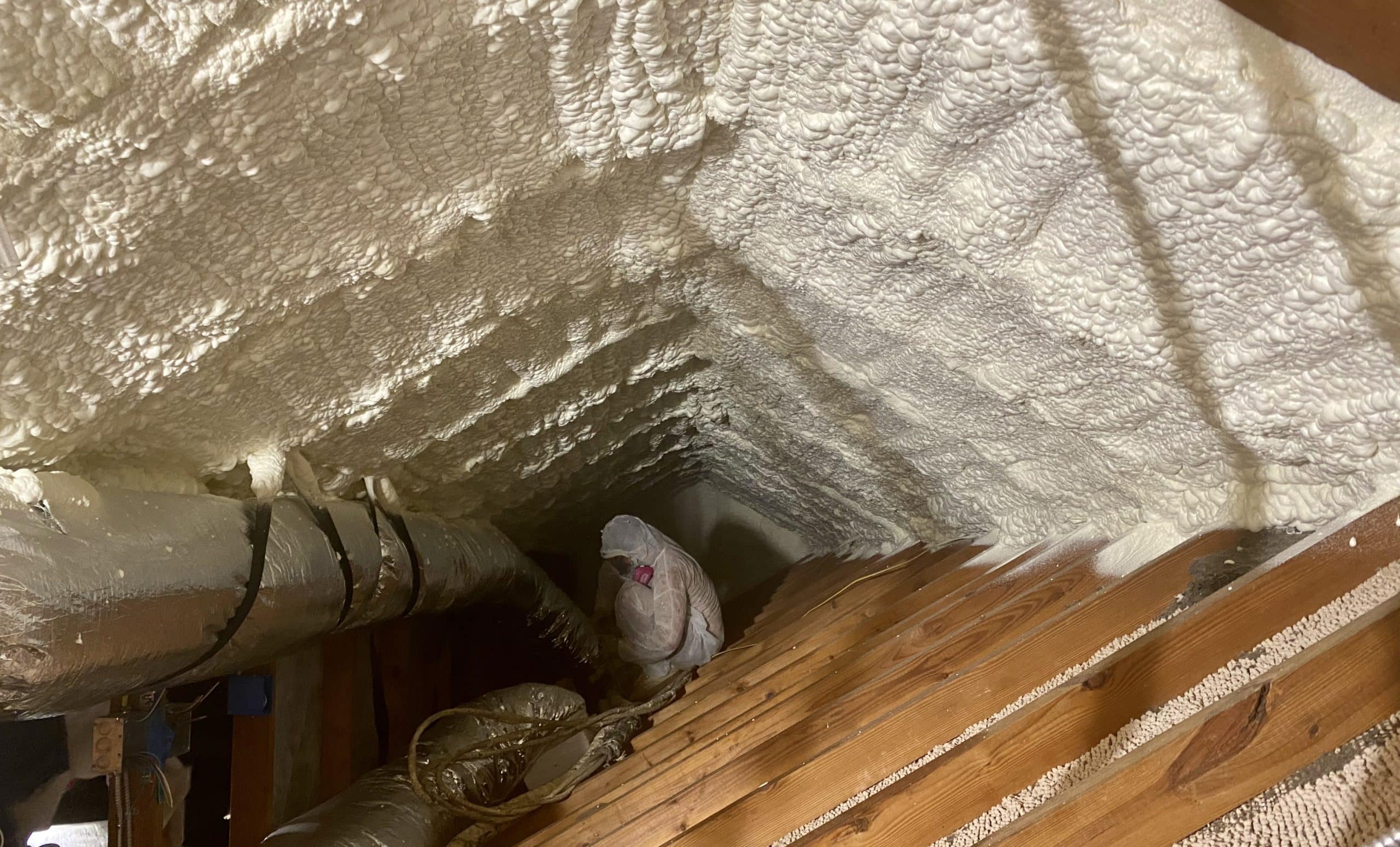

It's easy to apply and looks cool so that's good for instagram builders/remodelers, plus they'll probably be out of business before you notice the damage.
https://vtdigger.org/2023/05/22/i-wanted-to-cry-devastating-...