Portrait vs. Landscape has always been an interesting debate to me, especially in the context of filmmaking, a space where, until the advent of TikTok, basically everyone scoffed at the idea of cinema being vertical -- because, well, physical cinema screens are landscape! But cinema screens are no longer the dominant place people go for movie entertainment -- they watch instead on their smartphones, where they can choose either orientation as they please. This has led to the dawn of vertical cinema, something I find very exciting. I don't know if there will ever be vertical movie theaters (I personally doubt it), but that doesn't mean that there can't be vertical movies that are ever bit as artistically valid and "sophisticated" as their horizontal counterparts!
I've noticed quite a bit of gatekeeping around this topic in filmmaking circles -- people love to act as though horizontal is an innately superior format somehow, and that vertical is only suitable for childish, amateur productions. I think that's a rather myopic take though that doesn't consider the many factors that go into a cinematic viewing experience!
A couple excellent reasons for the gate keeping: panning and group shots are quite difficult in portrait video and are much better handled in landscape.
The “uninteresting” elements of the landscape mentioned in the article are the settings for the objects (that often the photographer shot in portrait), and are often seen as essential in photography and films for setting moods and a sense of place.
Counterpoint -- tilts and shots of people standing up are framed very nicely in portrait. Humans might have widescreen vision, but we are vertical creatures physically.
To be clear, I totally think landscape is the correct choice for a lot of things, my original comment was mostly directed at the idea that vertical is somehow not a valid artistic choice.
Plenty of medium format cameras used square shaped areas of film negative and you were meant to adjust the aspect by cropping. Often the viewfinder would provide guides for both orientations.
Calling a more vertical representation ‘portrait mode’ when speaking of stone tablets or bibles is a bit ridiculous. Also ridiculous is the casual hand waving survey of historic mediums and deciding that ‘portrait mode’ reigned large. There are scrolls, frescos, cave paintings, woven works and more that are wider than they are tall. Further, convoluting what is comfortable to look at with full detail for reading versus what replicates the human field of vision is as contrived as the smug reference of anyone who does otherwise as a ‘newbie.’
A portrait mode image is a decision, and it should be a decision made with intent. It is both a technical and artistic choice and if a ‘newbie’ decides to only shoot landscape, they aren’t somehow disappointingly restricted.
Also, if you want to landscape the Mona Lisa, you’d do better to add to the width than to chop off the height.
Early talkies mostly used the Academy ratio which is not very wide.
The introduction of television encouraged the movies to go colour as standard.
The introduction of colour tv encouraged the movies to go widescreen as standard.
I wish films and television dramas would still consider the Academy ratio (or 4:3) (and black and white!). I see many productions that I don't think really use widescreen effectively. In any case, different ratios suit different material.
Oh, and I wish someone would sell widescreen televisions with built-in curtains that automatically move according to the ratio.
And please stop chopping bits off old tv shows to 'make them widescreen'. It was awful seeing pan-and-scanned movies on tv in the old days, please don't do the same thing in reverse.
Originally, cinema was square-ish, then TVs came along, and cinema needed to be 'better' to get people back into theatres, so they went wide, and then wider, and then cinemascope-wide.
The author seems to be advocating the photographic composition technique of filling most of the frame with the primary subject without discussing photographic composition in general. This is a standard approach for portraits, which are typically of humans posed in a sitting or standing position such that they're taller than they are wide. The term "portrait orientation" comes from this fact and indeed, the author's example of the Mona Lisa is a portrait.
It's no surprise that humans are more interested in portraits of humans than images of most anything else; we're a social species. A Google image search for "most famous photograph" also returned a portrait as the first result: Afghan Girl. Interestingly the first result for "most famous painting" is a squarish landscape: Starry Night. (Standard disclaimer about this not being a scientific method goes here)
Ultimately, I don't think the author has done his homework here because he doesn't address elements of photographic composition beyond "fill the frame" even to dismiss them. I also disagree with his claim that "nowadays we’re surrounded by rigid landscape screens". Laptop PCs have those, but phones and tablets can be freely rotated and are most commonly used in a portrait orientation. Rotating mounts for desktop displays are very common, though it's rare I see anyone else's in anything but landscape.
You're right about phones and tablets, but fixed screens are rigidly landscape, hmmm.
I've found plenty of paintings etc that follow my portrait formula without being portraits. For example Van Gogh's various sunflowers paintings, the blossoms in the upper half and the less interesting vase in the lower half.
I don't pretend this article is a complete manual of composition.
TikTok being predominantly portrait-mode is definitely changing the tide for video. And having vertical phones means a majority of casual phone photos are probably portrait these days.
I'm hoping that this all converges into video not having an "orientation". Currently there's a lot of good technical reasons behind this, but as far as the viewer is concerned, they're not always able to watch videos that suit their viewing preference, and authors have to pick beforehand.
Videos have been an unnecessarily rigid experience for some reason. For example, one can't typically watch a video while zoomed in and pan around the same way one can to when viewing photos... Because reasons?
Agreed. I think portrait as a format opens up some cool compositional ideas, too, especially when trying to convey a sense of distance in city areas with lots of converging parallel lines.
While the Mona Lisa's portrait in portrait orientation probably does rank no.1, I'd wager landscape oriented paintings like those of Renoir [1] or Monet or Turner would be very different if they were otherwise painted.
TL;DR: Avoid elbows out for portraits. Right thumb on shutter button, camera body on right palm, lens barrel on right knuckles, right elbow in your ribs.
- - - - - - - - - - - -
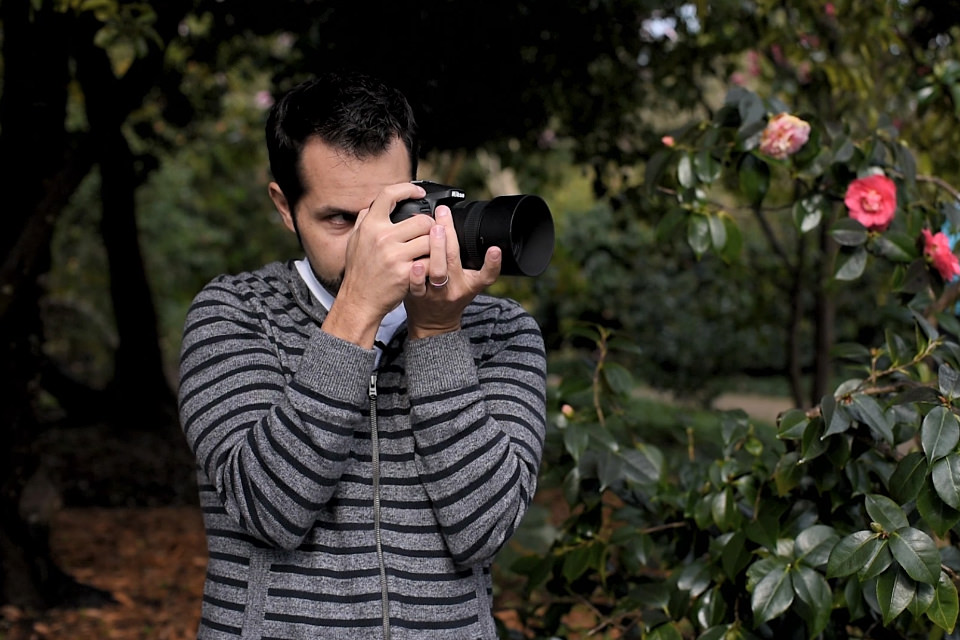
Contrary to the instructions in most camera booklets or even books, and contrary to most images such as the one featured in this article, some sports photogs or photo journalists that learned to shoot in a crowd will tell you the hero image of this article is how not to shoot a portrait.
If you stick your elbow out, you’re banging the person next to you in the face, or blocking them, and if not, they will jostle you when you’re composing your shot.
It’s also super unstable. High quality glass lenses are heavy, you’re trying to focus with the hand underneath, and the elbow out doesn’t support it.
INSTEAD:
Rotate the camera 180 degrees (shutter button at bottom, not at top), plant both elbows (or start with just your right elbow) in your front torso just below your ribs, rest the grip on your right palm, and put your THUMB on the shutter button. If it’s a telephoto lens, rest the lens weight on your knuckles (fingers folded in to your fist).
With your right arm, camera in your palm, lens on your knuckles, thumb on the shutter, you are now a mono-pod, and the camera is stable. You may now use your left hand to focus or zoom, as lightly as needed. In fast light, this is probably enough.
For rock solid shots, buying you perhaps 2 stops of light (really!), when ready to take the shot, plant your left elbow in your front torso, brace the karate chop part of your left hand against the back of your right hand, and cup the lens focus or zoom ring with your fingers. You now have the camera on a tripod (your forehead, and two arms braced). Feather press your thumb to take the shot.
Doing this (a) you won’t jam other people up or get your shot jostled because of a jutting elbow, (b) you’ll support more weight with less fatigue for longer, (c) all your portrait shots will be more stable and you can handhold low light portraits you wouldn’t believe.
Practice, and you’ll transition smoothly between this, and moving the camera weight onto the palm with the right hand tucked behind the left.
- - - - - - - - - - - -
PS. Manuals get this wrong, even while saying not to do the wrong thing.
It’s essentially impossible to find an online photo correctly depicting the technique, so above I posted selfies from the past using a full size camera.
To see what instructions books usually offer as (BAD!) example, notice how this starts out well for landscape:
Look carefully at the lower left TIP, where it says:
> “tuck your elbows into your body. The farther out your elbows are, the more unstable you will be.”
GREAT! But … then it goes horribly wrong, and pokes out someone’s eye with the right elbow in step two, instead of shifting the right hand behind the left hand to support the camera weight and keeping your elbows braced. WTF, didn’t we just cover that in step one? :-)
Step two also has NOTHING holding the weight of the camera except the left hand that should be focusing, meaning holding the weight, bracing, and focusing are fighting for muscle motor control. Don’t do this. :-)
- - - - - - - - - - - -
But wait, you say, my camera is so Pro I have a second shutter button, just for portrait shots!
However, unlike landscape where the weight of the camera body can sit in your right palm, braced on your arm, braced in your torso, this keeps your elbow in but doesn’t hold the camera weight. So elbows aren’t braced and the weight is on your focus hand.




I've noticed quite a bit of gatekeeping around this topic in filmmaking circles -- people love to act as though horizontal is an innately superior format somehow, and that vertical is only suitable for childish, amateur productions. I think that's a rather myopic take though that doesn't consider the many factors that go into a cinematic viewing experience!