Yes. I thought about words people use in priming studies, usually in order to trigger a behavior, and just typed the word with space and "person" appended.
I did use images.google.se in order to tell google which country I wanted my bias from since that is the culture and demographics I am most familiar with. I also only looked at photos of a person and ignored emojis.
I have also seen here on HN links to websites that have captured screen shots of word association from google images and published them so you could click a word see the screen shot. They tend to follow the same line as above, but with some subtle differences, and I suspect that is the country culture being just a bit different to mine.
You really should link to screenshots of your results so people can judge for themselves.
I just submitted all your searches to google.com from Australia, and the results were nothing like what you described; all the results were very diverse.
This is to be expected, as Google has been criticised for years for reinforcing stereotypes in image search results, and has gone to great effort to adjust the algorithms to reduce this effect.
I usually don't spend time producing evidence since no one else does it, nor did the parent comment, or you for that matter. It also tend to derail discussions onto details and arguments over word definitions.
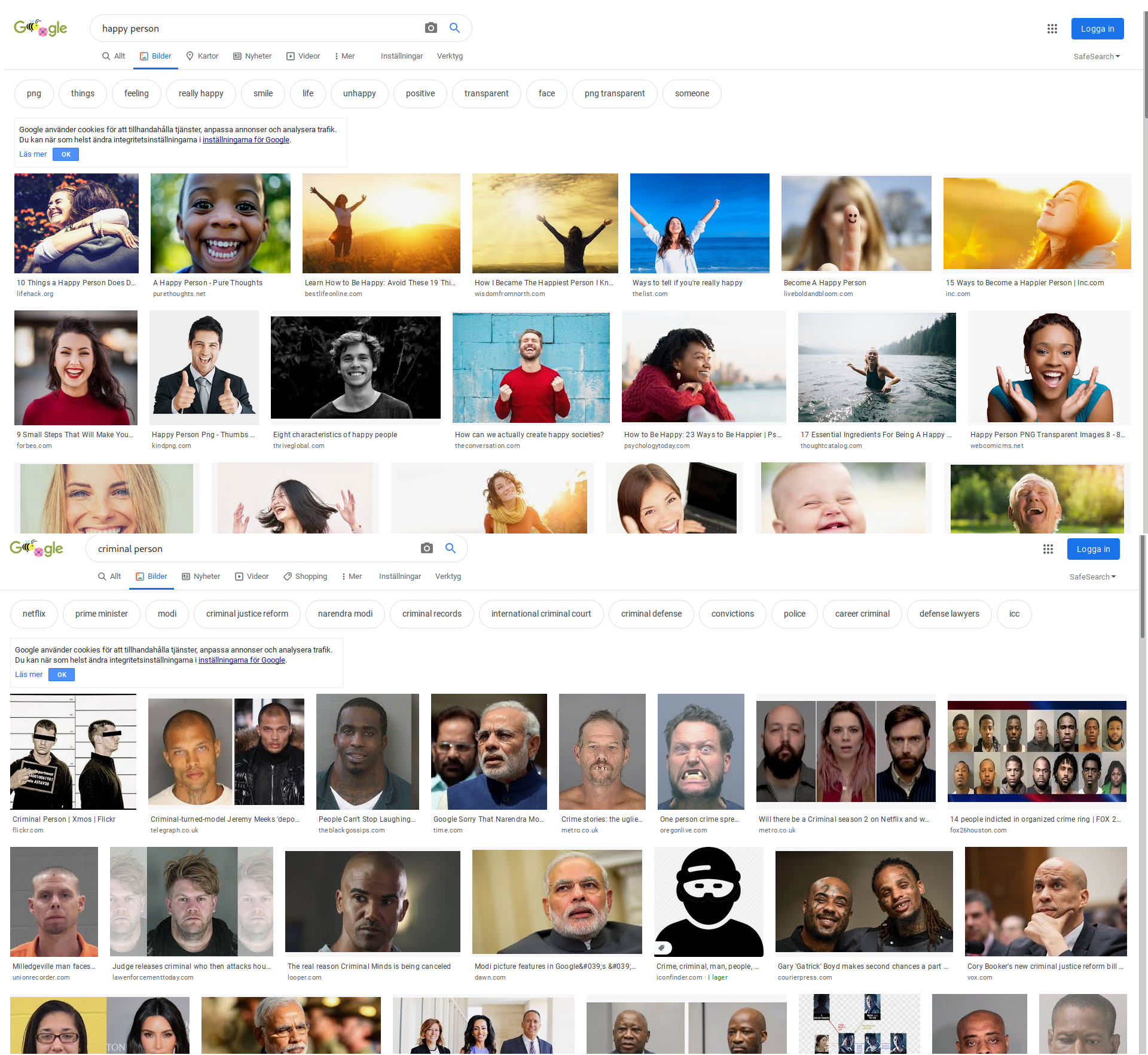
First is happy person. Out of 20 we have 14 women, 4 guys, 2 children.
Second is criminal person. The contrast to the first image should be obvious enough that I don't need to type it.
If I type in "person" only I get the following persons in the first row in following order:
Pierre Person (male)
Greta Thunberg (female)
Greta Thunberg (female)
Unnamed man (male)
Unnamed woman (female)
Mark zuckerberg (male)
Keanu Reeves (male)
Greta Thunberg (female)
Trump (male)
Read Terry (male)
Unnamed man (male)
Greta Thunberg (female)
Greta Thunberg (female)
Unnamed woman (female)
Unnamed woman (female)
Resulting in 8 pictures of females, 8 males, which I must say is very balanced (I don't care to take a screenshot, format and upload, so if you don't trust the result then don't).
Typing in doctor as someone suggested in a other thread I get in order (f=female, m=male): fffmffmmmmfmmfffmfmfmmmff
and Nurse: fffmffmfmmffmffmfffmffmffff
Interestingly the first 5 images have the same order of gender and are both primarily female, through doctor tend to equalize a bit more later while nurse tend to remain a bit more female dominated.
Thanks for the screenshot. It helps (and by the way, yes the onus is on you to provide evidence as you're the one making the original claim).
Your initial comment said "Happy person", women of color.
But your screenshot showed several white people, several men, and a diversity of ages. Yes, more women, which is probably reflective of the frequency of photos with that search term/description in stock photo libraries and articles/blog posts featuring them. No big deal.
You also said "Criminal person", Hispanic men
But the screenshot contains more photos of India's prime minister than it does of Hispanic men. In fact I can't see any obviously-Hispanic men, and the biggest category in that set seems to be white men (though some are ambiguous).
The doctor and nurse searches suggest Google is making some effort to de-bias the results against the stereotype.
To me the biggest takeaway is that image search results still aren't very good at all, for generic searches like this.
Indeed it's likely that they can't be, as it's so hard to discern the user's true intent (for something as broad as "happy person"), compared to something more specific like "roger federer" or "eiffel tower".