> Economic power doesn't come from thin air. It has a lot to do with political power, influence and domination. Those are two sides of the same coin.
The US managed to create the world's largest economy by 1890, through trade and domestic industry, while almost entirely staying out of major foreign affairs. It wasn't until WW2 that the US emerged fully onto the global stage by necessity due mostly to Europe's disastrous politics and ideologies at the time.
Clearly you can in fact have a massive economy without behaving the way the US has post WW2. Japan for some time had the world's second largest economy, they still have the third largest, and they've managed to mostly stay out of foreign affairs in the aggressive way the US has intervened.
History is complex. And interesting. And often we (and I) get it wrong. So I always enjoy a good discussion. :)
The US profited hugely from slave trade and labor. (Which most Americans usually conveniently ignore) Which helped it build up. So colonialization and domination was a factor for the US before they became a superpower.
It's true that in the earlier 19hundres the US were more reclusive and isolated.
The US economy wasn't in a good state before and after WW2... The war gave a huge boost to the economy and lifted the US out of the Great Depression. That probably laid the groundwork for the huge military-industrial complex today.
The Marshall plan wasn't just good will and benevolence either. A major goal was to create an export market to trade with. The US economy really took off after WW2! ( I can dig up a paper on that). Of course, building up a power base in western Europe to oppose Russia was also important.
Also, the falling apart of the old, Europe based empires from the late 18th century to 1930 and then the WW2 left a power vacuum, which the US filled, together with Russia.
And the world got a lot smaller then, thanks to airplanes, better technology. Nuclear weapons.
The US economy was embarrassing the major powers of Europe post civil war, when it came to almost all forms of industrial output. It was not after WW2 that the US economy really took off, it had been growing at an extreme pace from 1870-1930 - in fact that was the fastest period of growth in US history by far. The great depression was not just a US specific event.
The US ("west offshoots" in the graph, but south america can be mostly ignored until the later 20th century) grew faster then western Europe, but they only really diverged before WW1.
Europe never really recovered from the devastation that was WW1 until the 50ies.
And because of WW2 America accelerated out of the Great Depression and into an even larger and more dominant global economic superpower - an economic superpower that fueled the middle class and all the working blue collar jobs that Trump voters pine for.
The US has about the same share of global GDP today as it did in 1910-1920, before the US emerged onto the global stage. Your premise is wrong. The US was more powerful economically before WW2, than it is today. The particularly robust and brief post WW2 bubble was just that, courtesy of the rest of the developed world being blown up. In about ten years the US will approach $30 trillion in national debt, a sum so great nobody even seriously talks about attempting to pay it off any longer, and interest rates can no longer rise above perhaps 2% or 3% because the US Government would go bankrupt.
We're talking about 1980, not 2016. I didn't say they're the same relative economic superpower today than they were decades ago.
If I wanted to be facetious (this is obviously ridiculous), I would say that the solution to your complaint that America's economy is in decline is to start another war.
Japan gets to claim the US as a major ally though. They get to stay out of foreign affairs in the aggressive way because their friend carries a big stick, protecting them against China (I say this as a non-American by the way.)
>The US managed to create the world's largest economy by 1890, through trade and domestic industry, while almost entirely staying out of major foreign affairs. It wasn't until WW2 that the US emerged fully onto the global stage by necessity due mostly to Europe's disastrous politics and ideologies at the time.
All what this explains is that the potential of the domestic trade in large country such a the US is enormous. Duh.
Japan just like Germany relied on a post-war recovery, the Cold War, the US and invested back into their own growth instead of the military.
In short, no one denied that domestic trade has a lot of growth potential but that isn't an argument that international trade doesn't rely on one's influence and level of defense.
Also, regarding other comments, you always need to properly consider the full context when comparing the past to the present. For instance, until WW2 wars were consider much more of a political tool rather than a disaster. That is a vital point of view the culture of the West only slowly is developing and still in danger to get overthrown.


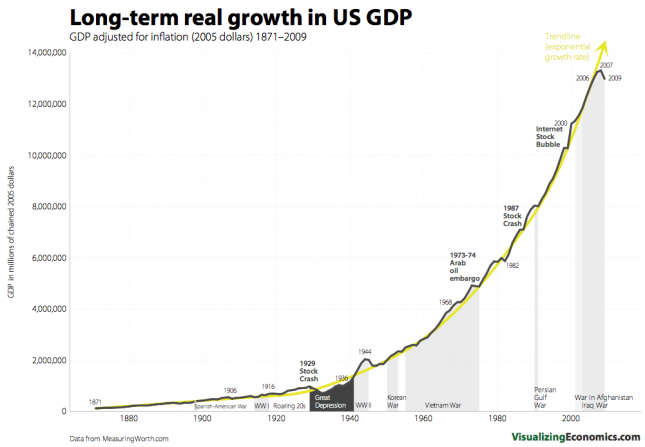
The US managed to create the world's largest economy by 1890, through trade and domestic industry, while almost entirely staying out of major foreign affairs. It wasn't until WW2 that the US emerged fully onto the global stage by necessity due mostly to Europe's disastrous politics and ideologies at the time.
Clearly you can in fact have a massive economy without behaving the way the US has post WW2. Japan for some time had the world's second largest economy, they still have the third largest, and they've managed to mostly stay out of foreign affairs in the aggressive way the US has intervened.