This assumes an inbox is a type of "project" that needs to be "completed". It's structured on the concept of removing messages from my screen until there is nothing left for me to "do".
My inbox is often more of a conversation that I fade in and out of. Sometimes it resembles a facebook feed. Granted, I'm not a type A personality, but not all email is has to be "done" anymore than all reading books need to be "done". They can be continuous reference or contemplation for a time.
I guess it depends on if we are talking about work email or personal email. Perhaps even more, it's just about perception.
Empirically, the way to do really big things seems to be to start with deceptively small things. Want to dominate microcomputer software? Start by writing a Basic interpreter for a machine with a few thousand users. Want to make the universal web site? Start by building a site for Harvard undergrads to stalk one another.
...
I think the way to use these big ideas is not to try to identify a precise point in the future and then ask yourself how to get from here to there, like the popular image of a visionary. You'll be better off if you operate like Columbus and just head in a general westerly direction. Don't try to construct the future like a building, because your current blueprint is almost certainly mistaken. Start with something you know works, and when you expand, expand westward.
The popular image of the visionary is someone with a clear view of the future, but empirically it may be better to have a blurry one.
----
Paul Graham, on Frighteningly Ambitious Start-up Ideas.
That's not a flaw in the metaphor. The whole point is that your plans are likely wrong and that the riches go to the ones who execute rather than the ones that spend all of their time on a perfect plan.
I actually like that since I've always thought like that, it's nice to see in reading (and better explained). However it has its downside, it's easy to fall into pitfalls where you can't decide which path to take. As opposite of having a vision, basically means you know where to go and what to do. I am constantly suffering from making decisions that seem important and of similar value.
The main reason is that you need to be backward compatible with 30 years of terrible hacks. That's why there's a ton of vaporware email clients --- there's a huge amount of work that most of your users don't suspect.
I have a project I was at first very excited about but then later paused working on as I discovered more about the email ecosystem. The reason I was excited about it at first was because email is--in theory--decentralized, this part was very attractive to me because I thought this was one potential way to disrupt all existing content silos. However the more I worked on it the more I found out how "centralized" it is when it comes to consumer email. If you take a look around there are only a handful of popular email providers (gmail, yahoo mail, microsoft, etc.) Rest of them are indies. I felt like building a consumer email client (or anything that utilizes consumer email) is as limited as building a twitter client, you're essentially tapping into a big platform. This is why I ran out of steam and put the idea on shelf until I come up with a compelling reason to start working on it again. I wasn't motivated enough.
Sorry, but I personally do not know the answer. I'd like to refer you to dmbaggett of Crash Bandi Coot and ITA Software fame who's currently working on fixing email:
This isn't about fixing email, it's about building big things off small ideas.
Microsoft didn't just turn into the biggest BASIC software company.
The point is that the outcome can often be unrecognizable from the origin, and not to worry to much about the endpoint, but focus on doing one thing well at the start.
No-one's "fixed" email because of the network effect. You think trying to break into the social networking space is bad? Consider that everyone who does use social networking has an email address, along with almost everyone who doesn't.
It also highly depends on your office culture around email, and how it affects your personal workflow.
At one job, it was like writing letters to fellow warriors across continents. You'd try to be thoughtful, taking a day or more to write really concrete and informational pieces. At another job it was basically the office instant messenger, replies were expected within 10 minutes of almost all email. Having direct reports changes a lot of how you're communicated with as well.
Right now I've been using notmuch+org-mode (to do list management that can link to emails, files, websites, etc), and so now I file tasks called "Read X" if it doesn't need immediate response, or archive/mark as read if I don't need to read it. Things that take less than a few minutes I do right away.
Once you take things as merely inputs to your personal management system, you no longer have to worry about how an app pushes it's workflow on you, you have an external one. This is why text files/physical papers are amazing - it's the lack of an interface that lets you organize things in whatever fashion makes sense.
I really like emptying my inbox now, but at the same time I sort of agree with you. Inbox's views can give you both, though: You can snooze messages you don't want to deal with right now and space them out based on how soon you think you might want to pay attention to them. Yet you can also at any time go in and look at the full list of messages.
It's nice as one more way of figuring out what to prioritise.
This is how I've come to use email, but the issue is the lack/limit of easy ways to make sure things don't get lost in the feed. It is easy for stuff to pile up, and that's been a real struggle for me to manage. I've given up on having inbox zero.
I work at Nylas and would love to incorporate some of this into N1, which is an open source mail app we built that also uses Electron. (https://nylas.com/n1).
If the author's hanging out in this thread, feel free to email me :) We could also make it work for non-Gmail using our open source IMAP stack!
Is email really broken or are people looking for things to change?
Reason I ask is because I see this "let's fix email" so often, peeps build something new then it either gets acquired & killed or goes no where.
What if email isn't broken. Instead email as we think we see it is merely a feed with or without action and its up to us to manage it.
PlainEmail appears like an attempt of changing our habits of reading a feed with GTD concepts. I'd much rather prefer to see my feed and an algo/machine learning identify action emails and suggest to me the best method (GTD or not) to handle it. Otherwise I'd carry on with my usual habits.
I tend to agree. The problem is that we choose to spend our time in a suboptimal manner. The email inbox is just a tool that makes it easier to waste our time. It's not like getting rid of the email inbox will keep others from sending us stuff we don't want or keep our bosses from asking us to do crazy things. If you want to fix email, recognize that you can't respond to everything, and hit the delete button more often.
I love email, but I'm still not really in love with any of the email clients I've used. I'd really like something with high information density ([0] for example) and fast keyboard shortcuts, but that has some of the soft edges that come with a gui client, such as drag and drop attachments and displaying images inline. I think astroid [1] is heading there but isn't widely supported and doesn't play nice with syncing changes back to a standard mailstore.
This is exactly what I need, I've been hoping for years for someone to create this. I even tried to do my own mutt installation to have a terminal / simple like e-mail.
I'd even go as far as removing the mouse and only doing keyboard shortcuts. Do not include attachments or images. I love it's full screen.
This will not be for everyone, and that is really OK, this is for people that must respond to a lot of emails very quickly, even if they are not on e-mail all day. I just spent 2 days going through actionable 475 unread e-mails (not newsletters, or spam)
I've always thought, software developers have vim, but there's nothing for business developers.
Thank you very much for creating this. If you will charge, I will gladly pay.
Either stick to the 4 D's of GTD: Delete, Do, Delegate, Defer; or use the commonplace terms: Archive, Reply, Forward, Snooze. When you do this, do you start to realize how similar it looks to existing email clients?
By the way you say there is no Snooze button- then what is Defer?
If I'm reading it right, "defer" means you actually schedule an appointment in a calendar. I much rather prefer the idea of snoozing (a fixed delay before reappearing) better. If I'm not interested in dealing with something now, then I'm also not really interested in vetting calendar space for it at that exact moment either.
In GTD parlance defer doesn't require a calendar appointment, it just means 'don't do right now'. Basically if a task takes more than 2 minutes to do but you intend to do it at some point, then it should not interrupt processing, but should be moved from an inbox to a 'trusted system' for organizing and tracking tasks.
Snoozing works ok, but strict GTD tries to build a discipline of not having items re-appear in the inbox. If it's moved to a list of things to handle, then it can be ignored or placed at a lower priority on that list.
Bwa ha ha ha ha. I guess the perception is different depending on where you're from. I immediately thought of the swipe left/right aspect - though I'm in a community that is more chaste than most though. For example, I know a couple who met through tinder without any sex before marriage. That's probably why I thought different - I just really haven't known enough people who use tinder like you described. Or used tinder at for that matter.
I treat emails as open loops. I currently have four in my inbox representing three open loops. I consider "inbox zero" to be a counter-productive strategy focused on the wrong things.
I still do GTD-style triage, but I'm more willing to let stuff sit in queues. Inevitably I get sick of looking at it and do something about it, moving it into a backlog or working out a way to just do it right now.
But my life isn't one where more productivity would really net me all that many life improvements. Generally, if I can visualize a pathway to a real life improvement, motivation to get it done is not an issue.
My life generally consists of trying to solve really hard, complicated situations using mostly intuition. Staring at something sitting in a queue is often all I need to get that intuition going. "Why do I want this? How does this connect to other parts of my life?"
I completely agree with this. I manage my inbox the same way and stare at lists thinking that as well. Are you using any different email client right now?
Yea me too. What I really want is something that looks like Trello where the first list is my Inbox, and then there are 2-3 other lists that I can make up like "This week", "Next week" etc.
Although there's a strong "email sucks" sentiment in the world, I believe the truth is that email is a complex system that has actually already evolved quite well. Gmail is quite an adept tool.
The inherent issue is volume - which isn't per-se the fault of the medium. Filtering and categorization has been the primary answer there - and those things (including this post) have helped evolve those issues.
It only supports GMail, but still works as far as I know. Back then it was the only app I knew that had that concept, but by now there is Triage, plus most modern mail clients have the "swipe" actions for quickly getting through emails.
Honestly I don't know why people keep trying to do this kind of thing: reinventing email. Email works fine and nothing has been able to replace it (e.g., Google Wave, Mailbox, etc). I think the reason is that email works fine for most people. And if it isn't, a new tool to help you manage it isn't going to fix your problems. It'll probably just create new ones.
The answer to "my inbox is crazy" is to work through your inbox - if there's too much for you to work through then you need to do less. That's it.
I'm not sure I necessarily agree. Inbox by Google (and before that Mailbox to some extent) has drastically improved my email workflow. Being able to "snooze" emails and get a notification about them when you're likely to be able to take action on them was a novel idea that moved the email space forward.
I refuse to believe that we've exhausted the list of designs we can try to continue to improve email. And considering how pervasive email is, even marginal improvements can have profound effects.
And I hate to sound like a wet blanket on a new tool/thing. Just an honest reaction to yet another email aid app. I'm sure there will be people who use this and find it useful.
I'm just trying to make the point that at some point all the lifehacks/efficiency-improvements in the world will not fix the problem of being over-burdened.
No tool will ever solve the problem of being over-burdened, as becoming more efficient just means doing more in the same amount of time.
Being over-burdened is a personal / social problem, and the only solution is not taking on / expecting more than is realistic... easier said than done!
Efficient use of time is it's own goal, and is orthogonal to the overall load.
I'll admit I spent a couple of minutes trying to establish a link between paired programming and the 'less than 3' before my teenage daughter helped dad out.
I'm beginning to categorically distrust these "Made with Love" people. Obsessive, made-with-love types seem to be these hard-charging, work-at-all-hours nerds that need to get out more
Like as in you started your head toward the screen but stopped? Or perhaps it occurred to you that headbutting the screen would be desirable but you refrained from doing so out of regard for your health and the health of your equipment. Or are you simply using "headbutting your screen" as an analogy for how you felt, which would be sort of ironic.
I like the approach! I'm a GTD user and would love for the app to integrate with OmniFocus, meaning that defer and delegate are added to the appropriate place within my contexts and projects.
"Snooze" to me implies delaying for a unit of time that you may choose to repeat. From their description of "Defer" it seems you pick a specific date/time and add it to your calendar.
verb (used without object), deferred, deferring.
1.
to yield respectfully in judgment or opinion (usually followed by to):
We all defer to him in these matters.
Defer forces you to book a time in your calendar instead of "snoozing" the message just so that it reappears later. Actually, snoozing was one of the most exciting features I saw in Mailbox, but after using it heavily I realised I get plenty of messages on Monday morning back to inbox and I just snooze them again. It turned to be a complete disappointment for me
How about making "defer" be snooze with a hard limit of 2 or 3 times max?
This I think would work because you could snooze if really you cant/dont want to deal with a message immediately but eventually you would have to.
Or maybe have up to X "snooze slots" so that you cant snooze everything and you snooze things that truly dont deserve to be deleted. And you would have to empty a slot by dealing with a snoozed message to be able to snooze a new one.
Honestly, you should change all the words except "Done". When people are using "simple" email software, they don't want to have to think about dictionary/uncommon words like "defer" and "delegate".
I believe I'll have the same problem with this app that I have with Kindle -- the lack of flipability in the name of apparent convenience and simplicity.
There is an unspoken importance in an inbox glance, in seeing a list of "undone" email and getting a gist of things. There is a similar feeling in flipping pages of an entire book.
Imagine being in a room where you only see one object at a time, you can either use it or defer it for a later time. Simple? Yes. Will I hope to stumble upon a gun to put in my mouth? Indeed.
There is a magic in looking at the world and deciding on what to do. It's much faster, efficient, and satisfying.
I just downloaded it. I like "response", "delegate", and "defer", and "unsubscribe".
I do not like that is only runs in fullscreen, but I think I get why you're doing it.
I current use Google Inbox and set my default "done" action to delete. You should support the notion of "done forever".
I maybe keep 10% of the email I receive. Having a heavy hand with deletion forces me to think about the value of the communication and to capture the important actions and details in my todo system.
The days of open source propaganda are long gone, at least for me. But this sounds like a thing that should be put into open source, in a way that not just the own gui can use it but that other email client creators can integrate it as well (i.e. a library). We've seen so many email clients come and go, having a single app do that is not enough to stay in the game.
Just a heads up, my workplace McAfee Web Gateway filters this website under the category "Phishing" with a "Medium Risk" reputation. Perhaps the previous domain owner wasn't the most reputable. Not sure what you have to do to get off of McAfee's list, but wanted to mention it as it might keep people from being able to visit your site.
Would be intersting to be able to tag the email as it's being marked "Done". It's the GTD analogy of filing it away. Yes full-text search can turn up almost anything but a tag may help for smartmailboxes or further post-processing work.
This Gmail workflow that I use religiously does the tagging but lacks PlainEmail's distraction-free interface to take the actions. I'm currently using keyboard shorts to accomplish this: L (to label), then P (for priority)/W (for waiting) or just Star (for reference). http://klinger.io/post/71640845938/dont-drown-in-email-how-t...
I really liked Mailbox (later acquired by Dropbox). It was clean, easy, zero inbox with one million user signups at the beginning and what happened to them? Went to the kitchen sink... I expect the same from this.
Cool product. From a design perspective I really love the website, you've done extremely well. Just a small note I believe the typography could be improved by implementing more headers.
I was hoping that this was going to be about using plaintext emails. It's pretty cool, though. I have a very similar workflow with mutt and a few keybindings.
The app itself is yet-another-email-client. Those original verbs in the screenshot are just pre-built macros. I don't consider "Inbox Zero" a worthy goal -- because the REAL goal should be reducing your total volume of email, by conducting one's work in a way that minimizes reliance and interactions with other people for day-to-day matters.
IMHO the REAL solution to less email is smarter communications and personal empowerment: keep your meetings short and laser-focused, keep conversations focused and purposeful, make sure everyone is in sync before beginning, and don't hire/work with stupids. I shouldn't have to email Bob just to ask him to request deliverable X -- I should be empowered (and intelligent) enough to get X on my own, and if I don't know how then I should use my powers of observation and inference to figure that out.
People over-rely on email, and on communication in general.
Page is pretty well put together (indicating some time was spent) - all the JS is for the "fancy" fading/sliding effects and is quite comment. Parent is being harsh, but you're also being too reactionary.
* Email software
* Main design aesthetical feature is whitespace
* Generic name
* Monochromatic gradient
* Modern typestack
* Rounded buttons
* Made with heart emojis
This landing page and design could have been generated by software that intentionally crafted status quo product examples, and I would not be able to tell it apart from something legitimately created.
This is a product of the times, not a product pushing the our times forward. It really is like the output of a Markov chain product generator.


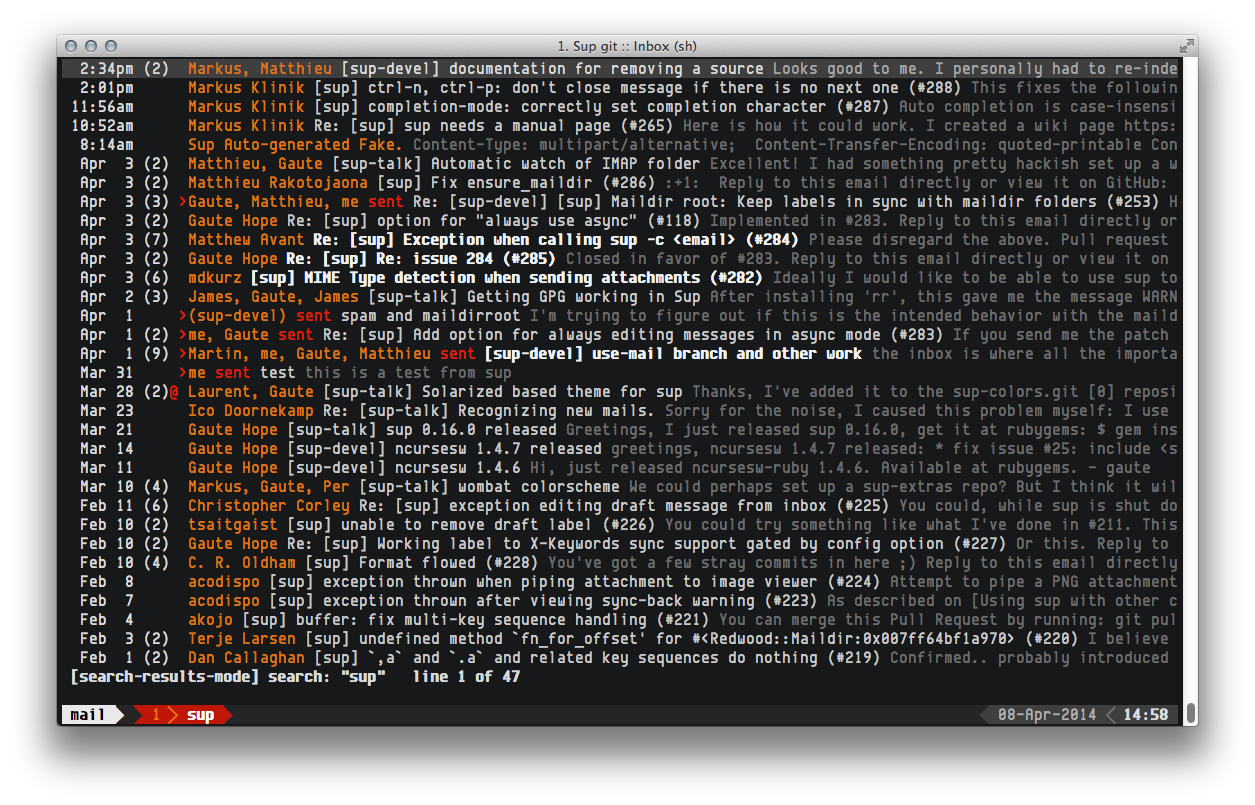
My inbox is often more of a conversation that I fade in and out of. Sometimes it resembles a facebook feed. Granted, I'm not a type A personality, but not all email is has to be "done" anymore than all reading books need to be "done". They can be continuous reference or contemplation for a time.
I guess it depends on if we are talking about work email or personal email. Perhaps even more, it's just about perception.