For your particular case, you're referring to some of the slower blockchians. There are much faster and essentially free blockchains (like Base or Solana) which solve 1-3 on your list. UX still an issue.
They do not really solve the issue because I still need to at some point transfer/convert to the "big guys coin" to actually get the funds to a exchange.
Ethereum and Bitcoin are really the only coins that suffer from congestion from time to time leading to high transaction costs. This is more apparent on Eth where contract interactions can lead to those high +$20 transaction costs, thats when it might be worth it to wait for when the congestion has cleared.
If you can avoid ethereum's main layer altogether it becomes much cheaper transact, most exchanges support the various l2 layers that have been popping up recently.
I do agree that it takes way too much time and effort for anyone not familiar to the crypto scene to figure out all the different chains, their compatibility, bridges, swaps etc. to make cost efficient transactions.
You can withdraw funds out of Base using Coinbase. Takes a few seconds, it is a legit entity approved by the US govt with all the KYC/AML regulations, and is going to cost very less in a few weeks after the Dencun upgrade.
Correct me if I'm wrong but this seems like a poorly messaged setting and an overreaction by users on X. Sounds like they will use a commercial AI when you use Dropbox AI to ask about a document.
In that case your organization account should make the decision on enablinng this capability, Dropbox should not have carte blanche to scan your content ahead of time.
the cost of indexing with an AI would be absurd. it's more likely a one off Clippy type service where it's only sending it to openAI when the user requests.
still should be optin universally, but it's unlikely they're wasting compute scanning before a user even wants the service.
The community seems stronger than ever. What was your experience of its fading away like? Projects like this don’t give the impression of a language falling by the wayside. People tend to fall in love with Elixir. You never forget falling in love.
might be just that core elixir is pretty stable. I haven't consulted the elixir forums in months because I rarely run into issues that require external help. I write elixir every day though. Would love to see more people get into elixir though for when we start hiring more people.
The most recent StackOverflow poll shows Elixir as having the highest percentage of people happy with working with it (over 70%), taking top spots among all tech languages and platforms … and is among the lowest for tech people wish they are using for work, but are not.
In other words, many of the developers who want to be working with Elixir are working with Elixir, and are quite happy doing so.
What drives great web framework is a culture of making product. RoR and PHP based frameworks have massive product makers, thus it drives forces into libraries made for variety of products.
Elixir's culture is engineering-ish. So you will see decent libs that deal with weird mechanism stuff, but lack of vibe and forces driven from business needs.
This is very true. the ecosystem has astounding next gen tooling for solving all sorts of things easily that are real bugbears in other languages (oban, horde, genstage, numbat) but the libraries for interfacing with actual third party services or doing mundane things are a bit lacking.
Its the reason I tell startups to use laravel or node instead even though I built my startup in elixir. Yes its a huge advantage for what we do (realtime synced apps for managing restaurants) but its overkill for most saas products that are just glorified crud apps. laravel is a huge winner there with its library of prebuilt apps that handle user authentication, billing, tenancy as drop in components.
There's plenty of example. Stripity stripe is an example of one of the better integrated examples and even I've been a bit frustrated with it at times. We're currently stuck on a slightly older version and last I checked, it didn't support the latest version of the stripe API. And that's an example of a library thats relatively well maintained. If you want to use authorize.net for instance, you have to roll your own. (there's a hex package but its still very much in beta). If you wanted to do banking and use Synapsefi, be prepared to roll your own.
Now it wouldn't' be any harder to write these libraries in elixir vs ruby or laravel. The difference is there are well polished libraries for both those platforms you can just drop in and use. That makes what could be a week of work in elixir, about half a day in ruby by virtue of the work largely being done for you already.
If the library doesn't exist for either, then I agree, elixir isn't going to be any harder to integrate.
Datadog APM, Segment: both key to building day to day products, none first party support. Community libraries exist, but their bus factor isn’t looking good.
That hasn’t been my experience at all. ElixirConf was well attended this year and regional conferences are coming back. The Slack is active. Most of the podcasts are still running.
Elixir was one of the few languages I saw in companies (albeit, infrequently) that wasn't like Java, C#, Python, or JS (Scala here and there). Was always curious about it as perhaps something that could be reasonably pitched as having some nominal uptake.
Pure anecdata there also. Literally just ones I have personally seen on clients or heard about from coworkers.
We use it at a large company and employ almost 60 people writing it. It’s been great so far. The talent pool is really good and it’s easy to teach to junior devs.
Interesting, I was thinking the opposite. Elixir Forum has so much volume I stopped following it 1-2 years ago and now hang out in the much quieter Erlang Forum :D
https://usdc.cool - I wanted to track the supply of the stablecoin USDC, and check against their audits. Another benefit was trying to see what happens to the USDC supply during certain crypto events, like crashes or pumps.
Turns out it's quite interesting. When crypto goes down, many folks sell into USDC, which causes more USDC buying by the exchanges. But when crypto goes up, people often get in with USDC.
So basically: USDC goes up. And since this money is sitting in Circle's bank accounts, imagine what happens when the Feds raise interest rates. $CND is the SPAC supposedly taking Circle public, if it ever goes through.
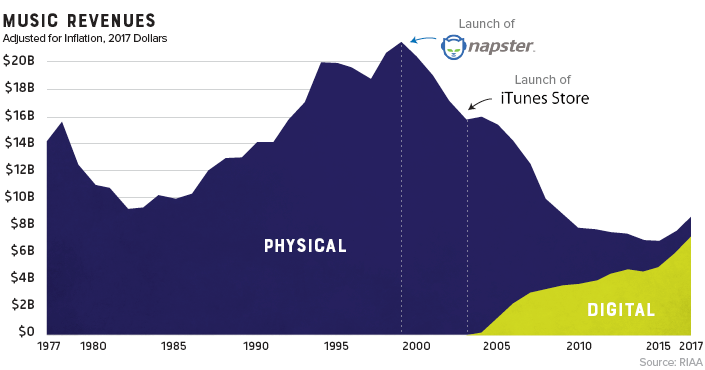
Napster is one of the two or three products that spawned a completely different world, entirely tossing established and antiquated rules on their head.
Of course, very directly, Spotify would not exist without Napster.
But a step further, it opened the eyes to end-users about their collective power, and the beauty of distributed distribution. It was the first proof that "regular" users would buy into such a thing. Napster, in many ways, gave birth to BitTorrent, Bitcoin, and all of the derivative work thereof.
I think p2p was so successful that the music industry had to change. They had to be more convenient or would lose all the control on media distribution. Users of modern streaming services owe a lot to p2p users of early.
>Napster, in many ways, gave birth to BitTorrent, Bitcoin, and all of the derivative work thereof.
You say that, but before Napster, there was Seti(?), a program that would search for extra-terrestrial life - by distributing the work load on top your personal laptop
SETI@home and Folding@home at least provided intrinsic value from their computations. It'd be nice if we could have a coin based on protein folding or climate simulations or something.
There's at least one coin that does that. It's a Nano clone (not sure if clone is the right word), called Banano.
You "mine" it by joining their folding@home team, and you get banano based on how many folding@home work units you complete. It's pre-mined though, so maybe that doesn't quite fit.
There was another cryptocurrency I remember which was mildly popular years ago called Primecoin, which attempted to find a certain type of prime numbers. It's interesting, but I'm not sure if it ever provided any actual usefulness from the work performed.
I don't see any reason that a cryptocurrency couldn't be tied to something like protein folding or climate simulations. People just don't choose to do so.
When bitcoin mining first became a thing, it felt like they'd found a way to make distributed computing (like the seti and protein folding projects) profitable.