Where are you getting these numbers? Looking at the PSFs Report for 2024 [0], 50% of their expenses went to pycon. Would you consider that outreach? I believe conferences are very important as part of the health of a language, and reading the definition of outreach[1], I would not classify the conference as that. The second highest amount of expenses (27.1%) went to (surprise!) "Packaging Work Group/Infrastructure/Other", i.e. pypi, pip etc... "Outreach & Education" was only 2.8% of 12.9% of expenses, i.e. 0.3612%, which is $17846 (actual dollars, not thousands like in the report.)
The assertions above are my memory from pre-covid, I’d look at 2019 and before perhaps. Many things changed after that (and council too) but it takes a while to change perception.
In 2019 [0] they only had 2.5 million of total expenses, of which 75% was pycon. So even if everything else was on "outreach" (it was not), that would only be $642,500, which is not "several million a year".
In 2020 [1] 48.1% went to "Packaging Work Group/Infrastructure/Other" (I assume because in person pycon was canceled).
I also checked 2021 [2], which was 32.7% pycon and 31.2% pip etc...
Also 2022 [3], 57.8% pycon, 26.6% Packaging Work Group...
In 2023 [4], 60.5% pycon, and Packaging Work Group expenses decreased to 9.6% because of fastly now provides the bandwidth/hosting: "We are grateful to Fastly for making the online services that the PSF provides possible, so that we can
invest time and resources into advancing our infrastructure to better meet community wants and needs."
I have looked at 2018-2016, where the expenses are almost completely the main pycon and more local pycons. Also sponserships like "Pallets group, which maintains projects such as Flask and Jinja" (2018). Everything other than the main pycon is less than 1 million dollars combined in expenses.
I feel it is important to look at the facts, not just vibes.
Those are "fiscal sponsorships" meaning the PSF holds money for other organizations. The PSF is not funding Pallets (or Boston Python or North Bay Python, etc, etc). They accept money earmarked for those organizations and provide administrative support. Details: https://www.python.org/psf/fiscal-sponsorees/
A portion of pycon expenses are spent on outreach and teaching during the event. Arguably all of pycon is outreach. There are dedicated grants, aid, support as well. The 2019 PDF breakdown doesn't seem to be available any longer.
As we all know, Astral stepped in and solved the problem for them. I moved to their tools as soon as was possible. And not simply because they were fast, but because they work.
I guess it depends on what you mean by English.
England is a country, but you can't have an English passport, you can only get a UK passport.
so, English is a kinda-sorta a non-nationality, but it is very much an ethnic group.
I don't think anyone is claiming that Rishi Sunak isn't a UK citizen, but he certainly isn't a member of the English ethnic group, or any of the Celtic ethnic groups that also make up the UK's native population.
If we go by the explanation from wikipedia [0], Boris Johnson and Nigel Farage would not be considered English, as their families are not part of the English or Celtic ethnic groups. Their ancestors are Turkish and German who came to the UK after 1850. Do you believe they are not English? I mean even the current King of the UK would not be considered English by your definition! He is descended from Greek, Danish and German people [1].
I agree, they are not ethnically English, they are British citizens and have all the rights that come with citizenship, the same as every other UK citizen including those that would call themselves English. You think there's some kind of gotcha there, but there isn't.
England hasn't had an English king since 1066, that's not controversial, and even then the inbreeding between the European royal houses was creating a pan-european elite that made world world 1 more of a really bad family argument than anything else.
What's really odd is that Rishi Sunak is extremely proud of his ethnicity and heritage, it's unfortunate that we've made it almost impossible for other people's to have that same pride.
The usual meaning of English. Say, roughly the criteria that would make someone eligible to play for the England football team. Skin color has nothing to do with it, and I can assure you that very few English people either know or care whether they have any ‘Celtic’ ancestry.
No-one questions the Englishness of white men born in England to two non-English parents. People raising the absurd non-issue of Rishi Sunak’s Englishness are just concealing their rather obvious prejudices with a lot of bafflegab about ‘English ethnicity’ (a concept which not even they can really take at all seriously, if they at least have some acquaintance with English history).
There are Ethnic groups in England that have been present for several thousand years. Some people clearly mean this and can't articulate it better.
Rushi Sunak ancestry is obviously Indian. I don't really care about his ethnicity (he another politician in a suit to me), but I can understand what people mean when they say he isn't English without automatically assuming they are Racist.
Sports teams aren't a particularly good criteria, I could be Scottish or Welsh and play for England, it's one of those idiocracies of living in a country that pretends to be 4.
Denying the existence of an ethic group is extremely racist, and is often considered a precursor to other much more serious issues.
If you have any acquaintance with English history you would be well aware that there are native ethnic groups that have been in the UK since approximately the end of the younger dryas around 11,000 years ago.
The last major migration was the anglo-saxons around 1500 years ago.
These groups still exist and the majority of the UK population can still trace their origin back to one of these groups.
>If you have any acquaintance with English history you would be well aware that there are native ethnic groups that have been in the UK since approximately the end of the younger dryas around 11,000 years ago.
And you'd be aware that nothing even vaguely corresponding to 'England' existed 11,000 years ago. If you are willing to lump the descendants of Romans, Normans, Jutes, Durotriges, Iceni, Vikings, etc. together into one group and call them all 'English' just because they happened to live in the territory of what is now England, then you've already conceded the point that the identity is national, not ethnic.
But hey, over in the other thread you are denying that Boris Johnson is English, so it's clear that you have a rather eccentric concept of the category.
It's interesting that other native groups, all of which have intermixed with others over thousands of years don't have to defend their right to their ethnic identity.
The English ethnic group is defined by a shared genetics and culture, the English enthic group isn't just political it is biological and can be identified via DNA.
I wouldn't consider my definition eccentric, it's based on the UN defintion: Ethnic group or ethnicity refers to a group of people whose members claim a common heritage or common ancestry and usually speak a common language and may have some common cultural practices.
The other thread argued that Boris Johnson is ethnically Turkic (I have no idea if that is true) on the assumption it is true, Boris Johnson may meet the requirement of a common language, but does not meet the requirement of a shared ancestry to be ethnically English.
Many of the groups that you mentioned existed in the UK over 1000 years ago, and shared in the same invasions, same issues, and developed a shared culture due to that shared history and closeness of relations, and of course as evidenced by DNA analysis interbreeding.
So yeah I would say that in the space of a millennium multiple groups can become one group.
If only a reason were given. This is the original:
> Rust is a security nightmare. We'd need to add over 130 packages to main for sequoia, and then we'd need to rebuild them all each time one of them needs a security update.
What has changed? Why is 130 packages for a crypto application acceptable?
That's not a Rust problem, that's a sequoia problem.
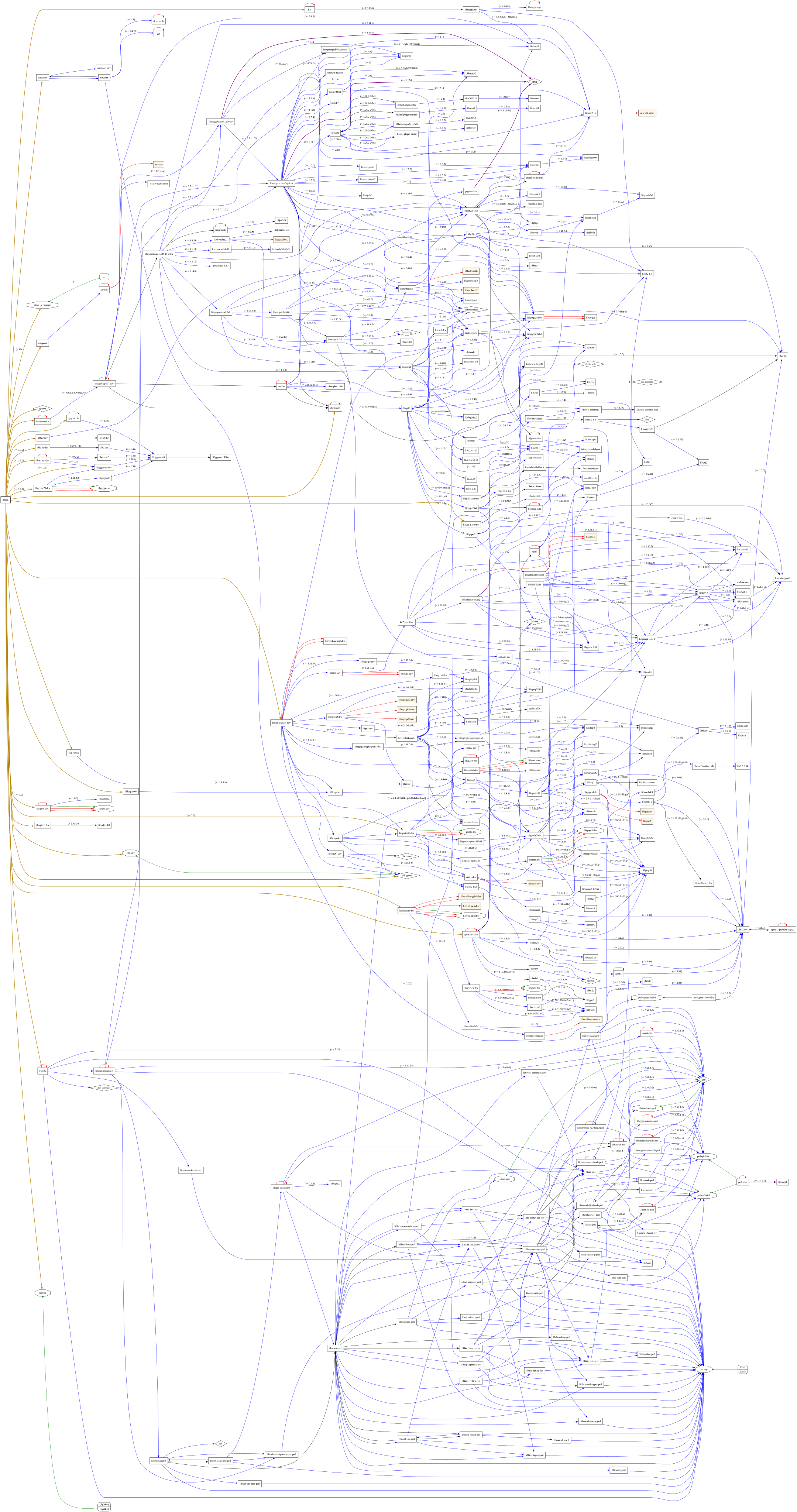
As for why, probably the same reason the dependency tree for gnupg (generate with `debtree -R -b gnupg` but grepping out all the gcc/mingw dependencies) looks like this: https://static.jeroenhd.nl/hn/gnupg.svg There's probably a good reason why I need libjpeg62, libusb-1.0-0-dev, and libgmp3 to compile gnupg, though they're hidden away from the usual developer docs in the form of transitive dependencies; complex software just tends to include external dependencies rather than reinventing the wheel.
Is it? Rust, or rather its online acolytes, deems a simple linked list "too complicated" for mere mortals, and routinely tells people "just" to use a crate that does it for you.
To me, this sounds like "leftpad" but for CS1 data structures.
Debian's tooling for packaging Cargo probably got better, so this isn't as daunting as it used to be.
Another likely thing is understanding that the unit of "package" is different in Rust/Cargo than traditionally in C and Debian, so 130 crates aren't as much code as 130 Debian packages would have been.
The same amount of code, from the same number of authors, will end up split into more smaller packages (crates) in Rust. Where a C project would split itself into components internally in a way that's invisible outside (multiple `.h` files, in subdirectories or sub-makefiles), Rust/Cargo projects split themselves into crates (in a Cargo workspace and/or a monorepo), which happen to be visible externally as equal to a package. These typically aren't full-size dependencies, just a separate compilation unit. It's like cutting a pizza into 4 or 16 slices. You get more slices, but that doesn't make the pizza bigger.
From security perspective, I've found that splitting large projects into smaller packages actually helps review the code. Each sub-package is more focused on one goal, with a smaller public API, so it's easier to see if it's doing what it claims to than if it was a part of a monolith with a larger internal API and more state.
It depends if the original opinion was a reasoned one or just based on personal feelings.
The dependency explosion is still a problem and I’m not aware of any real solution. It would have been interesting to to see why their opinion changed… I’m guessing it’s as simple as the perceived benefits overriding any concerns and no major supply-chain attacks being known so far.
It depends on how you define supply chain attacks.
Recently, there was an exploit discovered in an abandoned Rust package that was used by many other Rust projects, many unaware of it due to the sheer number of dependencies. Whether by negligence or malice, having a known vulnerability that permeates significant portions of the ecosystem is on the order of a supply chain attack.
Given projects that make the claim of switching to Rust to access new contributors, it remains to be seen how many of those new contributors are capable of being retained.
I would much rather work with someone that other people find abrasive but who communicates much like myself and is clearly open-minded, than the opposite.
I don't really understand the appeal of jj as someone who uses sublime merge [0].
It has good support for submodules, a lot of the editing commits (messages, squash, move etc...) is really easy and I can also see and edit my stashes directly. Is there any benefit to jj compared to this?
Thanks!!! I also saw your other post about C# - maybe one day JetBrains would change their mind!
I'm trying latest IDEA (2025.1 EAP) and for the first time a bazel project that I have got parsed successfully (had to enable some old legacy flag though), so there is hope!
Over the years I've tried both the google plugin, and now the BSP one.
Mixed results. Almost always works on Linux/OSX, but my dominant platform is Windows.
Yesterday tried it again (BSP one) with IDEA 21.5 EAP with nightly on the plugins, and things got synced, but was not able to find any targets (they are C++ targets), funny it found and listed a "filegroup"
But I have my hopes up, the BSP looks like it's doing the right thing discovering much faster the targets, and probably needs more work just to finish all edge cases (like mine - Windows).
The man who "wrote" the code disagrees with your take on Katie Bouman:
"While I wrote much of the code for one of these pipelines, Katie was a huge contributor to the software; it would have never worked without her contributions and the work of many others who wrote code, debugged, and figured out how to use the code on challenging EHT data."
Btw lines of code != amount of contribution, sad to see this kind of take on a supposedly programmer focused site.


[0] https://www.python.org/psf/annual-report/2024/ [1] https://en.wikipedia.org/wiki/Outreach