I'm obviously biased when it comes to FOSS foundations, but Simon is also a member of the board of the Python Software Foundation, which is not nothing in terms of looking after our craft.
The LLM stuff feels minor in comparison, even if it may be what HN knows him for. It's certainly not the same level of achievement as your average bargain bin AI rambler in your LinkedIn feed.
If anything, Python programmers should be mortified that PSF leadership includes someone who seemingly spends all his free time and social capital trying to normalize slop and downplay the negative externalities of a bunch of companies that openly wish to undermine software authorship, depress programmer wages, and obliterate career opportunities for novice programmers.
The Industrial Revolution is coming again. Look at data center spend for massive companies like Microsoft. Love it or hate it, the AI you see today isn’t going away. It will only become more capable.
Maybe the next generation can / will need to start the Butlerian Jihad but we’re stuck for now.
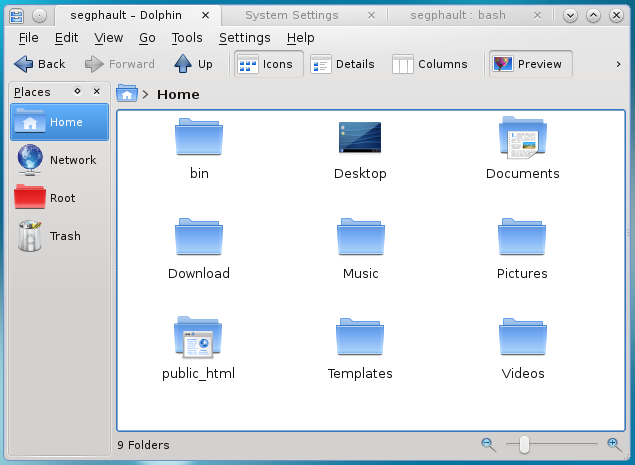
Clearly you've had some interaction that upset you and I apologize for that, but I've never come across any Plasma dev who felt we nailed that one (and I wrote large parts of the panels, the menu, the icon desktop, etc.) I was genuinely surprised by your comment.
To be honest, this is like.. 5 years back? Maybe more. But I don't switch DEs that often.
It's funny to see the two things that prompted the discussion (naming desktops and per-desktop wallpapers) come up heavily under that issue you linked.
Like I mentioned in another comment, I like that KDE devs are much more constructive than Gnome devs. In that issue you can clearly see you're asking users to rephrase their feedback so it is more useful.
With Gnome, I've for example opened an issue for something that isn't according to visual HIG practices. Implementing this would lead to more visual clarity and it would look better to boot. I got told that no, actually they know better. It was pretty clear that they thought that if code or design originated from their shop, there could be no (better) alternative.
When I linked and gave mockup examples I got snarked, and when I snarked back I immediately got dressed down for rule violation by some mod figure that completely ignored their dev's initial snark. Just very, very unpleasant people.
Apologies for the rant haha. Anyway, thanks for linking that and for responding!
I'm a bit wary if this is hiding an agist sentiment, though. I doubt most Rust developers were 'born into' the language, but instead adopted it on top of existing experience in other languages.
People can learn Rust at any age. The reality is that experienced people often are more hesitant to learn new things.
I can think of possible reasons: Early in life, in school and early career, much of what you work on is inevitably new to you, and also authorities (professor, boss) compel you to learn whatever they choose. You become accustomed to and skilled at adapting new things. Later, when you have power to make the choice, you are less likely to make yourself change (and more likely to make the junior people change, when there's a trade-off). Power corrupts, even on that small scale.
There's also a good argument for being stubborn and jaded: You have 30 years perfecting the skills, tools, efficiencies, etc. of C++. For the new project, even if C++ isn't as good a fit as Rust, are you going to be more efficient using Rust? How about in a year? Two years? ... It might not be worth learning Rust at all; ROI might be higher continuing to invest in additional elite C++ skills. Certainly that has more appeal to someone who knows C++ intimately - continue to refine this beautiful machine, or bang your head against the wall?
For someone without that investment, Rust might have higher ROI; that's fine, let them learn it. We still need C++ developers. Morbid but true, to a degree: 'Progress happens one funeral at a time.'
> experienced people often are more hesitant to learn new things
I believe the opposite. There's some kind of weird mentality in beginner/wannabe programmers (and HR, but that's unrelated) that when you pick language X then you're an X programmer for life.
Experienced people know that if you need a new language or library, you pick up a new language or library. Once you've learned a few, most of them aren't going to be very different and programming is programming. Of course it will look like work and maybe "experienced" people will be more work averse and less enthusiastic than "inexperienced" (meaning younger) people.
I agree that "programming is programming" but Rust feels very different with my background (some ML and many years of C, Java, some Python, a little Go, etc.) than for somebody whose only previous language is Java, or Javascript, or perhaps even C++
The "You can write Java in any language" mentality afflicts some languages worse than others, but if your programming is exclusively in a single language you will be tainted by that regardless of the language. C++ is perhaps worst for this because its proponents, and
indeed its standards committee have their own terminology for everything. So there aren't "methods" but instead "non-static member functions" for example. This has the "Call a rabbit a smeerp" problem, where you can't tell whether you actually don't know a feature or if you just know the exact same feature by a different name.
I guess what I'm saying is that writing any language in an idiomatic way takes a bit more than just "programming is programming" plus a word-for-word translation guide, and some people might be weary of learning new idioms.
>Experienced people know that if you need a new language or library, you pick up a new language or library.
That heavily depends, if you tap into a green field project, yes. Or free reign over a complete rewrite of existing projects. But these things are more the exception than the regular case.
Even on green field project, ecosystem and available talents per framework will be a consideration most of the time.
There are also other things like being parent and wanting to take care of them that can come into consideration later in life. So more like more responsibilities constraints perspectives and choices than power corrupts in purely egoistic fashion.
I still think you're off the mark. Again, most existing Rust developers are not "blank slate Rust developers". That they do not rush out to rewrite all of their past projects in C++ may be more about sunk costs, and wanting to solve new problems with from-scratch development.
> most existing Rust developers are not "blank slate Rust developers"
Not most, but the pool of software devs has been doubling every five years, and Rust matches C# on "Learning to Code" voters at Stack Overflow's last survey, which is crazy considering how many people learn C# just to use Unity. I think you underestimate how many developers are Rust blank slates.
Anecdotically, I've recently come across comments from people who've taught themselves Rust but not C or C++.
Oh I agree the survey has issues, I was just thinking about how each year the stats get more questionable! I just think it shows that interest in Rust doesn't come only from people with a C++ codebase to rewrite. Half of all devs have got less than five years of experience with any toolchain at all, let alone C++, yet many want to give Rust a try. I do think there will be a generational split there.
> Steve Klabnik?
Thankfully no. I've actually argued with him a couple times. Usually in partial agreement, but his fans will downvote anyone who mildly disagrees with him.
Also, I'm not even big on Rust: every single time I've tried to use it I instinctively reached for features that turned out to be unstable, and I don't want to deal with their churn, so I consider the language still immature.
Okay I had upvoted you but now you're just being an asshole. Predictable from someone on multiple fucking throwaways created just to answer on a single post and crap on a piece of tech I suppose; I don't even care much about Rust. And I'm sorry to inform you I'm not Klabnik, but delusions are free: Maybe you think everyone using -nik is actually the same person and you've uncovered a conspiracy. Congrats on that.
I'd shove you a better data point but people aren't taking enough surveys for our sake, that's the one we've got. Unless you want to go with Jetbrains', which, spoilers, skews towards technologies supported by Jetbrains; I'm not aware of other major ones.
This behavior is weird. Your parent writes nothing like me.
The only alt I’ve made on hacker news is steveklabnik1, or whatever I called it, because I had locked myself out of this account. pg let me back in and so I stopped using it.
According to the strange data at https://survey.stackoverflow.co/2025/technology#most-popular... , 44.6% have responded positively to that question regarding C++. But there may be some issues, for the question involves two check boxes, yet there is only one statistic.
Sure there are plenty of them, hence why you seem remarks like wanting to use Rust but with a GC, or assigned to Rust features that most ML derived languages have.
I absolutely understand the sentiment, but LWN is a second-to-none publication that on this rare occasion couldn't resist the joke, and also largely plays to an audience who will immediately understand that it's tongue-in-cheek.
Speaking as a subscriber of about two decades who perhaps wouldn't have a career without the enormous amount of high-quality education provided by LWN content, or at least a far lesser one: Let's forgive.
> Ouch. That is what I get for pushing something out during a meeting, I guess. That was not my point; the experiment is done, and it was a success. I meant no more than that.
Nah I used to read Phoronix and the articles are a bit clickbaity sometimes but mostly it's fine. The real issue is the reader comments. They're absolute trash.
The comments section is the biggest problem, but also, in addition to clickbait, the site has a tendency to amplify and highlight anything that will produce drama, often creating a predictable tempest in a teapot.
Anecdotally, 2023/24 all media in Germany was full of ads for shops trading refurb phones. Most of those talked lower prices, but some mentioned sustainability.
The first article does not look to be informative; it values the EU smartphone market at around 465 million USD, which is impossibly low. If you assume a smartphone is valued at $1,000, a market of that size would only amount to 465,000 devices sold; this is around 0.01% of the EU’s population.
The second article links to a paper which appears to be more informative (though it has not been peer reviewed):
> For example, in the United States, the average expected life span (replacement
cycle length) of consumer and enterprise smartphones was 2.67 and 2.54 years, respectively, in 2023, while in the UK almost 30% of surveyed consumers use their smartphone up to two years and 41% up to 4 years.
and
> Furthermore, evidence shows that European, American and Chinese consumers have reduced the replacement rate of their smartphones, increasing their average life cycle (see Figure 1). These data suggest that consumer preferences are changing, and new opportunities arise for companies who want to find new profitable ways to meet the needs of their customers.
Those numbers would be more realistic, amounting to around a thousand dollars spent per each EU citizen per year; this seems a little high if replacement rates are hovering around 3 years on average, but not impossible like the other figure.
What I don’t understand is why it would be written “USD 448.87 million.” This convention is common in accounting and finance as well, but they usually make an indication of it in a column header.
> This article feels like the perfect distillation of a uniquely American problem.
I think at this point LinkedIn culture is fairly globalized. Though America may be to blame for getting it there, largely via Deloitte & co originally. It's originally the language of managerialism.
Robotic baristas - I'm assuming the OP is referring to those 6dof robot arm deployments - are largely novelty or luxury items meant to catch attention. You either see them in touristy areas trying to attract the Instagram crowd, or (increasingly now, after the novelty is starting to wear of) in corporate lobbies trying to impress.


The LLM stuff feels minor in comparison, even if it may be what HN knows him for. It's certainly not the same level of achievement as your average bargain bin AI rambler in your LinkedIn feed.
reply