afaik, there are actually a ton of unique IoT integrations that node-red has. a majority of their nodes/flows have accompanying physical devices and sensors
Livestock emits between 10% to 20% of global greenhouse gases (in carbon equivalent/100y-GWP) [1]
In contrast, all data centers (not just AI) currently use less than 1.5% of all electricity, making up less than 0.3% of global emissions [2]. Although recent increases in data center electricity usage is lamentable, even in the short term future, much of this can and more importantly _will_ be low-carbon energy, and the ratio should continue to improve with time.
A 1% reduction in livestock emissions is therefore about the same as a 50% reduction in data center emissions.
The cow farts, the important forests being torn down far cattle, the important forests being torn down for soy beans that feed the cattle, the inhumane conditions in which the cattle are raised. The problem you dismissed is indeed far larger than the one you're worried about.
It's a bit extreme to refer to that "climate" summit "guests" as cattle, but I won't deny it gave me a chuckle.
>the inhumane conditions in which the cattle are raised
Gosh, that's sad.
One way to go about it is to vote with your hard-earned and only buy meat from the Ethically Raised in the Swiss Alps Cows that look quite happy on the photos then.
> Gosh, that's sad. One way to go about it is to vote with your hard-earned and only buy meat from the Ethically Raised in the Swiss Alps Cows that look quite happy on the photos then.
In a discussion about genetically modified fungus as a meat substitute?
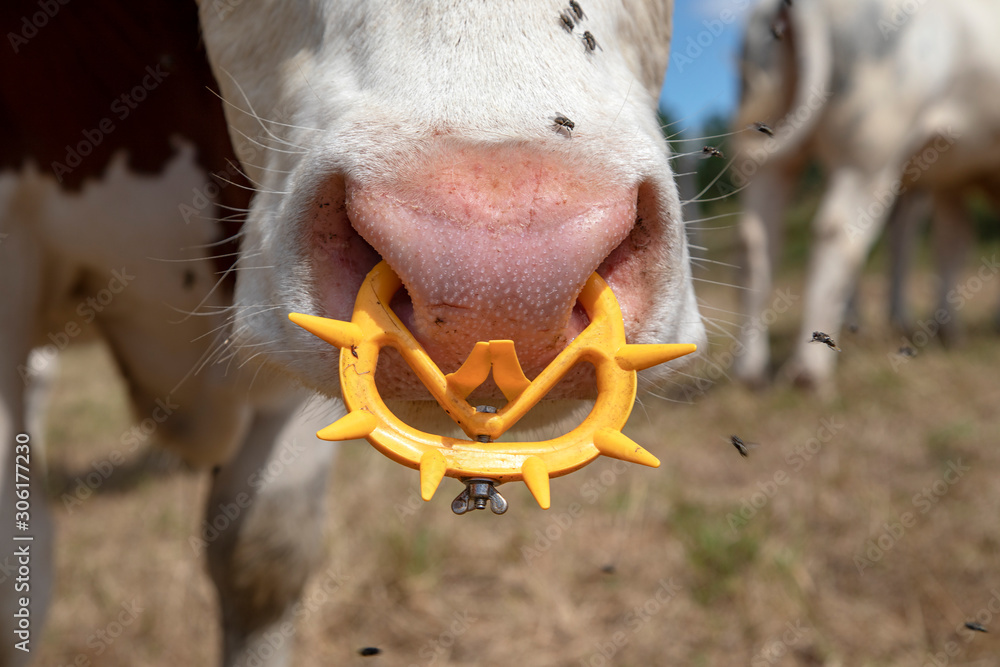
what is the context for this photo please? (that is not a calf btw?)
It certainly does not look very nice, are you relating this to the "Ethically Raised in the Swiss Alps Cows" in the comment you replied to?
In truth, they just take the calves away from the mothers after a short while, ship them out to the abbatoir. There is no benefit to them being in the same enclosure with a spiky nose ring, it seems that this must have a different purpose than the one you mentioned.
I suggest reading/listening a little bit outside of the PETA propaganda bubble. For example, here's a good short discussion on the topic with a cattle farmer: https://www.youtube.com/watch?v=n4cHn6NX4wQ
Just for some context, is the guy on the left with the white shirt a vegan who however supports ethical farming practices or did I get totally the wrong impression?
Meat was useful, back when we had not yet selectively bred fantastically better than natural crops of all kinds, back when we had not yet invented synthetic fertiliser that's now the ultimate source of 70-80% of the nitrogen in the body of someone in an industrialised nation, back when hunger was a bigger problem than obesity.
Now? Now meat's mostly a problem, not a good thing. Even if you ignore every ethical argument, regardless of if your concerns are your own health or the environment, meat's not good.
Data centres… well, I think this is a bubble, I also want it to be a bubble for various reasons, but the AI running on them today is in fact already useful.
Even if current AI wasn't at all useful (despite it having about half to one quarter of the market size as meat already), it does so at a cost orders of magnitude lower environmental harm than meat. Convincing half of the population to have "meat-free Mondays" (so, reducing consumption by 1/14th) would do more than switching off all the AI DCs, given the estimates from Greenpeace for AI https://www.greenpeace.de/publikationen/20250514-greenpeace-... and Our World In Data's estimates for livestock and manure https://ourworldindata.org/ghg-emissions-by-sector
I'll be the first to cheer if we get rid of industrial agriculture but there's an awful lot of land in the world that doesn't receive enough rain for farming but which is still fine grazing land and when used for grazing still supports most of its original ecology. And there's a lot of damaged, blemished, etc produce that pigs are happy to eat but which can't be sold in a supermarket.
I'd like to see meat consumption to something like half to a quarter of its current level rather than eliminate it outright.
OK, but (1) also a lot of good land is being used to feed livestock, the biomass of livestock is quite a bit higher than the biomass of humans; and (2) even reducing it just by a quarter is several times more than the combined impact of all the AI data centres.
> Does this come from a Big AI talking points memo?
It comes from the evidence I linked you to.
Which includes, to repeat, *Greenpeace*.
Also to repeat: I think this is a bubble, I also want it to be a bubble for various reasons.
As in, I do not buy into Big AI's talking points about how this is "it", and we're on a path to radical AI-based abundance. Not yet. Plus I think it would be bad even if we were on that track at this point, so I want it to be "not it".
> ridiculous
The global meat market is around 1.5 trillion USD, give or take. That is literally the value of meat, which like all things in a free economic sector can be measured in money.
You may also notice from me saying that AI is 0.5-0.25 of that, that I'm not using "Market Cap" of AI in this comparison. Market cap != market size. This is about what revenue AI and meat gets per year.
The people who think FizzBuzz is a leetcode programmer question are now vibecoding the same trash as always, except now they think they are smart x10 developers for forcing you to review and clean up their trash.
My product is "API first". Every UI task has an underlying endpoint which is defined in the OpenAPI spec so we can generate multiple language SDK. The documentation for each endpoint and request/response property is decent enough. Higher level patterns are described elsewhere though.
90% of the endpoints are useless to an AI agent, and within the most important ones only 70% of the fields are relevant. The whole spec would consume a huge fraction of context tokens.
So at a minimum I need a new manifest with a highly pared down index.
I'm not claiming that we're not in this classic XKCD situation, but the point of the cartoon is that that just how it be... https://xkcd.com/927/
Maybe OpenAPI will be able to subsume MCP and those manifests can be generated from the same spec just like the SDKs themselves.
Maybe what's confusing here is "true durability" but most people want to know that when data is committed that they can reason about the durability of that data using something like a basic MTBF formula - that is, your durability is "X computers of Y total have to fail at the same time, at which point N data loss occurs". They expect that as the number Y goes up, X goes up too.
When your system doesn't do things like fsync, you can't do that at all. X is 1. That is not what people expect.
Most people probably don't require X == Y, but they may have requirements that X > 1.
I think you're still not getting my point. Yes, a rare event of data loss may not be a big deal. What is a big deal is being able to reason about how rare that event is. When you have durable raft you can reason by using straightforward MTBF calculations. When you don't, you can keep adding nodes but you can't use MTBF anymore because a single failure is actually sufficient to cause data loss.
> As a child, one time I tried to make a CD unplayable and literally couldn't do it. (Sandpaper didn't do the trick.)
Either child you was incompetent or your player was very good at error recovery, because I personally saw a number of car CDs thrown out as the car’s stereo was unable to read them anymore.
you were probably scraping the thick transparent side, not the side with the label? the data is immediately under the label. the clear side can be surprisingly scraped up and still read properly, though I'm not sure how!! I have some CDs that I thought were ruined because of how scratched up the underside is, and they play just fine. Pretty sweet! Then I have one or two where the label side got a scratch taken out of it, and indeed, you can see right through the disc at those points - unrecoverable damage. Conversely a scratched up underside can simply be buffed/polished smooth and the disc will read good as new. I actually have one disc that cracked in half (a singular crack from the center to the outside edge, not spanning the total diameter of the disc)... and it actually plays without any skips (though surely depending on quality of the player and its resilience to read errors). I couldn't believe it at the time. A single piece of masking tape to hold the edge together was a sufficient "repair".
I worked in a CD foundry in the early 1990s. Scratches that were not tangential (perpendicular to the radius) were irrelevant, as the basic CD encoding scheme provide something like (IIRC) 30+ bytes of data parity protection. If the scratch width along the track wasn't longer than that, it didn't exist.
If it did exist, some toothpaste rubbed tangentially around the CD on your fingertips was often enough to buff it out, at least as far as the 30-byte limit cared.
It was a phenomenal jump in data integrity, built in at the recording level. Sure, you could encode even floppies with that scheme... but your computer didn't, natively.
CD pickup detects changes in the reflected light due to the reflective pits. As long as the scratches are significantly bigger than pits they will create lower frequency attenuation to the reflected light which won't affect the high frequency signal coming off pits. You will get occasional errors when crossing into and out of a scratch but that's just a few samples, likely those won't even make it through through the speakers. I have not tried but I imagine a very fine sandpaper could create the scratches at high enough frequency to interfere with the pickup.
But the label side is indeed very fragile as you can easily damage the reflective pits, only covered by a layer of paint. It's as same as a simple mirror, where the thin layer of reflective metal is very well protected from the front but is only covered with paint in the back.
They must’ve had a really robust kind of CDs wherever you lived, then. Like everyone else, I wore out a lot of discs simply by storing them outside their case.
Did that work? I heard everything already, from it being a wonder solution to it destroying the discs even further (if i had to guess they used the kind of toothpaste with little stones in them?)


reply