This may be overly pedantic (even more so than your correct comments about numbering harmonics and overtones), but in this case the overtones are not harmonics, which, as you say, are by definition multiples of the fundamental frequency (“harmonic series” is a mathematical term). That’s why gongs are “inharmonic”: they have an overtone series that is not a series of harmonics.
Legitimate criticism is about specific actions or behaviors. You could even say that you are opposed to certain laws, like the right of return.
Saying that a nation should just not exist, regardless of how they behave or what laws they have betrays a deeper irrational hatred. Especially if there’s only one state that must not exist, while there are many countries with laws you would disagree with.
Are you against the existence of South Africa? Or were you against the existence of some laws in South Africa?
It also isn’t racist to be against the existence of states in general and believe in a world without borders. But to say that Ukraine has a right to exist, Ireland has a right to exist, Palestine has a right to exist, Greenland has a right to exist - only Israel does not have a right to exist is antisemitic.
I am against the existence of apartheid South Africa, just as I'm against the existence of apartheid Israel.
No state should discriminate against people based on their religion. (And absolutely no state has a right to exist. People have rights, not governments.)
NYC is a special case, because it’s at or near the center of the universe: the US financial hub, the center of theater, dominant in all entertainment media, the UN headquarters, the most important historical entry point for all immigrant groups, the most important city for book publishing, advertising, etc. It’s one of the five most important, powerful cities in the world. It has its own foreign policy and diplomatic relationships. Its mayors have frequently, and for many decades, been interviewed for their opinions on world affairs that would seem, at first glance, to have nothing to do with city government.
‘“The people who designed it understood that in a 7-million-person city like Bogotá, a very small percentage would actually see the mime artists,” says Felipe Cala Buendía, the author of Cultural Producers and Social Change in Latin America. However, Mockus believed in the power of word of mouth.’
I used them at the (US) Naval Research Laboratory, programming in a dialect of C called C*. This automatically distributed arrays among the many processors, similar to how modern Fortran can work with coarrays.
If the problem was very data-parallel, one could get nearly perfect linear speedups.
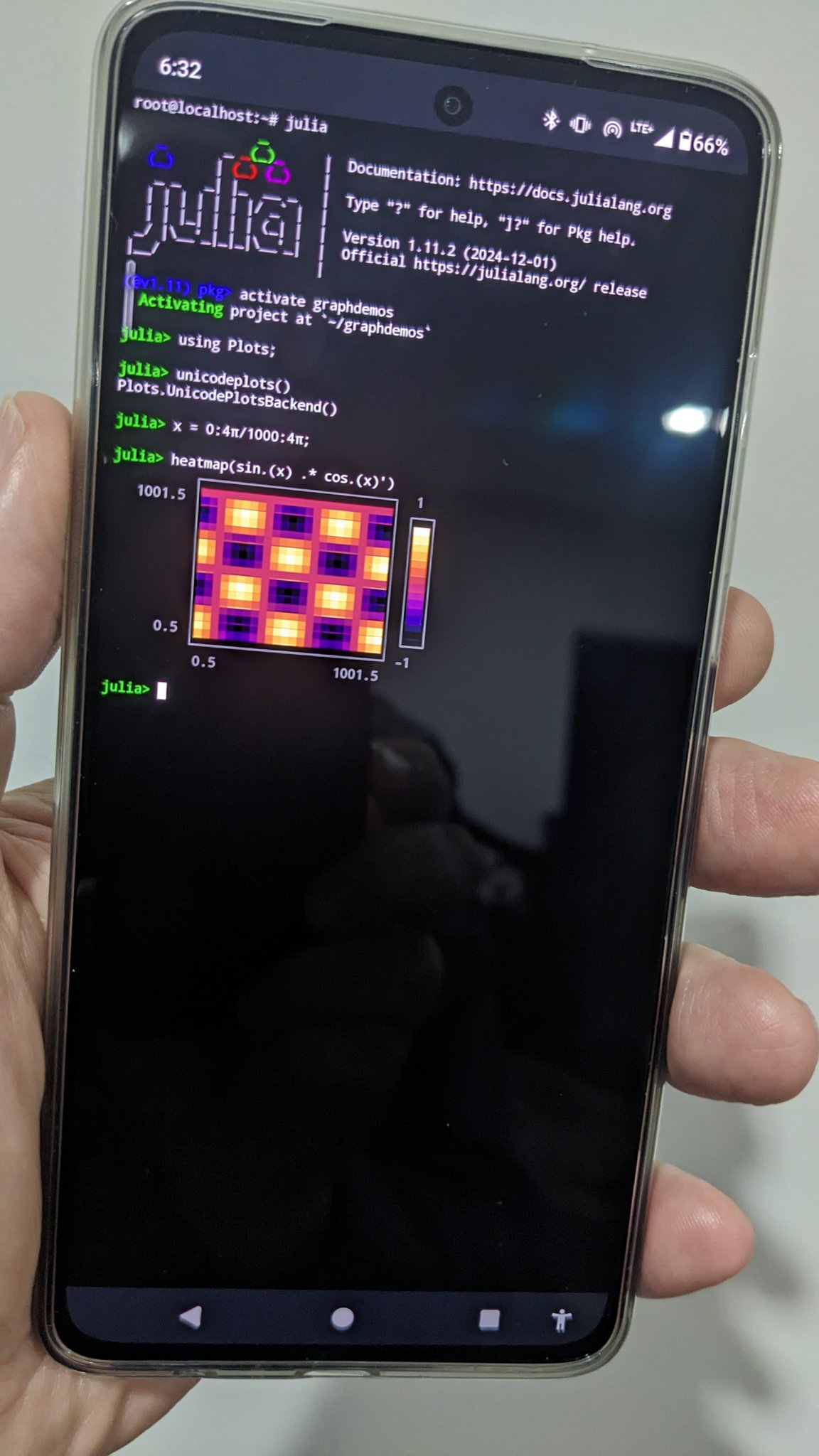
I just downloaded the archive (from the usual Julia downloads page) for ARM on the phone and put a link to the binary in /usr/local/bin — same as on Linux desktop. But I did this in the proot Debian environment.
Ah I see. Even after installing proot Debian I couldn't get juliaup to work, but I'll have to give it a shot manually installing the binary and linking to /usr/local/bin


reply