It was an insurrection, and he should have been barred from rerunning by the 14th amendment, but come on with adding deaths to the event that were not the one dumbass chick.
It's even sillier after looking into it. Of the 4 people listed that died the same date as the insurrection attempt, 1 was shot (already mentioned), 1 died of overdosing on meth, and the other two both were over 50 and had heart attacks. Not to say being exceptionally out-of-shape or meth-addled has zero demographic connection to the riot, but...
This is my experience of it too. Perhaps if it was chunking through a large task like upgrading all of our repos to the latest engine supported by our cloud provider, I could leave it overnight. Even then it would just result in a large daylight backlog of "not quite right" to review and redo.
I think that's the issue I have with using these tools so far (definitely professionally, but even in pet projects for embedded systems). The mental load of having to go back through and make sure all of the lines of code do what the agent claims they do, even with tests, is significantly more than it would take to learn the implementation myself.
I can see the utility in creating very simple web-based tools where there's a monstrous wealth of public resources to build a model off of, but even the most recent models provided by Anthro, OpenAI, or MSFT seem prone to not quite perfection. And every time I find an error I'm left wondering what other bugs I'm not catching.
What I tell my kids is:
You know how when you ask AI about something you know very well, how its answers are always somewhat wrong? It's like that for things you do not know very well too.
If Gmail rejects emails from your domain it is up to you to fix it. Google is not going to change, and enough of your users will be interacting with people on Gmail that you have to fix it. It doesn't help that Google has been pushing people away from running their own email and into Google's services by ever tightening what it accepts over the years. More than one person has given up on their email server because it was a constant battle with Google, Microsoft, and company to not have important emails disappear into the void.
My takeaway is there is no bug. My takeaway is that his test email bounced because he didn't have the reputation Viva does. Emails are handled on a reputation basis, this is why we use email service providers like Sendgrid, Mailgun, Postmark, etc.
It always amazes me how people can read a blog post like this one that has a clear description of the problem with a log excerpts demonstrating the problem, and then people will confidently make up a completely different scenario that was not mentioned at all and blame the problem on that.
WTF you talking about? Rene, this is defamation and I'm probably going to take action because honestly, enough is enough. I'm fed up of folk like you who lack basic technical knowledge or any knowledge making up bullshit. Your hourly rate makes me like you have money to take.
It amazes me people read that in this community and don't know for an email to bounce it means it didn't find an inbox. If it didn't find an inbox how did he check the logs?
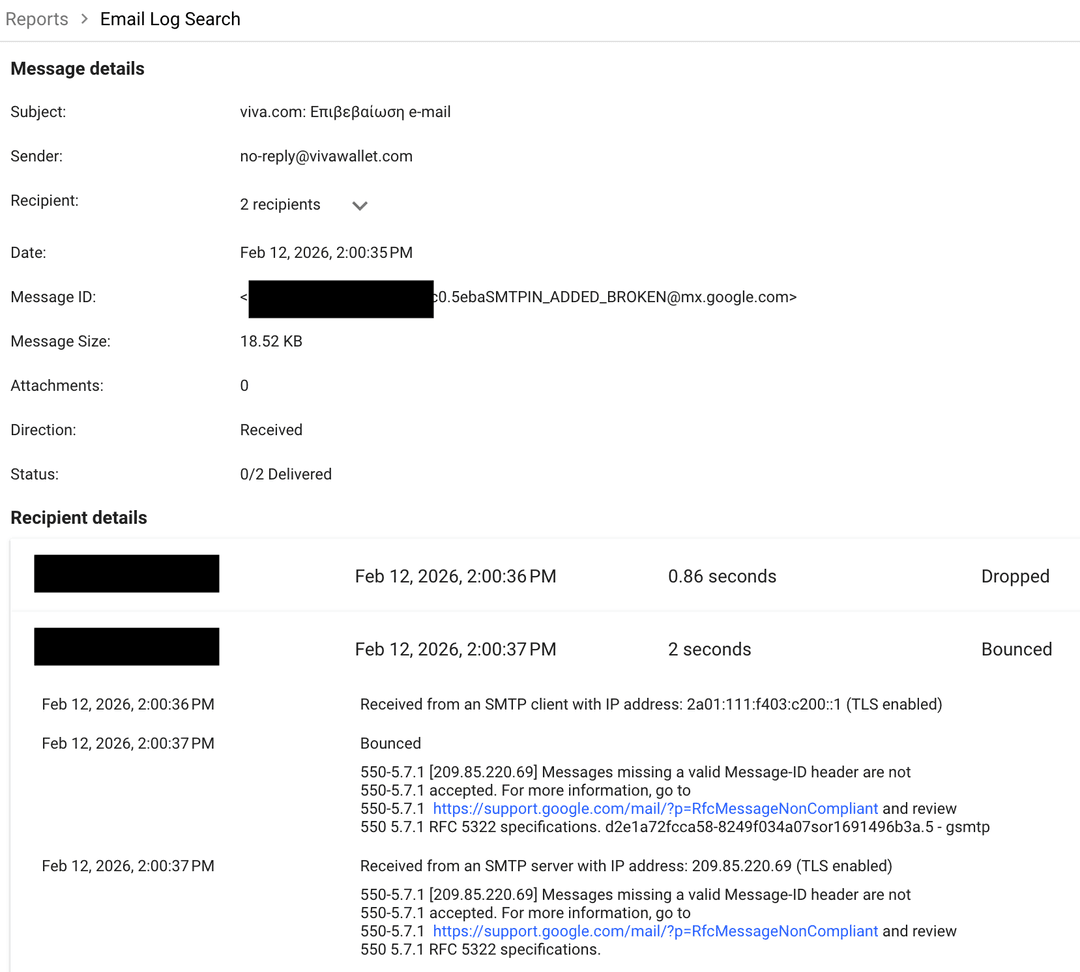
TFA shows an excerpt from the email log for his google workspace account, showing the bounce of email sent from viva.com.
Then, TFA states that he switched "the account" (his viva.com account) from using his GWorkspace address to a personal @gmail.com address, and asked viva to send another verification email. That one arrived.
At no point does TFA describe the author themselves sending a test email.
I think that's a misunderstanding of the tale. Viva sent a "click here to verify your email" to OP. That email never arrived because Google rejected it for missing a header. OP tried to tell viva, but they don't wanna hear it because OP worked around it.
Yeah. I think email receiving is a game of exceptions… the email receivers (In the business world it’s essentially just MSFT and GOOG of course) answer to the addressees because they are the customer, and those customers will start to shriek if their inbox doesn’t receive “Important Messages.” But GOOG or MS have no leverage over the senders in this case so they just add an exception: “if IP range is just right and message fault ___ is present, fix message” (or otherwise allow)
Of course, they do have leverage over “marketing email” senders since they can block it and no one will complain, so those senders always have impeccable compliance with every year’s new “anti-spam standard.”
Apple is another major player in the email receiving game for consumers. And they are awful, by far the worst of all the big providers. They do not send dmarc reports and they make it very difficult to tell why they accept some email and not others.
Message-Id being required for automated mails is a de-facto industry standard
while the consequences differ between mail provider, it missing will also make it much more likely for mail to be reject or put into the spam folder
It's also well known. Pretty much viva engineers fucked up doing proper research.
Now to be fair:
- it sucks that you can't just implement the RFC(s)
- the standards suck, docent of different RFCs overlapping and replacing each other and referencing often older versions of other RFCs, with docents of ways to do the same things of which only some can be used reliable in practice and a common gaps in the standards about edge cases or about the "higher level semantics" of constructs.
- so overall mail seems very simple at first but if you want to automated send mails reliable internationally it's a total pain and Message-Id is just the head of the iceberg.
This article I think is about a very specific subset of software stocks.
If you're holding say a total market index fund, or s&p500, or even qqq or many tech index funds, this would get hidden by the so-far very good growth on other tech stocks.
Was that a mistranslation, and instead the meaning is that the true population is 1 billion fewer than the generally accepted ~8 billion people? So more like 7 billion?


reply