> Soon after the merge and due to conflicts with @bpinto regarding the direction of the project and other issues, we decided to not continue working together and ended our relationship
> @bpinto has continued to use the entire "wahoo" source code without my consent and expelled me from oh-my-fish organization. They also failed to state "oh-my-fish" is a complete copy of "wahoo" or provide copyright attribution since our separation.
They've clearly had some (admittedly non-specific) history. It looks like long talks were had, with little or no progress. Make what you will of this, but it seems a DMCA is the only way that this could be taken care of.
@striking, the comments you mention appear to be from one side.
@bucaran's alleged censoring of the discussion [0] makes it difficult to know what was actually discussed, but it's telling at the same time, especially in the context of everything else that appears to have happened:
- @bucaran appears to have usurped an open source repo from two other owners
- @bucaran appears to have deleted comments posted by people who objected to his alleged usurpation
- @bucaran filed a DMCA takedown when omf community members tried to reboot their project without him
i've heard of hostile takeovers in the corporate world, but never for a github repo. i thought transparency was guard enough against machiavellian behavior like this. i mean, who would want to work with someone who has a history of hijacking repos, censoring comments, and filing DMCA takedowns on open source repos?
Look, I'm not saying he's a good person. But a DMCA is warranted when copyright isn't followed. As annoying as this guy is, it's still his work and he should be identified in the copyright of that project (unless all of his code has been removed/rewritten. Then a counter-notice should be filed.)
If the copyright notice is wrong, then it's wrong, but then you get into a very weird legal quagmire where people were committing code under someone else's copyright. I don't know if they were giving up their copyright in that case or not. And if there's something wrong with the DMCA notice (like if it was submitted for no reason), a counter-notice should be filed. And if this person is in the wrong, he'll get more than he bargained for when he began throwing his weight around.
Someone's going to get what they deserve. I don't know who, but someone will.
"refers" got their start in chicago, when george h. hammond patented a refrigerated rail car design in 1868 [0].
although the technology was initially used to transport meat via rails, hammond's company (and the rest of the meat trust) quickly adapted the technology for transatlantic shipping (circa 1875) [1].
> Is anyone using a pedal in addition of a keyboard on a daily basis?
i've been using foot pedals with a kinesis advantage for a couple of months. note: i don't always use the pedals.
> Do you really think this could be a significant help when typing code?
no. i'm slower with the pedals, but my immediate goal was to reduce RSI-related pain, not to increase typing speed. to that effect they've been effective.
> “The real problem is that the car is too safe...”
no. this statement is fallacious, and i believe it is dangerously misleading. it sounds like something out of the mouth of a corporate attorney, and not someone who cares about being actually safe. out here in the real world driving laws are more like guidelines.
my take on the situation is the car knows and follows all of the written rules of the road, but not the unwritten ones. kind of like a 16-year-old kid who's just aced his driving exam, but doesn't yet have a feel for driving. every so often he encounters a situation not covered by the law or the driver's handbook, and he's forced to choose the safest course of action on his own.
i live near google in mountain view, and (usually) encounter the self-driving SUVs many times a day, either biking around town or as they drive past my residence. in hundreds of encounters i've only witnessed one potentially dangerous incident (many months ago) involving a self-driving SUV. it wasn't clear to me who/what was at fault.
whilst making a protected left turn onto west el camino real from el monte ave [0], a self-driving SUV came to a complete stop in the middle of the intersection, causing the vehicles behind it to halt and lay on their horns. since the incident occurred a few yards behind me (over my left shoulder) i don't know exactly what precipitated the incident, but reflecting on the experience has caused me to recognize some potential flaws in this generation of self-driving vehicles.
that intersection's turning lanes are delineated by dotted lines. this isn't unique, but it's interesting to me because dotted lines can sometimes be more difficult to see than solid lines (especially in certain lighting or weather conditions, or when there are debris on the road). for example, i remember lanes on stretches of 101-N marked with faded dotted lines and no reflector dots. these lanes were impossible to see under wet conditions and the sun's reflection. drivers were forced to either guess where the lanes might be, or to follow other vehicles, but we could still proceed safely. how would a driverless vehicle respond?
further, some human drivers completely ignore lane markers even when they are perfectly visible. in india and some central american countries, for example, driving conditions are like the polar opposite of suburban SV: lawless. yet in my experience, driving there is not without rules; it's just that the rules are unwritten. and though this is an extreme analogy, it led me to an interesting question: if self-driving vehicles can't safely navigate the crowded streets of mumbai, how comfortable are we giving them free reign in the US? or perhaps should we exclude them from certain roads until they can?
the main point i'm trying to make is this: the current generation of self-driving vehicles has not developed (whether by feature or flaw) the level of intuition of an experienced and safe driver. they are quite literally like student drivers whose instructors have a foot above the brake and a hand on the steering wheel. and while it's conceptually possible to create safer roads by eliminating human error, i'm not confident replacing humans with a bunch of robotic student drivers is the best solution. i'd feel much safer as a passenger in a vehicle driven by someone or something that's A) primarily concerned with my safety (and not corporate liability), and B) knows what to do in unexpected or unpredictable circumstances.
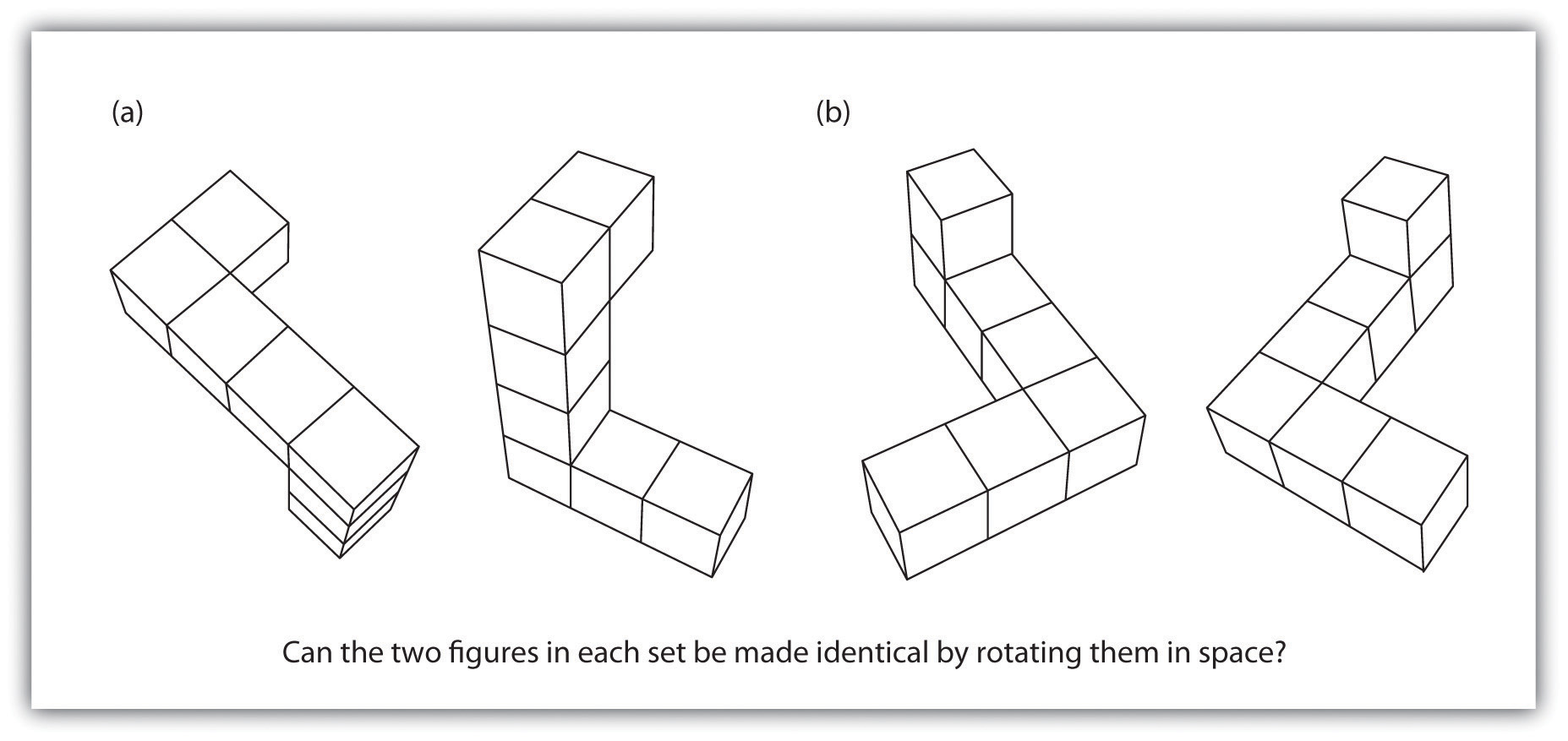
some questions on IQ tests depict rotated images of figures, and ask things like:
> can the two figures in each set be made identical by rotating them in space? [0]
this isn't my domain, so without knowing any better i would kind of expect the Vividness of Visual Imagery Questionnaire and its abridged version to ask similar questions. but if they didn't, and you wanted to create another test, here's where i'd start:
1. devise a test with a bunch of similar questions (to the one in the above example) of varying difficulty. use these hypotheses:
H_{0}: there will be no difference in performance for people with aphantasia
H_{1}: people with aphantasia will perform worse.
2. find some people with aphantasia and test them to get a baseline.
Other commenters and myself feel we have low visualization ability but do well on those tests. In fact, at one point for me they were significantly my best area in a battery of similar IQ-like tests.
> The browser should be ... for viewing and retrieving data, not executing that data.
i'm genuinely interested in what a modern version of that would look like.
recently i watched a 1992 interview [0] with brewster kahle in which he described WAIS (wide area information server) [1].
aside: i've not used WAIS, nor do i feel it is the way forward.
my understanding is that WAIS provided a client-side interface to a directory of servers. it also seems the presentation of content was simple: mostly text, but some images and video, too. this appeals to me because after more than 20 years on the web i struggle to remember what it was like when (or even if) the majority of pages i visited were focused on delivering pure content.
don't get me wrong -- i'm fortunate to have access to the web and a way to search for information -- but i'm becoming increasingly frustrated with the quality of today's content.
i'll concede SERP SPAM is a hard nut to crack, but that doesn't stop me from cringing every time i click on a dodgy question/answer aggregation site or some wholesale ripoff of another site [2].
and less dodgy but arguably more frustrating are legitimate publishers who modify their content presentation strategy based on google algorithm updates. for example, i can't tell you how many times i've searched for a simple recipe but the top SERP was a slideshow instead of a simple recipe i could print out and place on my counter top.
lastly, over the past 20 years it seems like primary content has become a secondary citizen on the web. when i visit SERPs today it feels like i'm less likely to be presented with what i actually searched for. instead, i'm increasingly bombarded with "SIGN UP NOW!" mortars .. erm modals .. and the presentation of the content i searched for feels more like Dahala Khagrabari [3] than the main reason for my page visit.
one might read the above and conclude i'm a bitter luddite. quite the contrary, i feel blessed to be alive and am optimistic (mostly ;) WRT the future of IT. however, i am concerned with (what seems like) this generation's tendency to favor presentation over information. the older i get the less patience i have for popups/modals, slideshows, and pictures-because-google-likes-pictures; just gimme my goddamned information already.
so. i'd really like to see a dumb client-side app that gives me only what i want to see. i've tried lynx/w3m-emacs/etc. but JavaScript ruined that effort. keen for alternative suggestions :)
[2] http://stuccy.com/ is a wholesale ripoff of stackoverflow. (note: i don't recommend visiting this site; who knows what they're up to.) i've emailed SO, whose response was essentially this:
> Please note, bringing these sites into compliance (or getting them to no longer serve our content) is often a long and arduous process. You may not see immediate results. However, rest assured that we're working on it.
the proliferation of driverless cars could make the debate about losing access to public roads (i.e. losing one's drivers license) much more interesting.
agreed. interesting read, yet far from complete, and certainly questionable.
a couple that jumped out to me as questionable:
the "discounting" section reminds me of the stanford marshmallow experiment (itself questionable iirc). i'm not convinced a marshmallow is worth an additional 5 minutes of delayed gratification, and i'm even less convinced an additional 0.07ml of juice (or a whole 0.002oz) is worth waiting at all.
the "Relative and Absolute Utility" section, and particularly the quoted section of Glimcher's example, fail to acknowledge a fundamental component of human motivation: context.
for example, strand someone on a remote, uninhabited, desert island (with no way to escape, etc.), and offer her a choice of $1,000,000 worth of goods or $1,000 worth of goods. her choice at this point is uninteresting because currency is arguably worthless in the absence of trade; she assigns value based on what these goods can do for her rather than what they would fetch at auction back home.
for example, let's say the $1,000,000 worth of goods is a lifetime supply of jello, and the $1,000 is a safe ride home on a fishing vessel. the safe ride home is arguably the better choice despite its lower monetary value. this is why i believe it's silly to blindly apply the transitive property of inequality (in terms of monetary value) as a predictor of human motivation while ignoring context.