At HelloBonnie, we believe that employee happiness is the driving force behind each company's success. Every employee is unique and requires individual appreciation to boost their engagement. That's why we are building HelloBonnie: The employee happiness platform for New Work, where personalized benefits and employee engagement converge.
We are looking for our first developer with a hands on mentality that enjoys working in a startup environment. Please see the job description for more details and also use it to apply:
`import Y from X` is a terrible language design decision, established by the JavaScript ecosystem. It should be along the lines of `import X.Y` or `from X import Y` so that autocomplete tools can assist you.
Yeah, I think we only allow import x from y for the minute. And because we don't have a language server yet, it wasn't obvious that it was an issue. That'll change soon when the server is up though!
Disagree. I rarely remember what lib has the class/function/whatever I need. Doesn't help that some libs often use "proprietary" names (e.g. "Uno", "Avalonia", "Rotativa"). I often don't even write "imports" myself. I use stuff in code and let my IDE autoimport stuff.
> With the release of Vue 3, a Storybook alternative named Histoire has gained some traction. In this blog post, we’ll explore how to create interactive documentation of UI components for Vue 3 projects. As with Storybook, Histoire is designed for making your life much easier to create living style-guides and component showcases.
Germany actually replaced the nuclear energy with wind & solar. The argument that remains is that instead of phasing out nuclear, reducing coal would have been preferred. The decision to phase out nuclear has long been made (for good reasons). Keeping them active or even building new reactors of that kind is not an economically viable solution. The price Germany pays for this is higher carbon emissions for the time being until renewables push coal out of the mix. What Germany gains, on the other hand, is the removal of the most expensive form of energy from its production and one big step towards a fully renewable and modern electricity grid.
If you could leave nuclear, and "replace" lignite with wind and solar instead, you actually replaced nuclear with lignite.
>The decision to phase out nuclear has long been made (for good reasons).
No, it was made for bad reasons.
>Keeping them active or even building new reactors of that kind is not an economically viable solution. The price Germany pays for this is higher carbon emissions for the time being until renewables push coal out of the mix. What Germany gains, on the other hand, is the removal of the most expensive form of energy
_Existing_ nuclear reactors are the cheapest possible source of electricity. You already had to build them and will have to close them. Left is the cheapest part, of actually operating them.
Just selecting 2023 as a timeframe isn't good data.
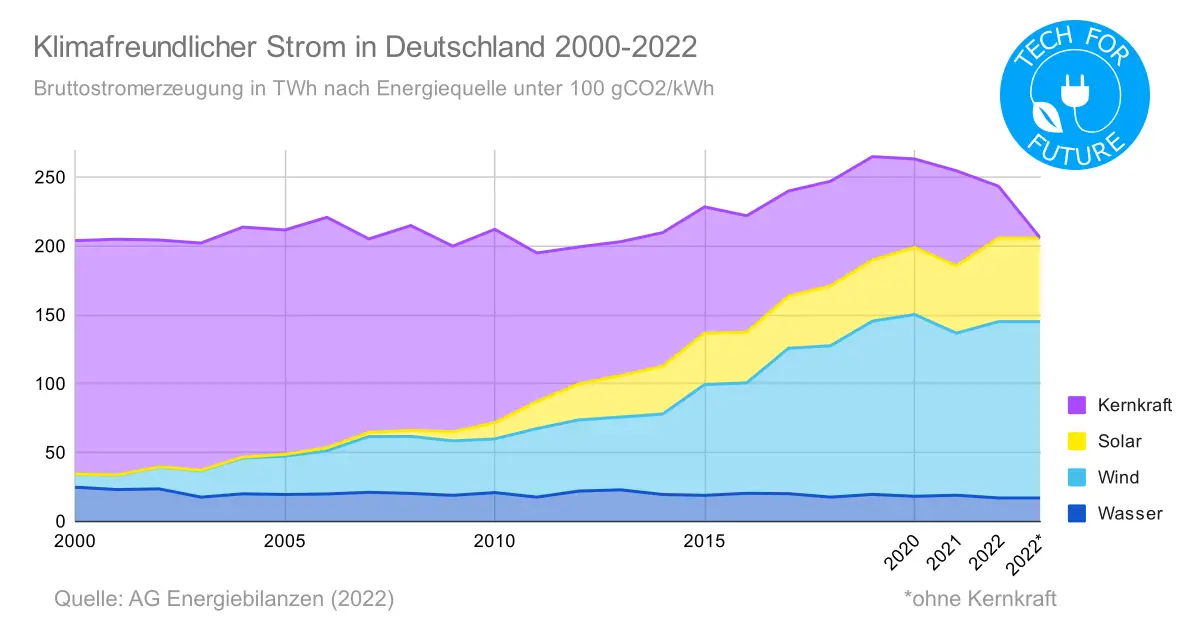
You can see here [1] that on a time frame of 2000 to 2022 Germany is yet to replace reduction of nuclear generation (Kernkraft) with renewables. Construction of renewables in 2023 has only accelerated 50% relative to 2022 [2].
I'm not sure at which one of those graphs I should be looking at. The gross power consumption one seems to refute your own claim. The total gross electricity usage of Germany in 1990 was 551 Twh, 587 twh in 2003 and is currently around 550 Twh. Current expectations is that usage will grow to 650 Twh in 2030 and to 750+ Twh in 2050.
Charts are an irrelevant red herring. The argument is simple and indisputable: Germany's collective investments in renewables was not predicated on the closing of nuclear plants instead of coal plants. Had Germany not shut down nuclear, they could have shut down coal. It's that simple.
What Germany gained is more pollution, higher CO2 emissions and a lot of hopium that current energy fubar will somehow be resolved sometimes in the unspecified future using semi specified technology (there is no large scale energy storage solution available for renewables and it will stay like this for some years to come). Shutting down nuclear was a political decision, fueled by pure ideology (and some Russian help because natural gas exports).
What entire EU gained is getting to support often unstable electricity grid in Germany. So we all gained a lot by the looks of it.
The European electricity market is working quite well, imports and exports are expected to happen. Countries prefer to import electricity when it is cheaper than producing it themselves. Germany has more than enough capacity installed to handle its energy needs (even if a lot of this is still fossil). Germany does not have an "often unstable electricity grid", not at all. That information is simply wrong.
In other words, shutting down nuclear plants means a) replacing the energy generation with coal (mostly lignite), or b) importing energy from other countries, which generate it from coal (mostly lignite) like Poland.
Importing will likely be "cheap", because we all agree to collectively pretend that externalities like CO2 emissions or catastrophic pollution from coal plants are not a thing.
Oh no no. Germany loves importing nuclear electricity from France, Czech Republic and others too. Makes the government feel good about having quit nuclear, because somehow when it comes from across the border it's not so bad anymore.
Many of your comments are misleading and are often renewable energy propaganda.
"In 2023, Germany lacks 15 to 20 gigawatt of secured power output”. This comment was from Harald Schwarz, Professor for energy distribution and high voltage technology at the Brandenburg University of Technology. EU Fact check rates this as mostly true.
The claim that germany has sufficient capacity for its energy needs is just wrong.
That is true, but it is also not the goal to achieve 100% secured power output, nor is it necessary. The calculations that determine the necessary electricity production to cover Germany's needs at all times are more complicated than just looking at the installed secured power output and involve factors, such as the likelihood of unavailable renewable energy production. And even if the worst case happens, there are solid strategies in place to avoid a blackout, including backup power plants and coordination with high energy consumers to reduce or shut down their consumption.
And all of this still ignores the fact, that there is a highly connected international electricity market, that large scale storage solutions are being prepared, and that the grid is becoming more decentralized.
this is all well and good but seems to ignore the central problem - energy security is a national priority. Hand waving away the problem by pointing to energy markets or a decentralised grid does not address the fundamental issue.
You are right, the goal is not 100% secured energy supply but we have multiple problems at the same time - energy security and climate change to name just two.
Zoom out one more time and you see that the world gained a solution to climate change that is actually competitive economically.
Competitive even without a strong government regulation to enforce people paying for externalities, and even working against the entrenched intests of fossil fuels.
A solution which is rolling out at a truly astonishing rate.
What happens in Germany is irrelevant compared with what has happened globally due, in large part, to Germany.
Yep. We all gained primarily a lower living standard without reducing any CO2 consumption globally at all _and_ without improving the environment locally. Looks like a good policy to continue with, doesn't it?
Total frequency error over time is not a good measure of stability because the frequency is actively adjusted to control this. The grid could fail every day and still have 0 frequency error over time if they ran it faster when it was working to compensate.
It's hard for renewables to replace coal or nuclear though, because coal and nuclear provide baseload power, whereas wind and solar are very intermittent and require basically 100% gas backup (as there will be circumstances with very low wind and solar, which tends to happen in europe on very cold, still, winter nights when demand is the highest).
There is absolutely no reason the (ex-west) German nuclear power plants could not have been life extended. They were extremely reliable and about 10GWe of modern PWRs were finished in the late 80s. They could have easily be extended to at least 2030 had there been the political will at not a huge amount of cost. The RoI with current/previous high energy prices would have probably been 100 fold.
> It's hard for renewables to replace coal or nuclear though, because coal and nuclear provide baseload power, whereas wind and solar are very intermittent and require basically 100% gas backup (as there will be circumstances with very low wind and solar, which tends to happen in europe on very cold, still, winter nights when demand is the highest).
I absolutely agree with you that we need the coal plants and imports for base load. For a fully renewable grid, we need massive storage capacity. This, however, is far from an unsolved problem. The problem is that the economic incentives aren't aligned with that goal yet. There is reason to be optimistic though, and that the money Germany is saving on nuclear, is more sustainably and effectively spent on renewables and storage.
Germany has enough storage capacity for natural gas to last a couple of months. The same can be build for Hydrogen. Some of the existing infrastructure can even be reused.
Yes but you need 10s or 100s of GW of hydrogen electrolyzers, which are expensive, and they will only be running a small % of the the time (when there is excess renewables).
I'm not sure how much existing natural gas infrastructure can be reused given how much lighter hydrogen is and I assume it needs much tighter tolerances on all the equipment compared to natgas.
Yeah, true. But it turned from a "we don't have enough of element XY on Earth to build that" to a "it sounds kind of expensive" problem. As it turns out people did the math already and building the hydrogen infrastructure is probably not prohibitively expensive, in fact it might turn out to be reasonably cheap. There is a tradeoff between overbuilding renewables, improving the grid, making the demand side more dynamic, and storage.
Yes, but my point isn't so much it couldn't ever be done, it's that by the time you upgrade the grid massively, build the renewables, build the electrolyzers, build the hydrogen infrastructure and the infrastructure to convert it back to electricity, it's almost certainly way more expensive than already expensive nuclear to build.
Renewable energy is unpredictable, thus you need a backup source of energy for when there's no wind, sunlight or rain. It's yet unfeasible to store large amounts of energy unfortunately so that means using either natural gas or coal, because you need to be able to rapidly increase/reduce/regulate the energy output. It's coal at the moment for Germany and that means more pollution and dirty politicians that don't care about the environment, just about votes. Actually nuclear power plants can nowadays also regulate their output fast enough, but they got rid of those.
Before Russia's invasion of Ukraine coal was on its way out due to purely economical factors: coal plants are more expensive to operate than natural gas plants.
Of course recent months changed that since a lot of our gas used to come from Russia. If we went all-in on nuclear we could reactivate (East) German uranium mines that were closed shortly after reunification. But (traditional) nuclear also loses on economic factors, on top of being politically untenable.
it's possible to store huge amounts of energy with hydro, but at that point nuclear is not that bad in terms of price and nr of people killed by nuclear vs hydro accidents, so again Germany fkd up
Actually, the death toll from hydro is many orders of magnitude worse than nuclear. It's almost insulting to compare them. (And before anyone pipes up, you don't get to exclude Chinese hydro from the ledger, for the same reason we don't exclude Soviet Union nuclear.)
That this is a big pretend game to make the people responsible of the closing of nuclear power look not that bad in regard of the climate issue. Electricity generation should be increasing as we electrify transportation and heating. If this not what is happening then it means that globally the problem is just displaced. (Which doesn’t work at the planet scale)
Germany has more energy generation capacity installed than it had last year. I certainly wish there would be a push for even more renewable and storage capacity, though. The fact that Germany is generating less energy has nothing to do with the phase out of nuclear though.
Raw energy generation is the bad number if you don’t take into account capacity factor. To replace 1MW of nuclear generation with a capacity factor of 0.9 you need almost 5MW of wind at 0.2. The 21 GW of nuclear energy of 2009 have barely been replaced in 2023 when taking into account the capacity factor.
> more energy generation capacity installed than it had last year
Nameplate capacity of a new solar plant with a capacity factor of 15% (remember, a cloudy country north of the 50th latitude) is not comparable with nameplate capacity of a well maintained nuclear plant with around 90% capacity factor...
A few reasons why people might be pushing against nuclear:
  - high electricity generation costs
  - "I don't want to live next to a nuclear plant"
  - If Japan can't handle it securely, why do we think we can?
  - Unsolved long-term waste storage location
  - Cost for long-term storage must additionally covered by the society
  - We are producing radioactive waste that must be securely stored for thousands of years to feed the energy needs of a couple generations, even though there are more sustainable and cheaper alternatives
-nuclear is realiable and cheap after built
-living next to nuclear vs next to coal plant/hydro dam isn't that bad
-japan wasn't able to handle one plant, and almost none were killed(most deaths were from tsunami
-Long term is solved: Sweden is building a special storage place. Combine with vitrification(solidification of waste) it's going to be ok
-cost is still negligible compared to cost/problems we have now bc of pollution
-France can reprocess 95% of nuclear fuel, actually 17% of their el energy is from reprocessed nuclear, the rest 5% should be stored for ~300 yrs to handle most dangerous radiation. Combined with vitrification, you get a safe way to store a solid form waste in a single controllable place instead of spreading it in the air(fossils)
So yeah, most of the fears are driven by fossil propaganda
" - If Japan can't handle it securely, why do we think we can?"
What does that even mean? There are no large earthquakes, let alone any tsunamis in Germany. And even if there were, most nuclear plants were not at the sea.
I always wonder what web scraping tools use as their proxy solution, because afaict they tend to be quite expensive, especially for residential IPs. How are you handling that?
All the sample photos are obviously photos that were originally in good condition, but you added the scratches, unwanted objects, etc. on top of them. This of course makes it very easy to show a before/after, but feels like false advertising. Use real photos, even if they are cherry-picked.
The feature that mrkeen is describing is called higher kinded types (HKT). I.e. in Scala (and similarly in Haskell), you could write something like:
def process[L[_]](input: L[Int]): Unit = ???
Where `L[_]` could be any type that has a type parameter, e.g. `List[_]`, `Option[_]`, `Future[_]` or `Either[String, *]`. This opens the door to a new level of abstraction where other languages must resort to code generation or similar ad hoc-like solutions.
Chrome is also rather aggressive in this regard and I find myself constantly battling this issue when trying to add places autocomplete to an input. A workaround that seems to work reliable though, is to place the autocomplete-input outside of the form element. That is clearly not always a feasible solution, depending on your page / form layout, but for OPs layout it should be straightforward. After the user makes a selection you usually continue by dumping the json result into another hidden input anyway.